




RAWALPINDI: Visitors to the newly established New Kartarpura Food Street at Chandni Chowk are immediately drawn to an unusual sight — a group of men wearing long, ankle-length robes, typical of the Middle East and North Africa, their heads covered in ghutras, spinning lassi with wooden ladles in large metal pots.
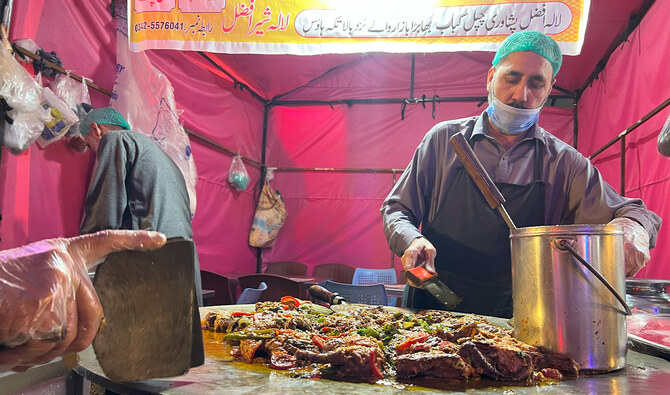
Food vendor Lahore 0 Kilometer is one of around 30 eateries to spring up on Rawalpindi’s new food street, which is seen as a more spacious, less crowded and family-friendly alternative to the city’s historic Kartarpura Street.
The old street, part of Rawalpindi’s Sikh district and the city’s main commercial area in the 19th century, has become a major food hub over the recent decades. It is famous for dishes such as nihari, a stew of tender beef or mutton meat with bone marrow, and siri paye, a traditional breakfast meal of cow or goat head and trotters.
Lassi, both salty and sweet, remains a key attraction, with many vendors coming from Lahore and Gujranwala to sell the yogurt–based beverage, a staple at iftar and sahoor meals — especially when Ramadan falls in the warmer months.
However, customers and vendors alike have long complained of traffic congestion and crowds.
This year, many stalls and sellers have been shifted to the New Kartarpura Food Street. Set up under the Chandni Chowk flyover on the first day of Ramadan, it will continue to operate once the holy month is over.
“Our main branch is in Kartarpura, but this venue has created a new trend, a proper space for families,” Abdul Latif Rashid, from the famed Kala Khan Nihari House, told Arab News. “Because of that, the [public] response here has been very good.”
Organizer Raja Usama said the idea for the new market was inspired by Ramadan food festivals in Dubai.
“Different kinds of food are available here,” he told Arab News. “Small new businesses and young people are also being promoted. Families are being given a good environment.”
At Lahore 0 Kilometer, Muhammad Hamza said people were coming from both Rawalpindi and Islamabad to try their lassi, available in seven flavors.
“We have great love for Arab countries. The attire I am wearing has been given a lot of respect by the [local] people, and I wish to wear the same attire when I visit Saudi Arabia,” Hamza told Arab News, as people stopped to take photos of him preparing lassi in his thobe and ghutra.
For visitors like Mahnoor Kareem, a Chinese language instructor, the new food street provides much-needed respite to the old, overcrowded Kartarpura.
“Kartarpura in Rawalpindi is very famous, especially for sehri [sahoor], but we never went there because it’s always too crowded. Most people prefer to come here with their families,” she said. “We tried their paye and lassi, and we really liked it.”
Kanwal Zahra, who sells Pakistani cuisine, has also set up shop at the new market. She said: “We serve traditional dishes passed down from our grandmothers, roti made from pure wheat flour, special jaggery and sugar tea, palak paneer, and lassi.”
There are more innovative offerings available, too.
Dumpling vendor Meena Nabeel told Arab News: “Initially, people said they did not eat momos, especially boys. But once they try, they come back with their friends and say that it is good, they like the taste. The filling and dough get a lot of praise. Our sauces also receive a lot of compliments.”


