

‘Great time’: In Pakistani capital, padel pops up as new favorite Ramadan sport

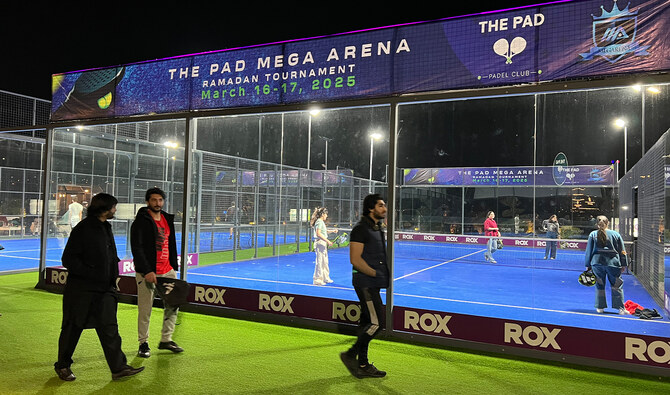
People walk past a padel court at The Pad in Islamabad, Pakistan, on March 17, 2025. (AN photo)
Short Url
Updated 20 March 2025
Follow

‘Great time’: In Pakistani capital, padel pops up as new favorite Ramadan sport

  • Padel is one of the fastest growing sports in the world and Islamabad residents are bewitched by global craze this Ramadan season
  • Padel games provide fun-filled pastime, opportunity to socialize and means to enjoy exercising without hard strain during fasting month

ISLAMABAD: On a recent Ramadan night, Mamoon Sabri, 27, slipped into a tracksuit an hour after the iftar meal and headed to his new favorite getaway: a padel court.

Racket in hand, he walked onto the artificial turf at The Pad, Islamabad’s first padel club, as a group of his friends also arrived. Soon they began hitting forehands and backhands across the net, slamming the ball off the back wall, scooping it over the net and teasing each other with shots close to the wall — and so went on an hour-and-a-half long game of padel.

The racket sport, a mix of tennis and squash that is the fastest-growing sport in the world, is also gaining traction in Pakistan, especially in Ramadan, with its culture of sports and physical activities in parks, streets, and sports grounds after iftar and until the pre-dawn suhoor meal, fostering a sense of community and promoting health at the same time. 

At The Pad and other padel courts in the Pakistani capital, padel games are offering people both a fun-filled pastime and an opportunity to socialize and exercise in the hours between iftar and suhoor. A Ramadan tournament is taking place at The Pad currently, with more than 50 teams participating in all-girls, mixed doubles and advanced team categories. 

As of 2024, there are approximately 30 million amateur padel players worldwide, with the sport, founded in Mexico in the 1960s, now played in over 130 countries, according to the International Padel Federation.

“Padel is a great time and Ramadan is always a great time for sports in Islamabad anyway because everyone wants to play, everyone wants to stay awake till sehri [suhoor] one way or the other,” Sabri, a sports broadcaster and consultant, told Arab News shortly after winning a men’s doubles game.
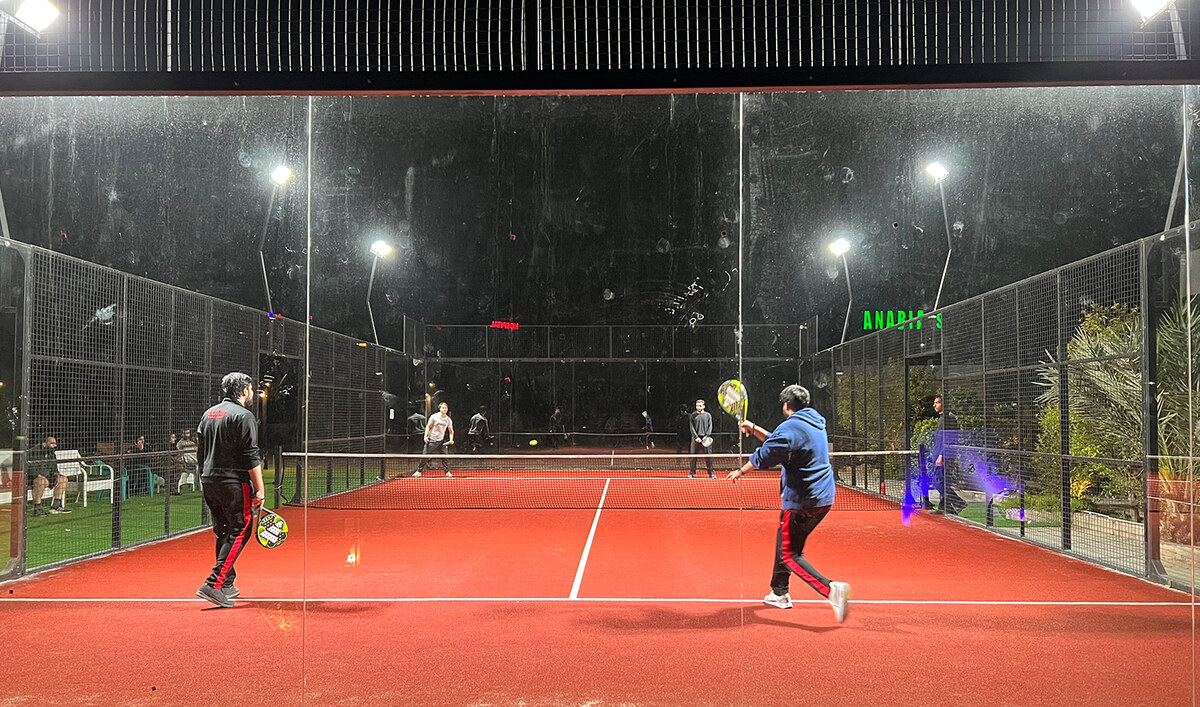


People play padel at an outdoor court at The Pad in Islamabad, Pakistan, on March 17, 2025. (AN photo)

Mustafa Mirza, a co-founder of The Pad, said the club was fostering an atmosphere of camaraderie in Ramadan.

“Padel is a social hub and it is linked more with the lifestyle,” Mirza said. “We have an excellent response in Ramadan. We feel that the people who were not familiar with padel, because they ventured out in Ramadan and they found this sport to be so challenging and rigorous, and then they have taken part in it.”
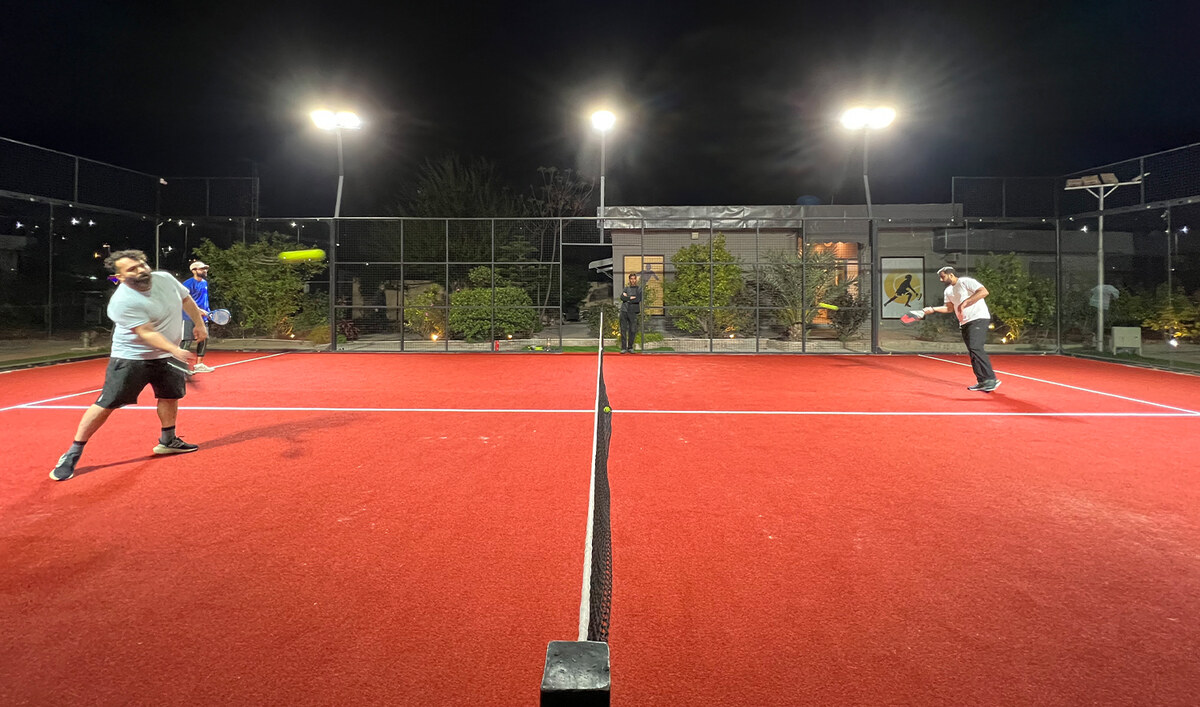


People play padel at an outdoor court at The Pad in Islamabad, Pakistan, on March 17, 2025. (AN photo)

Indeed, from dedicated sports clubs to pop-up facilities in upscale neighborhoods, there is a surge in courts and players this Ramadan, with families, friends, and even corporate groups gathering late into the night and enjoying the sport’s social nature. Many players said they would cap off their matches with post-game hangouts at nearby cafés and restaurants where they could enjoy suhoor in groups. 

Mahnoor Khan, a 27-year-old employee at a telecom company, said she had come to the courts for the first time with her husband and a group of friends, describing padel as a “very good sport for family and friends.”

“In Islamabad you don’t have a lot of options other than dining out, so this is the very first time that they have introduced something that is other than dining out for socializing,” she told Arab News. “You have a good game, and you go out after iftar or whenever … I think the concept is now spreading really fast.”



The picture taken on March 17, 2025, shows sign board of The Pad, a padel club, in Islamabad, Pakistan. (AN photo)

Zainab Ameen, who manages The Pad club with her husband, another co-founder Ameen-ud-Din Hafeez, said though the club had only launched a few months ago, the response was “tremendous.”

“We never thought that we will get this kind of response. We just started with two courts and when we got a very good response, we opened two more. And now, we are going to open a futsol [arena],” she told Arab News.

What makes padel particularly appealing during Ramadan is that as a low-impact sport, padel lets one enjoy exercising without any hard strain on the muscles, thus serving as an effective means of staying fit without feeling exceedingly overwhelmed in Ramadan.

“It’s a very low skill floor for the game to play. So, anyone who is starting off will have a good time because they are going to feel like, ‘Wow, what a shot, I am a machine’,” Sabri said. 

“But then there is also a very good skill ceiling … It’s a very interesting mixture in a way most racket sports are.”


History-chasing Djokovic and Alcaraz to meet in Australian Open final after epic semifinal wins

Updated 31 January 2026
Follow

History-chasing Djokovic and Alcaraz to meet in Australian Open final after epic semifinal wins

  • Carlos Alcaraz striving to become the youngest man ever to complete a career Grand Slam
  • Novak Djokovic is aiming to be the oldest man in the Open era to win a Grand Slam title

MELBOURNE: Novak Djokovic finally beat one of the two men who have been blocking his path to an unprecedented 25th Grand Slam singles title when he edged Jannik Sinner in five sets Friday to reach the Australian Open final.
To get that coveted No. 25, he’ll next have to beat the other: top-ranked Carlos Alcaraz.
They’re both chasing history in Sunday’s championship decider, with the 22-year-old Alcaraz striving to become the youngest man ever to complete a career Grand Slam.
The top-ranked Alcaraz also had to come through a grueling five-setter. He fended off No. 3 Alexander Zverev 6-4, 7-6 (5), 6-7 (3), 6-7 (4), 7-5 in a match that started in the warmth of the afternoon Friday and, 5 hours and 27 minutes later, became the longest semifinal ever at the Australian Open.
That pushed the start of Djokovic’s match against Sinner back a couple of hours, and the 38-year-old Djokovic finally finished off a 3-6, 6-3, 4-6, 6-4, 6-4 win just after 1:30 a.m.
“It feels surreal,” Djokovic said of his 4-hour, 9-minute triumph. “Honestly, it feels like winning already tonight. I know I have to come back … and fight the No. 1 of the world. I just hope that I’ll have enough gas to stay toe-to-toe with him.
“That’s my desire. Let the God decide the winner.”
Djokovic was at the peak of his defensive powers, fending off 16 of the 18 breakpoints he faced against the two-time defending Australian Open champion. It ended a run of five losses to Sinner, and a run of four semifinal exits for Djokovic at the majors.
“Had many chances, couldn’t use them, and that’s the outcome,” Sinner said. “Yeah, it hurts, for sure.”
Alcaraz and Sinner have split the last eight major titles between them since Djokovic won his last title at the 2023 US Open.
Nobody knows how to win more at Melbourne Park than Djokovic. He has won all 10 times he’s contested the Australian Open final.
He said he saw Alcaraz after the first of the semifinals was over and he congratulated him on reaching his first final at Melbourne Park.
“He said sorry to delay,” Djokovic later explained. “I told him ‘I’m an old man, I need to go earlier to sleep!”
Djokovic, aiming to be the oldest man in the Open era to win a Grand Slam title, was kept up late.
“I’m looking forward to meeting him on Sunday,” he said.
Final 4
With the top four seeds reaching the Australian Open men’s semifinals for just the fifth time, Day 13 was destined to produce some drama. The season-opening major had been a relatively slow burn, until the back-to-back five-setters lasting a combined 9 hours and 36 minutes.
Alcaraz and Zverev, the 2025 runner-up, surpassed the 2009 classic between Rafael Nadal and Fernando Verdasco as the longest ever Australian Open semifinal.
Medical timeout
Alcaraz was as close as two points from victory in the third set but was hampered by pain in his upper right leg and his medical timeout became contentious.
He said initially it didn’t feel like cramping because the pain seemed to be just in one muscle, the right adductor, and he needed an assessment.
He navigated the third and fourth sets and was behind in the fifth after dropping serve in the first game. He kept up the pressure but didn’t break back until Zverev was serving for the match. He then won the last four games.
“I think physically we just pushed each other to the limit today. We pushed our bodies to the limit,” Alcaraz said. “Just really, really happy to get the win, that I came back. I just rank this one in the top position of one of the best matches that I have ever won.”
Believe
Asked how he was able to recover despite being so close to defeat, Alcaraz admitted he was struggling but said kept “believing, believing, all the time.”
“I’ve been in these situations, I’ve been in these kinds of matches before, so I knew what I had to do,” he said. “I had to put my heart into the match. I think I did it. I fought until the last ball.”
Zverev was demonstrably upset about the time out out in the third set, taking it up with a tournament supervisor, when his rival was given the three-minute break for treatment and a massage on the leg.
After the match, he maintained that he didn’t think it was right, but he didn’t think it should overshadow the match.
“I don’t want to talk about this right now, because I think this is one of the best battles there ever was in Australia,” he said “It doesn’t deserve to be the topic now.”