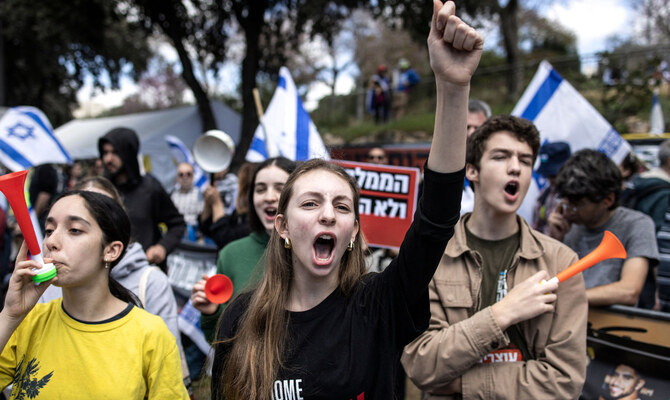
JERUSALEM: Thousands of protesters massed in Jerusalem on Wednesday, chanting slogans against Israeli Prime Minister Benjamin Netanyahu who they accuse of undermining democracy and resuming Gaza strikes without regard for hostages.
Protesters shouted “You are the head, and you’re to blame” as well as “The blood is on your hands” at the demonstration near parliament, the largest to take place in Jerusalem for months.
The demonstration was organized by anti-Netanyahu opposition groups protesting the premier’s move to sack Ronen Bar, head of the Shin Bet internal security agency.
Following Netanyahu’s announcement to dismiss Bar, which threatened to trigger political crisis, Israel launched a wave of overnight strikes on Gaza, by far the deadliest since the start of a fragile ceasefire in January.
Relatives of the Israeli hostages still held in Gaza joined the rally outside the parliament in Jerusalem.
“We hope all people from Israel will join this movement and we will not stop until we restore democracy and freedom for the hostages,” said Zeev Berar, 68, from Tel Aviv.
“At this rate we won’t have a country left, not a democratic one. It will be a dictatorship,” student Roni Sharon, 18, told AFP.
Some in the crowd brandished banners reading: “We are all hostages.”
Relatives of the hostages in the Gaza Strip have said the decision to resume strikes could “sacrifice” their loved ones.
Of the 251 hostages seized during the unprecedented October 2023 Hamas attack that sparked the war, 58 are still held in Gaza, including 34 the Israeli military says are dead.
The demonstrators in Jerusalem also accuse Netanyahu of using the war against Hamas to distract from domestic political concerns.
The prime minister has so far refused to set up a national commission of inquiry into Hamas’s October 7, 2023 attack, while his bid to dismiss Bar threatened to plunge Israel back into deep political crisis.
Netanyahu’s government recently also moved to oust Israel’s attorney general and government judiciary adviser, Gali Baharav-Miara, a fierce defendant of the judiciary’s independence.
A 2023 judicial reform project aimed at curbing the supreme court’s powers fractured the country and sparked major protests — before coming to an abrupt halt with Hamas’s October 7 attack.
“The last two years have been a nightmare for us,” said Yael Baron, 55, from the city of Modiin.
“I feel as though we are in the 99th minute and time is running out to save the country, the oxygen is running out for us, like democracy is running out.”


![]()

Thousands join anti-government rally in Jerusalem
Short Url
https://arab.news/c6y7h
Thousands join anti-government rally in Jerusalem
- Relatives of the Israeli hostages still held in Gaza joined the rally outside the parliament in Jerusalem


Latest updates


© 2026 SAUDI RESEARCH & PUBLISHING COMPANY, All Rights Reserved And subject to Terms of Use Agreement.