


RIYADH: The United Arab Emirates “exploited the legitimacy of the the coalition of restoring legitimacy in Yemen to achieve its own agenda (in Yemen)”, Salam Al-Khanbashi, the governor of Hadhramaut, said today.
“We thought the UAE would be a support and aid to us, but we were shocked by its actions,” he added
He confirmed that the province suffered from armed groups affiliated with Aidrous Al-Zubaidi, backed by the UAE.
Al-Khanbashi noted that these groups had carried out acts of invasion and terror against citizens, committing crimes of robbery, kidnapping, murder, and displacement, in addition to destroying state property and looting its premises, causing widespread damage to various segments of the province's population.
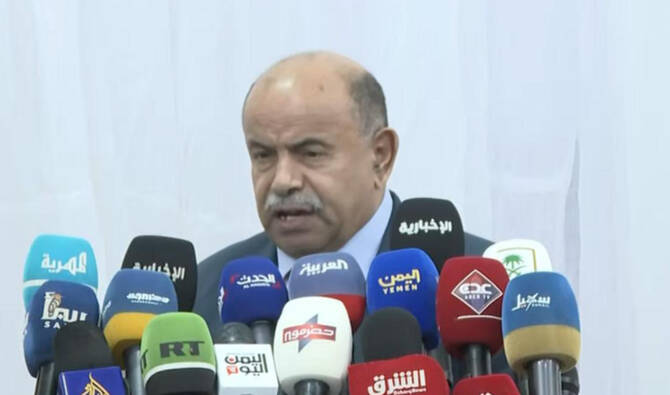
During a press conference, the governor of Hadhramout confirmed that the Yemeni government had discovered suspicious Emirati equipment and practices at the Rayyan base in Mukalla that are not consistent with the declared goals of the legitimacy support coalition or the principles of brotherhood, Islam, and Arabism.
He explained that the equipment included wires, explosives, detonators, and communication devices used to carry out assassinations, murder, and torture. He noted that the presence of these tools within the Rayyan airport camp is not consistent with the nature of the camp's tasks and reflects its use as a headquarters for planning and implementing crimes and violations targeting civilians.
Khanbashi added that the type of materials discovered and the way they were prepared are not consistent with the tools and equipment used by regular armies in military bases, which confirms that the base was used to carry out criminal acts against civilians. He said that the armed groups loyal to Al-Zubaidi had exploited the just southern cause as a cover for their crimes against southerners, marginalizing their legitimate demands and serving what he described as an Emirati agenda aimed at spreading chaos and hindering any political initiatives to address the southern issue.
The Governor of Hadhramaut argued that these recent revelations explains the UAE's eagerness to smuggle Al-Zubaidi through Somalia to Abu Dhabi, in order to protect him from legal prosecution for the crimes and violations committed against the people of the south, and to prevent him from being exposed as a tool for implementing Abu Dhabi's agenda in Yemen.
He noted that the evidence presented also revealed the existence of secret prisons run by Emirati forces in the city of Mukalla, used for arbitrary detention outside the law, enforced disappearance, and torture.
Khanbashi stressed that the relevant authorities will take the necessary legal action against Al-Zubaidi and all those involved in these violations, in accordance with the law, and in a way that ensures the protection of citizens' security and the stability of the Hadhramaut province. He affirmed that the southern provinces are experiencing increasing liberation from the oppression and domination imposed on them.
For its part, and in a statement posted on X, The Ministry of Defence of the United Arab Emirates has categorically denied the claims made during the press conference held by Khanbashi.
The ministry further claimed that UAE forces officially and publicly completed their full withdrawal from Yemen on 2nd of January 2026. “This withdrawal included the transfer of all equipment, weapons and assets,” added the statement.
With regard to the accusations concerning the existence of “secret prisons” at Riyan Airport, the UAE ministry claimed that the facilities referred to are “merely military accommodation, operations rooms and fortified shelters, some of which are located underground”.


