

Pakistan, Russia conduct joint naval exercise in North Arabian Sea

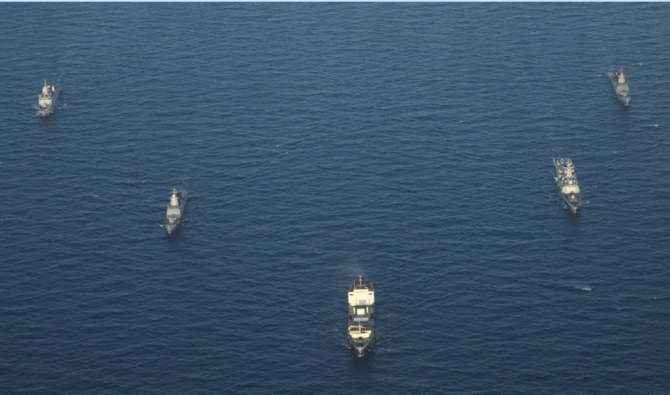
Pakistani and Russian navy ships during a bilateral naval exercise named “Arabian Monsoon-VI” in the North Arabian Sea on March 19, 2025. (ISPR)
Short Url
Updated 19 March 2025
Follow

Pakistan, Russia conduct joint naval exercise in North Arabian Sea

  • Both navies hold ‘Arabian Monsoon-VI’ exercise in Arabian Sea to enhance interoperability
  • Russian navy delegates meet Pakistan Navy officials, pay tribute to Pakistan founder Jinnah

KARACHI: Pakistani and Russian navies conducted a bilateral naval exercise named “Arabian Monsoon-VI” in the North Arabian Sea on Wednesday, the Pakistan Navy said in a statement, in their bid to counter maritime security threats and enhance interoperability. 

Pakistan and Russia, once Cold War rivals, have strengthened their relations through increased dialogue, trade and cooperation in energy and defense. Regular port visits and joint exercises between the Pakistan Navy and the Russian Navy have deepened bilateral ties, enhanced naval collaboration and fostered mutual trust.

“Various assets of Pakistan Navy, including a Destroyer, an Offshore Patrol Vessel, a Fast Attack Craft (Missile), a Maritime Patrol Aircraft and a UAV, participated in the exercise alongside Russian Federation Navy ships,” the Directorate General Public Relations (DGPR) of the Pakistan Navy said. 

Multi-faceted maritime warfare serials and a coordinated patrol featured in the exercise, which also aimed at enhancing the interoperability of both navies, it added.

The exercise also featured participation from the Pakistan Air Force fighter aircraft. 

The Russian navy delegates also called on Pakistan Navy officials and paid tribute to the nation’s founder Muhammad Ali Jinnah, laying a floral wreath at his mausoleum.

“Joint maritime exercises with key naval forces underscore Pakistan Navy’s commitment to maintaining maritime security and ensuring a stable maritime order in the region,” the statement added.

On Mar. 13, the Russian navy flotilla arrived in the southern port city of Karachi where cross-ship visits, harbor drills and table-top discussions between the two sides were conducted. 

The Pakistan Navy regularly collaborates with allies and friendly nations, conducting joint military exercises to enhance synergy, promote regional peace and stability, deter piracy, drug trafficking and other illicit maritime activities.


IMF urges Pakistan to expedite reforms to strengthen economic growth, maintain stability

Updated 7 sec ago
Follow

IMF urges Pakistan to expedite reforms to strengthen economic growth, maintain stability

  • Pakistan has undergone difficult period of stabilization, marked by inflation, currency depreciation and financing gaps
  • IMF official marks Pakistan plans to privatize state entities, improve financial management as key to boost country’s exports

KARACHI: The International Monetary Fund (IMF) on Thursday said Pakistan should accelerate the pace of structural reforms the government has committed to take under its $7 billion Extended Fund Facility (EFF) program, a move that would help the South Asian nation strengthen growth, maintain macroeconomic stability and boost exports.

Pakistan has undergone a difficult period of stabilization, marked by inflation, currency depreciation and financing gaps, though international rating agencies have acknowledged improvements after Islamabad began privatizing loss-making, state-owned enterprises (SOEs) and ended subsidies as part of reforms under the IMF loan program.

Responding to questions from Arab News at a virtual media roundtable on emerging markets’ resilience, IMF’s director of the Middle East and Central Asia Jihad Azour said Islamabad’s implementation of the EFF requirements had been “strong” despite devastating floods that killed more than 1,000 people and devastated farmland, forcing the government to revise its 4.2 percent growth target to 3.9 percent.

“What is important going forward in order to strengthen growth and to maintain the level of macroeconomic stability is to accelerate the structural reforms,” he said at the meeting that was also attended by Pierre-Olivier Gourinchas, IMF’s economic counsellor and director of the research department.

The roundtable comes as a preview of the 2026 edition of AlUla Conference, a high level policy forum jointly organized by Saudi Arabia’s finance ministry and IMF for Feb. 8–9 to address key challenges and opportunities facing emerging markets.

In Dec., the IMF executive board competed its second review under the EFF and first review under the Resilience and Sustainability Facility (RSF) which helped Pakistan draw a total of $1.2 billion.

Azour underlined Pakistan’s plans to privatize some of the SOEs and improve financial management of important public entities, particularly power companies, as an important way for the country to boost its capacity to cater to the economy for additional exports.

“This comes in addition to the effort that the authorities have made in order to reform their tariffs, which will allow the private sector of Pakistan to become more competitive,” the IMF official said.

Prime Minister Shehbaz Sharif’s government privatized Pakistan International Airlines (PIA) in December by selling 75 percent of its shares to a private consortium, led by Arif Habib Group for Rs135 billion ($483 million).

The IMF in a statement earlier this month welcomed the completion of PIA’s privatization process, one of the commitments under its loan program.

“Of course, the strong implementation of the program by the authorities, despite the recent devastating floods, helped maintain stability as well as also improving the financing and external conditions that are supported by the EFF,” Azour said.

’RECOVERY REMAINS ON TRACK’
He said the government’s achievement of a current account surplus last year for the first time in 14 years was “important.”

Usually prone to deficits, Pakistan’s current account showed a surplus of $1.93 billion in the last fiscal year through June, compared with $2.1 billion deficit a year earlier (FY24), according to the State Bank of Pakistan data.

The IMF director said Pakistan’s primary fiscal balance had surpassed the program targets because of the efforts and the structural reforms on the regular administration side.

“The authorities, as you know, have reaffirmed their commitment to the program,” he said.

“The recovery remains on track.”

POTENTIAL WEAKNESSES
Earlier in his address, Gourinchas said despite trade disruptions and heightened uncertainty global economy was showing resilience and was expected to expand 3.3 percent this year through Dec. This growth forecast was led by advanced economies, emerging markets and developing economies.

Emerging markets and developing economies are expected to grow at around 4 percent for the next two years, Gourinchas said, calling it a “solid performance” by historical standards with an upward revision relative to the October round in most regions.

The IMF official, however, was concerned about global growth increasingly concentrating in sectors like information technology (IT) and artificial intelligence (AI) and labor market showing signs of softening in several countries. AI, when deployed, could displace many workers, he warned.

“These are potential weaknesses for the global economy. Now navigating this environment requires vigilance on the side of policymakers, preparation, and agility,” Gourinchas told the journalists.

YEAR OF HIGH UNCERTAINTY
Taking stock of regional economies under his watch, Azour said the story of 2026 was “a story of resilience” for the Middle East where, despite the high level of uncertainty, economic growth had been upgraded.

“2026 is a year of high uncertainty, especially as we see currently on the geopolitical front,” the IMF official said, alluding to renewed tensions between the United Sates and Iran and other hotspots in the volatile region.

The official said the region is likely to face four main risks in 2026, including flare-up of geopolitical tensions; increased global uncertainty that could slash growth for certain countries by as much as three percent with a delay of about two years; debt sustainability given the tightening in global financing conditions; and oil price volatility that could impact the countries’ current accounts and level of foreign reserves.

“The last impact is any international adjustment or any adjustment in the AI industry could also have an impact on some of the countries, especially those who are heavily invested in AI,” Azour said.