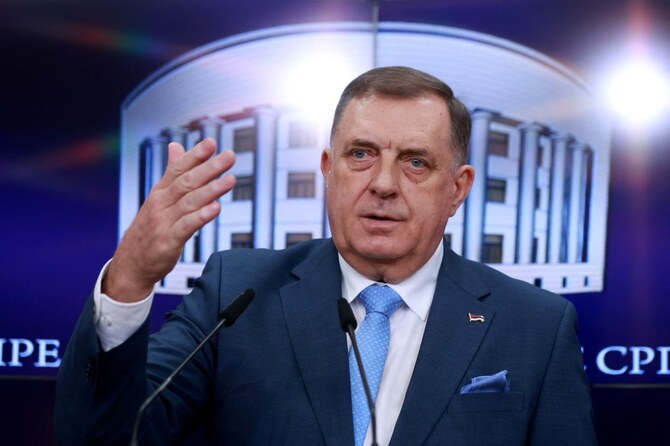
SARAJEVO: Bosnian authorities have issued an arrest warrant for ethnic Serb leader Milorad Dodik, a senior police officer said Wednesday, as part of an investigation into his alleged flouting of the country’s constitution.
The announcement comes a week after police said they were seeking to question Dodik, who remained defiant and called on federal police to ignore the order.
But according to the head of police in Bosnia’s Muslim-Croat statelet, an arrest warrant has now been issued by authorities.
It also includes orders to detain Republika Srpska Prime Minister Radovan Viskovic and Parliamentary Speaker Nenad Stevandic.
“We received an arrest warrant for these three individuals,” said Vahidin Munjic during an interview with local media.
“All police organs in Bosnia and Herzegovina, if they spot these individuals, are obligated to arrest them and hand them over to the state court.”
Tensions have soared in the divided Balkan country since Dodik was convicted last month for defying Christian Schmidt, the international envoy charged with overseeing the peace accords that ended Bosnia’s 1990s war.
Dodik, who is the president of Bosnia’s Republika Srpska (RS) statelet, remains unrepentant. He helped push through laws forbidding the federal police and judiciary from entering Bosnia’s Serb entity in retaliation.
The laws were later struck down by the constitutional court.
Since the end of Bosnia’s inter-ethnic war in the 1990s, the country has consisted of two autonomous halves — the Serb-dominated RS and a Muslim-Croat region.
The two entities have their own governments and parliaments and are linked by weak central institutions.
During a meeting in the RS capital on Wednesday, Dodik appeared to pay little attention to the latest news concerning the warrant.
“We will continue to implement the policies adopted by the parliament,” he said, referring to the RS’s legislator.
Bosnia’s divided politics and fragile, post-war institutions have faced increasing uncertainty due to the unfolding political crisis.
On Tuesday, the head of Bosnia’s federal police force Darko Culum — an ally of Dodik — announced that he was resigning from the post and would return to work for the interior ministry in the RS.
Days earlier, Dodik had called on ethnic Serbs working for Bosnia’s national institutions to quit and take up jobs in the RS.
Serbia’s President Aleksandar Vucic — a major backer of Dodik — also said he planned to raise the issue of the arrest warrant during a visit to Brussels this week.
“We could end up in a total disaster overnight. That’s why we must do everything to preserve peace and stability,” Vucic said during an interview with a Serbian broadcaster.
For years, Dodik has pursued a separatist agenda, repeatedly threatening to pull the Serb statelet out of Bosnia’s central institutions — including its army, judiciary and tax system — which has led to sanctions from the United States.
The RS leader had already pushed through two earlier laws that refused to recognize decisions made by Schmidt and Bosnia’s constitutional court.
That led to his conviction last month, when he was sentenced to a year in prison and handed a six-year ban from office.


![]()

Bosnia issues arrest warrant for ethnic Serb leader
Short Url
https://arab.news/6c4zq
Bosnia issues arrest warrant for ethnic Serb leader
- The announcement comes a week after police said they were seeking to question Dodik
- According to the head of police in Bosnia’s Muslim-Croat statelet, an arrest warrant has now been issued by authorities


Latest updates


© 2026 SAUDI RESEARCH & PUBLISHING COMPANY, All Rights Reserved And subject to Terms of Use Agreement.