

Fear at Antarctica base as researcher assaults colleague and makes threats

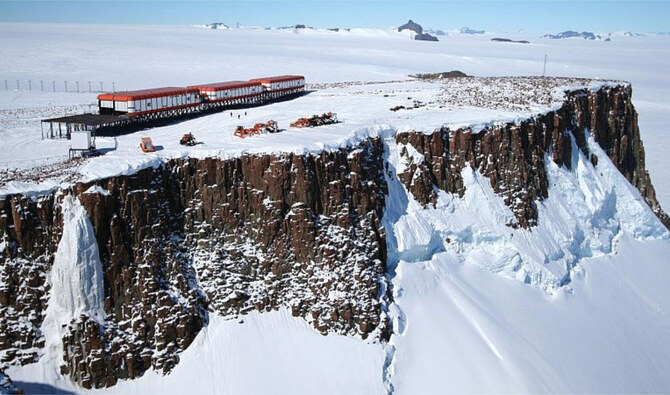
The SANAE IV base is more than 2,500 miles from South Africa’s closest point. (Wikimedia)
Short Url
Updated 19 March 2025
Follow

Fear at Antarctica base as researcher assaults colleague and makes threats

  • ‘His behavior has escalated to a point that is deeply disturbing,’ said an email sent to South Africa’s Sunday Times newspaper

CAPE TOWN: A member of a South African research team that is confined for more than a year at an isolated Antarctica base was put under psychological evaluation there after he allegedly assaulted and sexually harassed colleagues, government officials said.

The problems at the SANAE IV base were first reported by South Africa’s Sunday Times newspaper, which said it had seen an email from a team member to authorities last month claiming the man had attacked the base leader and made threats.

The email pleaded for help.

“His behavior has escalated to a point that is deeply disturbing,” the email said, according to The Sunday Times. “I remain deeply concerned about my own safety, constantly wondering if I might become the next victim.” The report said the man allegedly made a death threat.

South Africa’s Ministry of Environment, which oversees the research missions, said in a statement that the alleged assault on the base leader was reported on Feb. 27, and officials and counselors intervened remotely “to mediate and restore relationships at the base.” They were speaking with team members almost daily, it said.

“The alleged perpetrator has willingly participated in further psychological evaluation, has shown remorse and is willingly cooperative,” the ministry said, adding that he had written a formal apology to the victim of the alleged assault. It said the allegations were being investigated. No one was identified.

The nine-member team, which includes scientists, a doctor and engineers, is expected to stay at the base for about 13 months until next year, authorities said, living in close quarters through the hostile Antarctic winter, whose six months of darkness begin in June.

The base is on a cliff in Queen Maud Land and is surrounded by a glacial ice sheet, more than 4,000 km, from South Africa.

The next planned visit by a supply ship is in December, according to the South African National Antarctic Program. It takes the ship around 10 days to travel from Cape Town.

Authorities said they had decided not to evacuate anyone from SANAE IV, where the onset of unpredictable weather conditions meant the team was now confined to the base.

The ministry said all team members had undergone evaluations ahead of the trip to ensure they can cope with the “extreme nature of the environment in Antarctica” and the isolation and confinement, and no problems were identified.

“It is not uncommon that once individuals arrive at the extremely remote areas where the scientific bases are located, an initial adjustment to the environment is required,” it said.

Previous problems have been reported at another of South Africa’s remote research bases on Marion Island, a South African territory near Antarctica.

In 2017, a member of a research team there smashed a colleague’s room with an ax over an apparent love triangle, according to a report to South Africa’s parliament. Lawmakers said it appeared the researchers were living in highly stressful conditions.

The National Science Foundation, the federal agency that oversees the US Antarctic Program, published a report in 2022 in which 59 percent of women in the US program said they’d experienced harassment or assault while on research trips in Antarctica.


Trump administration labels 3 Muslim Brotherhood branches as terrorist organizations

Updated 13 January 2026
Follow

Trump administration labels 3 Muslim Brotherhood branches as terrorist organizations

  • The State Department designated the Lebanese branch a foreign terrorist organization
  • “These designations reflect the opening actions of an ongoing, sustained effort to thwart Muslim Brotherhood chapters’ violence,” Rubio said

WASHINGTON: President Donald Trump’s administration has made good on its pledge to label three Middle Eastern branches of the Muslim Brotherhood as terrorist organizations, imposing sanctions on them and their members in a decision that could have implications for US relationships with allies Qatar and Turkiye.
The Treasury and State departments announced the actions Tuesday against the Lebanese, Jordanian and Egyptian chapters of the Muslim Brotherhood, which they said pose a risk to the United States and American interests.
The State Department designated the Lebanese branch a foreign terrorist organization, the most severe of the labels, which makes it a criminal offense to provide material support to the group. The Jordanian and Egyptian branches were listed by Treasury as specially designated global terrorists for providing support to Hamas.
“These designations reflect the opening actions of an ongoing, sustained effort to thwart Muslim Brotherhood chapters’ violence and destabilization wherever it occurs,” Secretary of State Marco Rubio said in a statement. “The United States will use all available tools to deprive these Muslim Brotherhood chapters of the resources to engage in or support terrorism.”
Rubio and Treasury Secretary Scott Bessent were mandated last year under an executive order signed by Trump to determine the most appropriate way to impose sanctions on the groups, which US officials say engage in or support violence and destabilization campaigns that harm the United States and other regions.
Muslim Brotherhood leaders have said they renounce violence.
Trump’s executive order had singled out the chapters in Lebanon, Jordan and Egypt, noting that a wing of the Lebanese chapter had launched rockets on Israel after Hamas’ Oct. 7, 2023, attack in Israel that set off the war in Gaza. Leaders of the group in Jordan have provided support to Hamas, the order said.
The Muslim Brotherhood was founded in Egypt in 1928 but was banned in that country in 2013. Jordan announced a sweeping ban on the Muslim Brotherhood in April.
Nathan Brown, a professor of political science and international affairs at George Washington University, said some allies of the US, including the United Arab Emirates and Egypt, would likely be pleased with the designation.
“For other governments where the brotherhood is tolerated, it would be a thorn in bilateral relations,” including in Qatar and Turkiye, he said.
Brown also said a designation on the chapters may have effects on visa and asylum claims for people entering not just the US but also Western European countries and Canada.
“I think this would give immigration officials a stronger basis for suspicion, and it might make courts less likely to question any kind of official action against Brotherhood members who are seeking to stay in this country, seeking political asylum,” he said.
Trump, a Republican, weighed whether to designate the Muslim Brotherhood a terrorist organization in 2019 during his first term in office. Some prominent Trump supporters, including right-wing influencer Laura Loomer, have pushed his administration to take aggressive action against the group.
Two Republican-led state governments — Florida and Texas — designated the group as a terrorist organization this year.