


At Jazan festival, Suad Al-Asiri paints memory, land and leadership

1 / 9
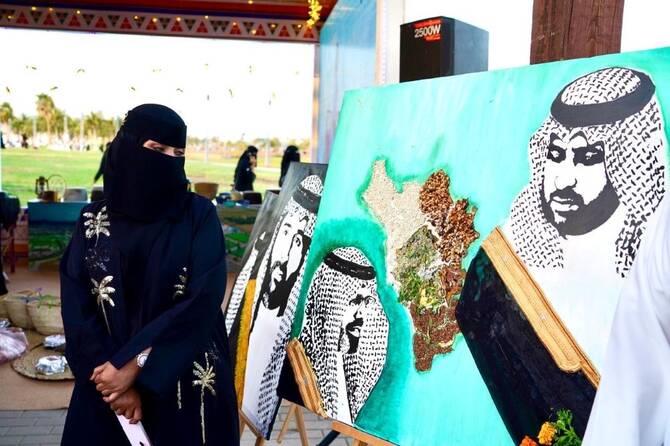
Suad Al-Asiri’s paintings blend memory, place and personal history, offering visual narratives shaped by beauty and hardship. (AN Photo)
2 / 9
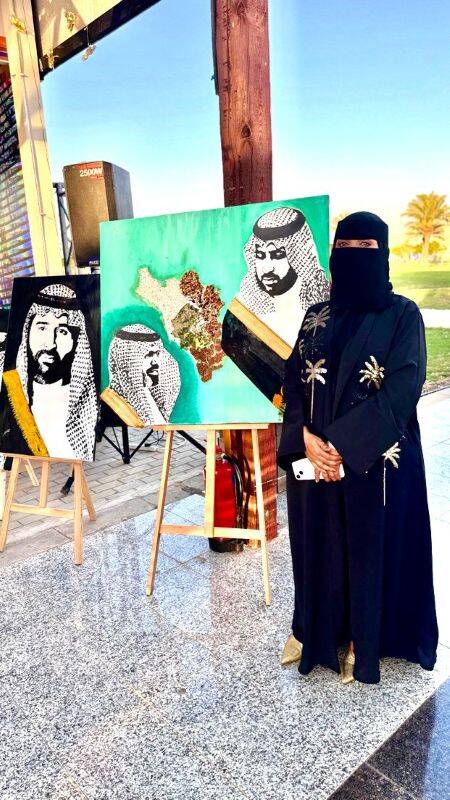
Suad Al-Asiri’s paintings blend memory, place and personal history, offering visual narratives shaped by beauty and hardship. (AN Photo)
3 / 9
Suad Al-Asiri’s paintings blend memory, place and personal history, offering visual narratives shaped by beauty and hardship. (AN Photo)
4 / 9
Suad Al-Asiri’s paintings blend memory, place and personal history, offering visual narratives shaped by beauty and hardship. (AN Photo)
5 / 9
Suad Al-Asiri’s paintings blend memory, place and personal history, offering visual narratives shaped by beauty and hardship. (AN Photo)
6 / 9
Suad Al-Asiri’s paintings blend memory, place and personal history, offering visual narratives shaped by beauty and hardship. (AN Photo)
7 / 9
Suad Al-Asiri’s paintings blend memory, place and personal history, offering visual narratives shaped by beauty and hardship. (AN Photo)
8 / 9
Suad Al-Asiri’s paintings blend memory, place and personal history, offering visual narratives shaped by beauty and hardship. (AN Photo)
9 / 9
Suad Al-Asiri’s paintings blend memory, place and personal history, offering visual narratives shaped by beauty and hardship. (AN Photo)
Short Url
Updated 13 January 2026
Follow

At Jazan festival, Suad Al-Asiri paints memory, land and leadership

  • Local artist channels personal hardship into works that reflect Jazan’s identity, heritage
  • Jazan: A Nation and a Prince, places region at the heart of a composition featuring Prince Mohammed bin Abdulaziz and Prince Nasser bin Mohammed bin Abdullah bin Jalawi

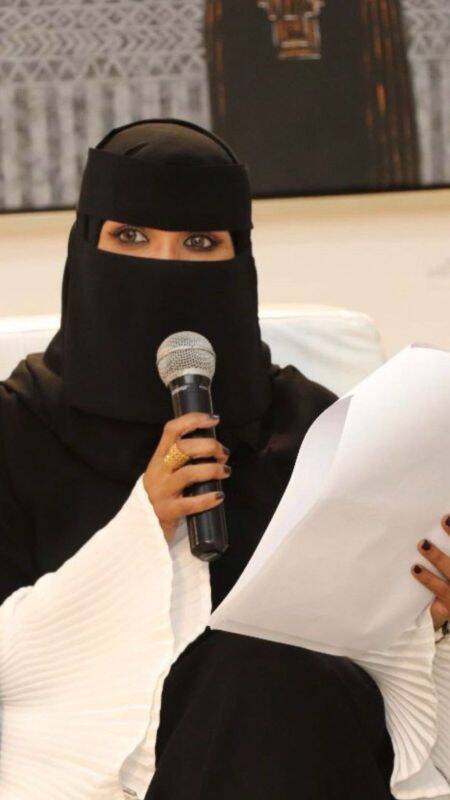
RIYADH: At the Ahad Al-Masarihah pavilion at Jazan Festival 2026, Suad Al-Asiri’s paintings blend memory, place and personal history, offering visual narratives shaped by beauty and hardship. 

A novelist and visual artist, Al-Asiri has long used art as a storytelling tool. After a near-fatal car accident in March 2024, her work took on a new urgency. Bedridden for 11 months, cut off from the public world for more than a year, she describes that period as one of the most painful in her life — yet also transformative. 

“First of all, praise be to God for granting me life, as the accident was extremely severe,” she said. “By God’s grace, I was given a new life. All my thinking after the accident was about becoming an inspiration to others — about enduring pain and obstacles, and still leaving an impact.” 

Her return to public life came in 2025, when she participated in National Day celebrations with the ministry of interior. By the time she arrived at Jazan Festival, she was ready to channel that experience into her art. 

The centerpiece of her display, “Jazan: A Nation and a Prince,” places the region at the heart of a composition featuring Prince Mohammed bin Abdulaziz and Prince Nasser bin Mohammed bin Abdullah bin Jalawi, governor and deputy governor of Jazan respectively. 

Visitors linger over the details: the painting incorporates coffee beans, sesame and khudair — materials drawn from local products.

“I wanted people to recognize these products immediately,” she said. “They are part of Jazan’s daily life, and using them makes the work more tangible, more connected to everyday experience.” 

The painting sparks conversation. Visitors discuss leadership, identity, and the intimate relationship between people and their environment. 

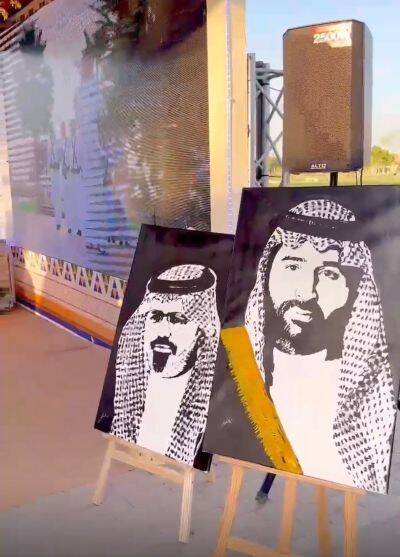
Beyond the central piece, Al-Asiri presents individual portraits of the two princes, expanding the dialogue into a broader exploration of heritage and memory.  

Her journey into art is tied to her life as a storyteller. Early experiments with charcoal and pencil evolved into abstract art, drawn by its expressive freedom. 

From there, she explored realism, surrealism, and eventually modern art, particularly pop art, which has earned her wide recognition in artistic circles. Her novels and media work complement her visual practice, earning her the title “the comprehensive artist” from the governor.

Yet what stands out most in this exhibition is how Al-Asiri’s personal resilience flows through each piece. Her experience of surviving a devastating accident, enduring months of immobility, and returning to the public eye informs every brushstroke. 

Visitors sense not just her artistic skill, but her determination to turn life’s hardships into inspiration for others. 

Walking through the pavilion, one can see it in the way she blends heritage symbols, southern landscapes, and scenes of daily life. 

Each painting becomes both a document and a dialogue — a celebration of Jazan’s culture, a reflection on identity, and a testament to the power of human perseverance. 

At Jazan Festival 2026, Suad Al-Asiri’s art is a quiet, persistent inspiration for anyone who pauses long enough to listen. 


Ithra offers a glimpse of colorful Spain through fashion

Updated 27 January 2026
Follow

Ithra offers a glimpse of colorful Spain through fashion

DHAHRAN: Step into Spain without leaving Dhahran at the “Threads of Espana: Fashion Across the Spanish Regions” show currently on at the King Abdulaziz Center for World Culture.

From structured capes to swirling silhouettes, the show at Ithra brings the nation’s colorful fabric traditions to life.

Arab News spoke recently with Cecilia Revuelta, a co-organizer of the exhibition who flew in from Spain.

“We did a selection of traditional costumes of each area in Spain. So first of all, here we have the three costumes of a traditional torero. These suits are from a real torero who’s still active.”

A torero — from toro, meaning bull — is a Spanish bullfighter.

“His name is Jorge Garcia De La Pena, and thanks to our relationship with him, he lent us the three costumes and the two capes,” she added.

“Actually, one of the capes even has the bull blood in them; we decided not to wash it or anything because we think it’s totally more real like this.”

The clothes are on display until Jan. 31. (AN Photo)

Revuelta described the garments, split among different display areas, as “real art pieces, very heavy and delicate pieces. Also, we brought some flamenca dresses.”

“They’re from a private Spanish collector who dances flamenco and she’s a real fan of the flamenco culture. And she has a big, big, big collection of dresses and we did a small selection to bring it here to Ithra.”

Northern Spain is represented through costumes created stitch-by-stitch specifically for the Ithra exhibition.

“We also fabricated from scratch the costumes of Galicia. They’re the typical traditional costumes that they use in the north of Spain in the countryside, in the small villages. When it’s very cold and rainy and you can see they have a lot of layering and many details.”

“These dresses are very expensive because they are real, real pieces of art. One of these dresses costs more than 4,000 euros ($4,750). Most of them are handmade with a lot of details and stones and different colors and layers. It’s really amazing.”

For Revuelta, the exhibition reflects her love of fashion and its history. “It’s my favorite part (of the Spain Cultural Days festivities) because I love fashion. I love clothes since the beginning.”

Revuelta highlighted the cross-cultural nature of the event.

“I think it’s super positive for all the citizens of Dammam to come here, to get to know more about other countries, different cultures, traditions. They have a lot of workshops. And in the market, we have many different booths selling pieces of art, ceramics and traditional Spanish souvenirs.

“I feel very proud. It is my first time in Saudi Arabia and people here are really interested in knowing more about the different costumes and fashion history of Spain,” she added.

The pieces will remain on display until the completion of the Spain Cultural Days festivities on Jan. 31.