

Indonesia holds first Independence Day ceremony in future capital, Nusantara

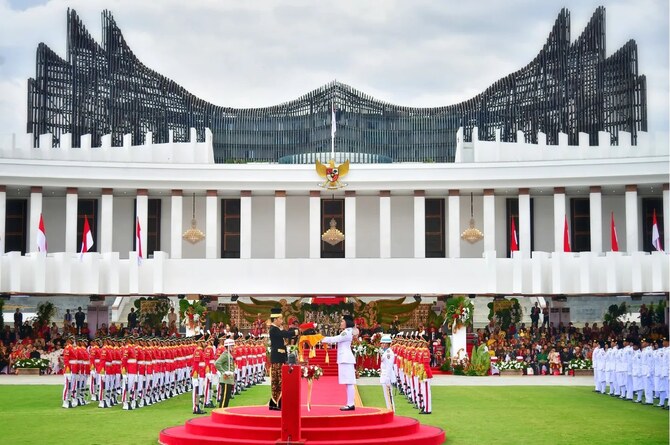
President Joko Widodo takes part in a flag-raising ceremony marking Indonesia's 79th Independence Day at the presidential palace in the future capital Nusantara in East Kalimantan province. (Presidential Secretariat)
Short Url
Updated 17 August 2024
Follow

Indonesia holds first Independence Day ceremony in future capital, Nusantara

  • Nusantara is intended to ease the burden on sinking, overpopulated Jakarta
  • Ambitious megaproject has been criticized by environmentalists, indigenous people

JAKARTA: Indonesian President Joko Widodo led the country’s 79th Independence Day ceremony on Saturday. It was the first time the ceremony has been held in the country’s unfinished future capital of Nusantara, marking a milestone in the government’s ambitious plan to move the center of government from Jakarta to the new city emerging out of the Borneo jungle.  

Widodo was accompanied by Defense Minister and President-elect Prabowo Subianto. A similar event was held simultaneously in the current capital, Jakarta, which was attended by Vice President Ma’ruf Amin and Vice President-elect Gibran Rakabuming Raka, Widodo’s eldest son.

Around 1,300 officials and invited guests wearing traditional attire from various Indonesian provinces attended the Nusantara gathering at the new State Palace.

“(Nusantara) marks the beginning of three big transitions for Indonesia: welcoming a new capital city, the change of leadership, and preparations for 2045 Golden Indonesia,” Widodo said in a statement in lieu of an Independence Day speech, referring to the plan to make Indonesia a developed nation by 2045, the centennial of its independence from the Netherlands.

“May our Independence Day celebrations this year remind us that the spirit of unity is what makes Indonesia stronger in its journey toward 2045 Golden Indonesia.”

Nusantara is being developed in East Kalimantan, a forested pocket on Borneo island, about 1,200 km away from Jakarta, which is located on Java island.  

Widodo officially announced the relocation of the capital in 2019. The move is intended to ease Jakarta’s issues with chronic traffic congestion, overpopulation, and heavy pollution. Jakarta is also one of the world’s fastest-sinking cities.

Widodo said one of the aims of the $32 billion Nusantara megaproject is to redistribute wealth across Indonesia, as Java island is home to around 56 percent of the country’s population and nearly 60 percent of economic activity. But many see it as an attempt to seal his legacy before the end of his second and final term in October.  

The relocation process is scheduled for completion by 2045, with Widodo envisioning Nusantara as an eco-friendly, smart “forest city,” powered by renewable energy.  

Widodo has said that the change of the seat of government will require a presidential decree that can only be signed by his successor, Subianto, who has vowed to continue the project and who will be sworn in as Indonesia’s eighth president on Oct. 20.  

Nusantara has suffered construction delays, and has failed to attract the hoped-for foreign investment. The project has also been criticized by environmentalists and indigenous communities, who have previously warned that the plans for the new capital were rushed through without consultation.  

On Saturday, on the side of a new bridge located in the same district as Nusantara, activists held a peaceful demonstration and hung a banner reading: “Indonesia is Not For Sale. Freedom!”  

“At the end of his term, (Widodo) is leaving behind a legacy of injustice. The Nusantara capital that he is so proud of is a haphazard and reckless project that violates the rights of indigenous and local communities, but provides a red carpet for oligarchs,” Arie Rompas, head of campaigns at Greenpeace Indonesia, said in a statement.

Earlier this month, the government launched new capital incentives, including land rights of up to 190 years, in an attempt to attract new investment, as the government hopes to cover only 20 percent of the project’s hefty budget, so is relying heavily on private-sector support to build key infrastructure and public facilities.  

Fathur Roziqin Fen, director of the Indonesian Forum for the Environment’s chapter in East Kalimantan, said there are “silent victims” of the Nusantara project, including endangered species such as orangutans and long-nosed monkeys, whose “habitat and existence are threatened” because of the development.  

Meike Inda Erlina, Trend Asia program campaigner, called Nusantara a “business project” that is likely benefiting only a small number of the political elite.  

“Behind the magnificent story conveyed to the international community about the development of the nation’s capital city, (Widodo) is leaving an economic burden and a burden of ecological damage for the people,” she said. 


Blacklisted naphtha tanker from Russia enters Venezuelan waters while another diverts, ship data shows

Updated 4 sec ago
Follow

Blacklisted naphtha tanker from Russia enters Venezuelan waters while another diverts, ship data shows

  • Under U.S. sanctions related to Russia, the ship has a different sanctions profile than Skipper, the tanker that was seized by the U.S. on December 10

HOUSTON: A tanker subject to U.S. sanctions carrying some 300,000 barrels of naphtha from Russia entered Venezuelan waters late ​on Thursday, while another began redirecting course in the Atlantic Ocean, ship tracking data showed, a reflection of diverging last-minute decisions by ship owners after President Donald Trump ordered a "blockade" of oil tankers under sanctions bound for the OPEC country earlier this week.
The move ramped up pressure on Venezuelan president Nicolas Maduro by targeting the country's main source of income and followed the seizure by the U.S. of an oil tanker off the coast of Venezuela earlier in December.
Vessels that were not subject to sanctions began setting sail on Wednesday from Venezuelan waters after a week's pause, helping drain the country's mounting crude stocks.
Gambia-flagged medium tanker Hyperion docked on Friday at Amuay ‌Bay on Venezuela's ‌western coast, according to LSEG ship tracking data. It loaded near ‌Murmansk ⁠in ​Russia in ‌late November.
Under U.S. sanctions related to Russia, the ship has a different sanctions profile than Skipper, the tanker that was seized by the U.S. on December 10.
The U.S. can only seize vessels outside of its jurisdiction, or vessels that aren't heading to or from the country, if Washington has placed them under sanctions for links to groups it designates as terrorist, said David Tannenbaum, a director at consulting firm Blackstone Compliance Services that specializes in sanctions and anti-money laundering compliance.
Skipper, formerly called the Adisa, was under sanctions for what the U.S. says was involvement in Iranian oil trading that generated ⁠revenue for Iranian groups it has designated as foreign terrorist organizations.
With the Hyperion, though, sanctions were imposed to reduce Russian revenues from energy because of ‌its war with Ukraine.
"The Hyperion doesn't have known ties to ‍terrorism, and therefore unless they can prove it's subject ‍to the jurisdiction of the U.S., Washington can't grab it extraterritorially," said Tannenbaum, who previously worked with the ‍U.S. Treasury's Office of Foreign Assets Control that administers and enforces economic and trade sanctions.

REDIRECTS AND U-TURNS
The Angola-flagged Agate, another medium tanker under sanctions that loaded in Russia and had been sailing toward the Caribbean, was seen redirecting on Friday, according to LSEG ship tracking. The vessel was pointing towards Africa, but had not yet signaled a new destination.
Oman-flagged Garnet, also under sanctions ​and loaded in Russia, continued on its track, signaling the Caribbean as its destination on Friday.
Benin-flagged tanker Boltaris, under sanctions and carrying some 300,000 barrels of Russian naphtha bound for Venezuela, made ⁠a U-turn earlier this month and was heading for Europe without having discharged, according to LSEG vessel monitoring data.
Two very large crude carriers not subject to sanctions set sail for China on Thursday from Venezuela, according to sources familiar with Venezuela's oil export operations, marking only the second and third tankers unrelated to Chevron to depart the country since the U.S. seized Skipper.
The American oil major, which has continued to ship Venezuelan crude under a U.S. authorization, exported a crude cargo on Thursday bound for the U.S., LSEG data showed.
Secretary of State Marco Rubio on Friday said the U.S. was not concerned about the four vessels that sailed from Venezuela on Thursday, as those were not ships under sanctions.
"Sanctioned boats, we have the capabilities necessary to enforce our laws. We'll have a judicial order, we'll execute on those orders and there's nothing that will impede us from being able to do that," Rubio said.
Venezuela's government ‌called Trump's blockade a "grotesque threat" in a statement on Tuesday, saying it violates international law, free commerce and the right of free navigation.