

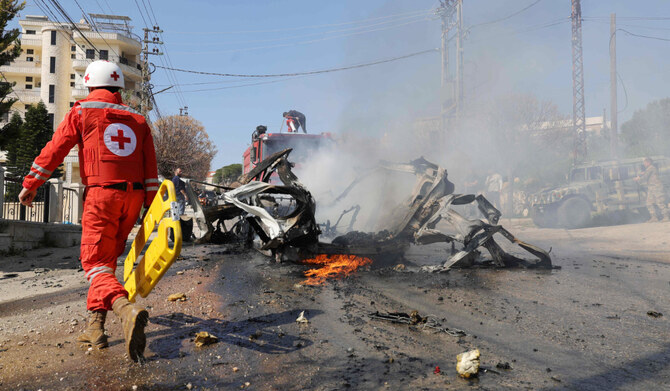

BEIRUT: As Israel resumes heavy strikes in the Gaza Strip, escalating Israeli attacks in south Lebanon have killed five Hezbollah members in the last few days, according to security sources in Lebanon, underlining the fragility of a US-backed ceasefire.
The war between Israel and the Iran-backed Hezbollah in Lebanon marked the deadliest spillover of the Gaza war, rumbling across the frontier for months before escalating into a devastating Israeli offensive that wiped out the group’s command and many of its fighters, along with much of its arsenal.
While the ceasefire brought about a big reduction in the violence, each side accuses the other of failing to fully implement it. Israel says Hezbollah still has infrastructure in the south, while Lebanon and Hezbollah say Israel is occupying Lebanese soil by not withdrawing from five hilltop positions.
The Israeli military has reported striking five Hezbollah members in three separate incidents in south Lebanon since Mar. 15. In one of the incidents on Sunday, the Israeli military said it struck two Hezbollah militants “who served as observation operatives and directed terrorist activities.” Security sources in Lebanon said five Hezbollah members were killed.
The Israeli military said on Sunday that a gunshot hit a parked car in the Israeli community of Avivim, and that the shot most likely came from Lebanon. No one claimed responsibility.
STRIKES DESTROY PREFAB HOUSES
In Lebanon, Israeli strikes in two towns on Monday destroyed prefabricated houses brought to the area for people whose homes were destroyed in the war, security sources said.
Noting an increase in Israeli strikes in recent days, the UNIFIL peacekeeping force in south Lebanon “urges all actors to avoid any action that could upset the current delicate calm,” spokesperson Andrea Tenenti said.
“We continue to urge Israeli forces to fully withdraw south of the Blue Line, and we continue to support the Lebanese Armed Forces in their deployment in the south of Lebanon,” he added.
The Blue Line was drawn by the United Nations in 2000, when Israeli forces withdrew from south Lebanon, and separates the country from Israel and the Israeli-occupied Golan Heights.
The ceasefire agreed in November required Hezbollah to have no weapons in the south and Israeli troops to withdraw as the US-backed Lebanese army deployed into the region.
Israel said earlier this month it had agreed to US-backed talks with Lebanon aimed at demarcating the border. It also released five Lebanese held by the Israeli military in what it called a “gesture to the Lebanese president.”
Hezbollah officials have put the onus on the Lebanese state to liberate the remaining land still occupied by Israel. Still, leading Hezbollah official Ali Damoush said on Friday the group would not give up its arms while there was an occupation.
Analysts say Hezbollah would have to think very hard before taking any decision to escalate against Israel, noting that its overland resupply route to Iran was severed by the fall of its ally Bashar Assad in Syria and that many of its supporters are homeless because of the devastation caused by the war.
“So far, Hezbollah is keen not to respond and to leave the decision to the government and the Lebanese army,” said Qassem Kassir, a Lebanese analyst close to Hezbollah.


