Lebanon says Israeli strikes kill four in south

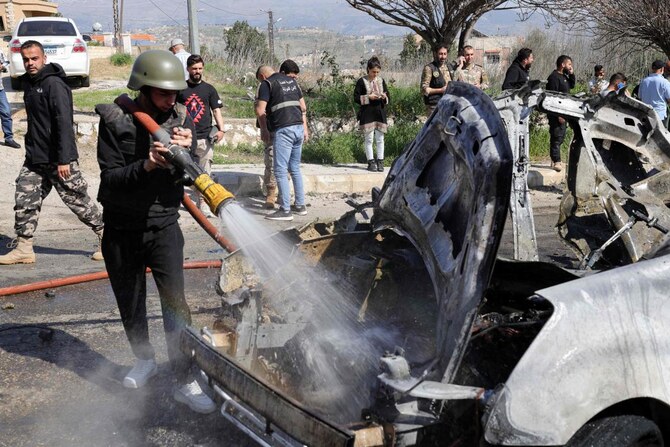
A man douses the flames of a car hit by an Israeli strike in the southern Lebanese village of Burj Al-Muluk on March 15, 2025, in which one person was reportedly killed. (AFP)
Short Url
Updated 16 March 2025
Follow

Lebanon says Israeli strikes kill four in south

  • “The Israeli enemy strike this evening on the town of Ainata led to the death of two people,” NNA said
  • Earlier, health ministry confirmed one person was killed in an Israeli strike on Mais Al-Jabal and NNA reported one other fatality in Bint Jbeil

BEIRUT: Israeli strikes on southern Lebanon killed four people on Sunday, Lebanese state media and the health ministry said, as Israel’s military said it had killed two Hezbollah militants.
“The Israeli enemy strike this evening on the town of Ainata led to the death of two people,” Lebanon’s official National News Agency (NNA) said, citing the health ministry’s emergency service.
Earlier, the health ministry confirmed one person was killed in an Israeli strike on Mais Al-Jabal and NNA reported one other fatality in Bint Jbeil.
The agency reported that an Israeli drone carried out “a strike on a vehicle in the town of Mais Al-Jabal, resulting in one fatality.”
The NNA said it was the third Israeli strike on southern Lebanon within 24 hours.
Earlier on Sunday, the health ministry said an Israeli drone strike killed one person and wounded another when it targeted a four-wheel-drive vehicle near Yater in Bint Jbeil district at around 2:00 am, the NNA reported.
“The Israeli enemy’s air strike on a vehicle in the town of Yater resulted in the martyrdom of a citizen and the injury of another,” the ministry said in a statement carried by the news agency.
Israel’s military said that it killed two Hezbollah militants Sunday in two separate strikes on Lebanon.
“Earlier today, the IDF struck and eliminated two Hezbollah terrorists who were surveillance operatives and took part in directing terror attacks in the area of Yatar and Meiss El Jabal in southern Lebanon,” the military said in a statement.
It comes a day after Lebanon’s health ministry said one person was killed in an Israeli strike on a vehicle in the southern border town of Burj Al-Muluk.
Following that raid, the Israeli military said it “struck a Hezbollah terrorist who took part in terrorist activity in the area of Kfarkela in southern Lebanon.”
And on Tuesday, the Israeli military said it carried out a strike in southern Lebanon that killed a senior Hezbollah militant.
That came as Lebanon received four detainees who had been taken to Israel during fighting with Lebanon’s Iran-backed Hezbollah group, with a fifth detainee, a soldier, released on Thursday after he was taken earlier this month.
A November 27 truce largely halted more than a year of hostilities between Hezbollah and Israel, including two months of full-blown war in which Israel sent in ground troops.
Israel has continued to carry out periodic strikes on Lebanese territory since the agreement took effect.
Israel had been due to withdraw from Lebanon by February 18 after missing a January deadline, but it has kept troops at five locations it deems “strategic.”
The ceasefire also required Hezbollah to pull back north of the Litani River, about 30 kilometers (20 miles) from the border, and to dismantle any remaining military infrastructure in the south.


Palestinian coach gets hope, advice from mum in Gaza tent

Updated 5 sec ago
Follow

Palestinian coach gets hope, advice from mum in Gaza tent

DOHA: Coach Ehab Abu Jazar is guiding a national team that carries on its shoulders all the hopes and sorrows of Palestinian football, but it is his mother, forced by war to live in a Gaza tent, who is his main inspiration and motivation.
The war that broke out following Hamas’s unprecedented attack on Israel on October 7, 2023 put an end to Palestinian league matches, and left athletes in exile fearing for their loved ones in Gaza.
But Abu Jazar’s mother refuses to let the conflict overshadow the sporting dreams of her son, to whom she feeds tactical advice from the rubble of the Palestinian territory by phone.
“She talks to me about nothing but the team. She wants the focus to remain solely on the tournament,” the 45-year-old manager told AFP.
“My mother asks me about the players, who will play as starters and who will be absent, about the tactics, the morale of the players and the circumstances surrounding them.”
The manager, himself a former left-back, says he wants his players to convey the spirit of his mother and Gazans like her.
“We always say that we are a small Palestinian family representing the larger family,” he said.
“Undoubtedly, it puts pressure on us, but it’s positive pressure.”
The Palestinian team are 96th in the FIFA rankings, and their hope of playing in their first World Cup vanished this summer.
But the squad, most of whom have never set foot in Gaza, is within reach of the Arab Cup quarter-finals, keeping their message of resilience alive.
Palestine play Syria in their final Arab Cup group match Sunday, where a draw would be enough to achieve an unprecedented feat for the team.
He said progress would show the world that the Palestinians, if given the right conditions, can “excel in all fields.”

- ‘Genes of resilience’ -

Abu Jazar finished his playing career in 2017 before managing the Palestinian U-23 team and eventually taking the top job last year.
After the war broke out, his family home was destroyed, displacing his mother in Gaza, like most of the territory’s population during the height of the conflict.
He now feels pressure to deliver for them after witnessing from exile the horrors of the war, which came to a halt in October thanks to a fragile US-backed ceasefire.
“At one point, it was a burden, especially at the beginning of the war,” he said.
“We couldn’t comprehend what was happening. But we possess the genes of resilience.
“If we surrender and give in to these matters, we as a people will vanish.”
In her maternal advisory role, Abu Jazar’s mum, who goes by the traditional nickname Umm Ehab, is only contactable when she has power and signal.
But she works around the clock to find a way to watch the team’s matches from Al-Mawasi camp.
“My mother and siblings... struggle greatly to watch our matches on television. They think about how to manage the generator and buy fuel to run it and connect it to the TV,” he said.
This determination is pushing him to give Gazans any respite from the reality of war.
“This is what keeps us standing, and gives us the motivation to bring joy to our people,” he said.
“All these circumstances push us to fight on the field until the last breath.”