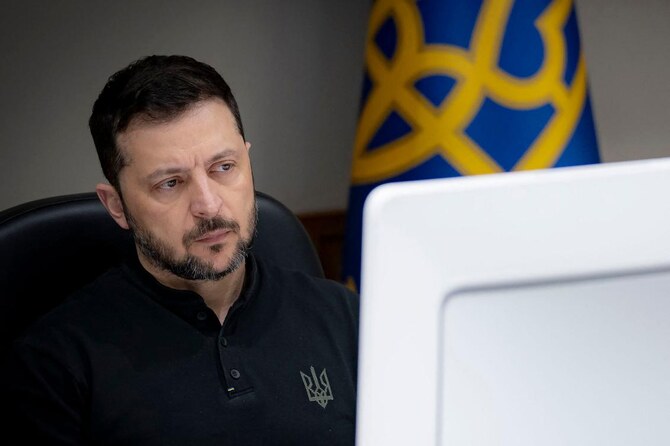
Ukraine’s Zelensky arrives in Finland, will meet defense industry

Ukraine’s President Volodymyr Zelensky has arrived in Helsinki ahead of an official visit to Finland on Wednesday, the office of Finnish President Alexander Stubb said on Tuesday. (AFP)
Short Url
Updated 18 March 2025
Follow

Ukraine’s Zelensky arrives in Finland, will meet defense industry

  • The two presidents will discuss Finland’s support for Ukraine
  • Finland’s finance, defense and foreign ministers will participate in Wednesday’s meeting

HELSINKI: Ukraine’s President Volodymyr Zelensky has arrived in Helsinki ahead of an official visit to Finland on Wednesday, the office of Finnish President Alexander Stubb said on Tuesday.
The two presidents will discuss Finland’s support for Ukraine, including steps to end Russia’s war, and meet with defense industry companies, it added.
The announcement comes as US President Donald Trump started a phone call with Russian President Vladimir Putin in a bid to secure a ceasefire in Russia’s war with Ukraine and move toward a more permanent end to the three-year conflict.
Finland’s finance, defense and foreign ministers will participate in Wednesday’s presidential palace meeting, and Zelensky will also meet with Prime Minister Petteri Orpo and parliament speaker Jussi Halla-aho, Finland said.
During his second visit to Finland since Russia’s 2022 invasion of Ukraine, Zelensky is accompanied by his wife Olena Zelenska who will visit local schools with Stubb’s wife Suzanne Innes-Stubb, the Finnish statement said.


Palestine Action hunger strikers launch legal action against UK govt

Updated 23 December 2025
Follow

Palestine Action hunger strikers launch legal action against UK govt

  • They accuse authorities of abandoning prison safety policies
  • Several of the imprisoned activists have been hospitalized

LONDON: Hunger strikers from Palestine Action in the UK have launched legal action against the government, accusing it of abandoning the policy framework for prison safety, The Independent reported.

A pre-action letter was sent to Justice Secretary David Lammy by a legal firm representing the activists.

It came as several imprisoned members of the banned organization — including one who has refused food for 51 days — were hospitalized due to their deteriorating health while on hunger strike.

They say they have sent several letters to Lammy, who is also deputy prime minister, but have received no response.

He was urged in the latest letter to respond within 24 hours as the issue is a “matter of urgency.”

The letter added: “Our clients’ health continues to deteriorate, such that the risk of their dying increases every day.”

An “urgent meeting” is needed “with the proposed defendant to discuss the deterioration of our clients’ health and to discuss attempts to resolve the situation,” it said.

Seven of the Palestine Action prisoners have been admitted to hospital since the hunger strike was launched on Nov. 2, including 30-year-old Amu Gib and Kamran Ahmed, 28.

They are being held in prisons across the country. Two members of the group have been forced to end their hunger strike due to health conditions: Jon Cink, 25, ended on day 41, while 22-year-old Umer Khalid finished on day 13.

Gib, now on day 51, was hospitalized last week and reportedly needs a wheelchair due to health concerns.

Dr. James Smith, an emergency physician, warned journalists last Thursday that some of the imprisoned activists “are dying” and need specialized medical care.

In a letter signed by more than 800 doctors, Smith said the hunger strikers were at “very high risk of serious complications, including organ failure, irreversible neurological damage, cardiac arrhythmias and death.”

The strikers are demanding that Palestine Action, which is classified as a terrorist organization, be de-proscribed.

They are also urging the government to shut down defense companies with ties to Israel, among other demands.

In response to the latest letter, a Ministry of Justice spokesperson said: “We strongly refute these claims. We want these prisoners to accept support and get better, and we will not create perverse incentives that would encourage more people to put themselves at risk through hunger strikes.”