

Netanyahu coalition jeopardized over ultra-Orthodox exemption from army

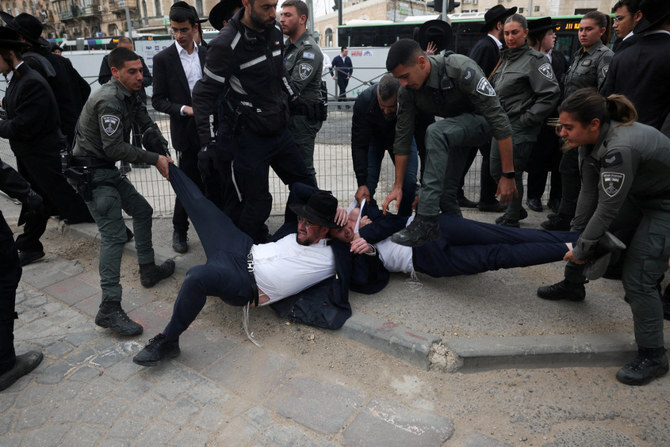
One of Israel’s most divisive domestic issues has reared itself again to challenge Prime Minister Benjamin Netanyahu, after a group in the ruling coalition said it would bring the government down unless it exempts ultra-Orthodox Jews from army service. (Reuters/File)
Short Url
Updated 18 March 2025
Follow

Netanyahu coalition jeopardized over ultra-Orthodox exemption from army

  • The government must pass the budget by the end of the month or call snap elections
  • United Torah Judaism holds seven seats in the Knesset, Israel’s parliament

BNEI BRAK, Israel: One of Israel’s most divisive domestic issues has reared itself again to challenge Prime Minister Benjamin Netanyahu, after a group in the ruling coalition said it would bring the government down unless it exempts ultra-Orthodox Jews from army service.
Some members of United Torah Judaism, one of two ultra-Orthodox Jewish parties in the coalition, said in a letter that they would vote against the budget if the government did not pass a new law formalising exemptions for religious students.
“If this matter is once again sidelined or delayed for any reason, we will not be able to continue as partners in the coalition,” said the March 6 letter signed by Housing Minister and party chairman Yitzhak Goldknopf and two others.
The government must pass the budget by the end of the month or call snap elections. United Torah Judaism holds seven seats in the Knesset, Israel’s parliament.
It is too early to predict the consequences. Netanyahu, Israel’s longest-serving prime minister, is a proven master at smoothing over disagreements in his coalitions. An ultra-nationalist group that quit the government over the ceasefire in Gaza in January announced on Tuesday it was returning.
But pollster Mitchell Barak, who worked for Netanyahu in the 1990s, said this time ultra-Orthodox politicians appeared unwilling to compromise, and the prime minister might have to look outside the coalition for support to pass the budget, an extraordinary step.
“He’s going to look for someone who can compromise, save him, and be that ‘freyer’,” he said, speaking before the ultra-nationalists announced their return to the coalition and using a Yiddish word for someone who lets others take advantage of him. “That’s how he operates.”
The prime minister’s office declined to comment on the ultra-Orthodox ultimatum and whether he believed the budget could pass without their support.

MILITARY STRAINED
In Israel, military service is mandatory at age 18, after which Israelis become reservists liable to be called up for training or deployment.
But dating back to Israel’s founding in 1948 it made an exemption for ultra-Orthodox communities, known as Haredim, whose young men mainly dedicate their lives to studying religious texts in academies known as yeshivot.
Those communities were initially small but have grown rapidly in the following decades. According to government data, there are now 1.4 million Haredim, accounting for about 14 percent of the population, deepening resentment among other Israelis who are conscripted.
In 2017, the Supreme Court ruled that the exemption was unconstitutional, and last year it ordered the military to conscript yeshiva students. Legal experts say the only way to restore the exemption would be to pass a new law enshrining it.
Members of the Haredi community say they would resist any attempt to conscript their children.
“They can put us in prison,” said Yehoshua Menuchin at his home in Bnei Brak, a densely populated city close to Tel Aviv where many Haredim live.
Menuchin, who has a 19-year-old son who is not serving, said the debate was driven by politics, rather than by genuine military need.
“If it’s a matter of survival, like an Arab invasion, then the Haredim will be the first to volunteer in order to save lives. But as long as it is political, it won’t ever happen.”
But 18 months into war in Gaza and major military operations in the West Bank and Lebanon, resentment is growing, and many lawmakers say the exemption is unjustifiable.
“They don’t know what 30 days of reserve duty a year is, and they don’t know what it is to dread that knock on the door,” centrist opposition lawmaker Elazar Stern, a former general, told Reuters, referring to the moment a parent learns of a child’s death in service.

DIVINE INTERVENTION
The Haredim live in insular neighborhoods centered around strict religious observance, with their own schools that largely eschew math and science. They have twice as many children as the national average, rely heavily on state welfare and charity, and those who work are often in low-paying jobs.
They believe that sending their children to the military is an existential threat, fearing that exposure to secular Israelis and outside influences could undermine their way of life.
“I know one thing: we must go the way the Torah instructs us,” said Meir Zvi Bergman, one of Israel’s most widely followed Haredi rabbis. “God does not want us to go, so we won’t go.”
The army says it is working to create conditions to make it easier for more Haredim to serve, such as dedicated battalions with strict religious practices, including regular prayer and gender segregation.
“The responsibility to defend the country must be shared fairly,” Eyal Zamir, Israel’s new chief of the military staff, said in a speech this month taking up his post. (Reporting by Alexander Cornwell, additional reporting by Maayan Lubell and Steven Scheer)


Lebanon approves financial gap draft law despite opposition from Hezbollah and Lebanese Forces

Lebanon's Prime Minister Nawaf Salam speaking during a press conference after a cabinet session in Beirut on December 26, 2025.
Updated 21 min 28 sec ago
Follow

Lebanon approves financial gap draft law despite opposition from Hezbollah and Lebanese Forces

  • Legislation aims to address the fate of billions of dollars in deposits that have been inaccessible to Lebanese citizens during the country’s financial meltdown

BEIRUT: Lebanon’s Cabinet on Friday approved a controversial draft law to regulate financial recovery and return frozen bank deposits to citizens. The move is seen as a key step in long-delayed economic reforms demanded by the International Monetary Fund.

The decision, which passed with 13 ministers voting in favor and nine against, came after marathon discussions over the so-called “financial gap” or deposit recovery bill, stalled for years since the banking crisis erupted in 2019. The ministers of culture and foreign affairs were absent from the session.

The legislation aims to address the fate of billions of dollars in deposits that have been inaccessible to Lebanese citizens during the country’s financial meltdown.

The vote was opposed by three ministers from the Lebanese Forces Party, three ministers from Hezbollah and the Amal Movement, as well as the minister of youth and sports, Nora Bayrakdarian, the minister of communications, Charles Al-Hajj, and the minister of justice, Adel Nassar.

Finance Minister Yassin Jaber broke ranks with his Hezbollah and Amal allies, voting in favor of the bill. He described his decision as being in line with “Lebanon’s supreme financial interest and its obligations to the IMF and the international community.”

The draft law triggered fierce backlash from depositors who reject any suggestion they shoulder responsibility for the financial collapse. It has also drawn strong criticism from the Association of Banks and parliamentary blocs, fueling fears the law will face intense political wrangling in Parliament ahead of elections scheduled in six months.

Prime Minister Nawaf Salam confirmed the Cabinet had approved the bill and referred it to Parliament for debate and amendments before final ratification. Addressing public concerns, he emphasized that the law includes provisions for forensic auditing and accountability.

“Depositors with accounts under $100,000 will be repaid in full with interest and without any deductions,” Salam said. “Large depositors will also receive their first $100,000 in full, and the remainder will be issued as negotiable bonds backed by the assets of the Central Bank, valued at around $50 billion.”

He said further that bondholders will receive an initial 2 percent payout after the first tranche of repayments is completed.

The law also includes a clause requiring criminal accountability. “Anyone who smuggled funds abroad or benefited from unjustified profits will be fined 30 percent,” Salam said.

He emphasized that Lebanon’s gold reserves will remain untouched. “A clear provision reaffirms the 1986 law barring the sale or mortgaging of gold without parliamentary approval,” he said, dismissing speculation about using the reserves to cover financial losses.

Salam admitted that the law was not perfect but called it “a fair step toward restoring rights.”

“The banking sector’s credibility has been severely damaged. This law aims to revive it by valuing assets, recapitalizing banks, and ending Lebanon’s dangerous reliance on a cash economy,” he said. “Each day of delay further erodes people’s rights.”

While the Association of Banks did not release an immediate response after the vote, it previously argued during discussions that the law would destroy remaining deposits. Bank representatives said lenders would struggle to secure more than $20 billion to cover the initial repayment tier and accused the state of absolving itself of responsibility while effectively granting amnesty for decades of financial mismanagement and corruption.

The law’s fate now rests with Parliament, where political competition ahead of the 2025 elections could complicate or delay its passage.

Lebanon’s banking sector has been at the heart of the country’s economic collapse, with informal capital controls locking depositors out of their savings and trust in state institutions plunging. International donors, including the IMF, have made reforms to the sector a key condition for any financial assistance.