

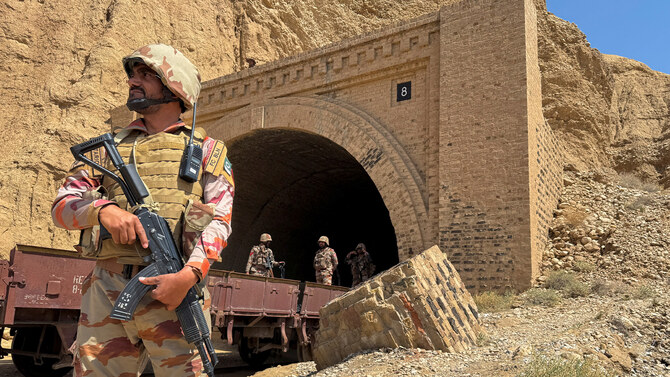

QUETTA: Residents of Quetta, the capital of Pakistan’s southwestern Balochistan province, expressed concerns about safety this week and many opted not to go out for Ramadan and Eid shopping amid heightened security following a string of deadly separatist attacks.
The Balochistan Liberation Army claimed responsibility for a deadly attack in Nushki district on Sunday, where a vehicle laden with explosives was driven into a paramilitary convoy, killing at least five and wounding over 30.
The attack comes just days after the BLA hijacked the Jaffar Express train in Balochistan on March 11, blowing up train tracks in an attack that killed 31 soldiers and civilians, the military said. The BLA is the largest and strongest of several ethnic Baloch insurgent groups which have been fighting for decades to win independence for the mineral-rich province, home to major China-led projects including a port and gold and copper mines.
In the background of the latest attacks, Quetta residents said they were opting to stay indoors rather than venturing out for Ramadan Eid shopping, citing persistent fears of terrorism and violence, according to local resident Navid Khan.
“During Ramadan’s Eid shopping season, many people still have pending purchases, but the deteriorating law and order situation has made it daunting to venture out.” Khan said. “Fear of terrorism incidents, target killings, and other violent acts persist, despite active security measures. As a result, we feel safer staying indoors, rather than risking our safety outside.”
The city of Quetta remains on high alert, with multiple checkpoints established and a heavy deployment of security personnel. The Zehri Flyover, situated behind Quetta Cantonment, has been closed until further notice due to security concerns.
A Balochistan provincial assembly member, Zmarak Khan Achakzai, warned that the region’s situation was spiraling out of control, urging the federal government to safeguard citizens’ rights and provide access to resources, equal rights, and job opportunities to prevent desperation-driven extremism.
“It’s a two-way street — the people must accept the state, and the state must acknowledge and empower its people,” the MP said.
“But unfortunately, employment is scarce, leaving our educated youth with no prospects. With borders tightly controlled, those living on the border are struggling to survive, unable to feed their children,” Achakzai added.
“What options do they have? They’ll turn to drugs, crime, or fall prey to anti-state elements and enemies of the country. We urge you to focus on Balochistan, home to 15 million people, nearly 6 percent of Pakistan’s population. What is it that we lack? What can’t we handle?“
Pakistan’s parliamentary committee on national security is set to convene an in-camera meeting today, Tuesday, where the military leadership will brief lawmakers on the country’s current security situation.


