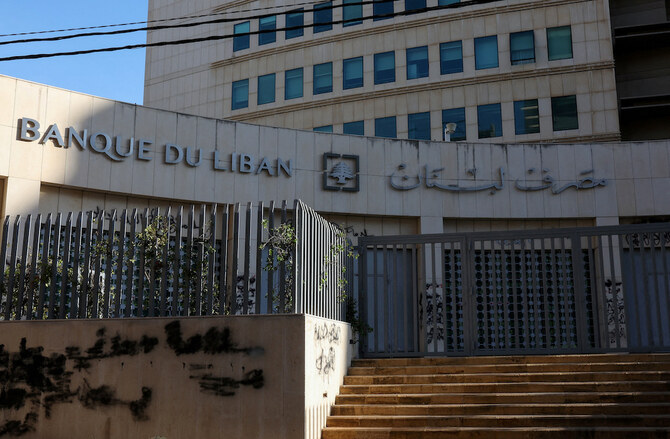
BEIRUT/WASHINGTON: The US is weighing in with Lebanon’s government on the selection of the country’s next central bank governor in a bid to curtail corruption and illicit financing for armed group Hezbollah through Lebanon’s banking system, five sources familiar with the issue said.
Washington’s feedback on the candidates for the top role in shaping Lebanon’s monetary policy is the latest example of the US’ unusually hands-on approach to the Middle Eastern country, where a more than five-year financial crisis has collapsed the economy.
It also demonstrates the US’ continued focus on weakening Hezbollah, the Iran-backed group whose sway over the Lebanese government has been reduced after the group was pummelled by Israel in last year’s war.
Since then, Lebanon has elected US-backed Joseph Aoun as president, and a new cabinet without a direct role for Hezbollah has taken power. That government must now fill vacant posts — including at the central bank, run by an interim governor since July 2023.
The US is reviewing the profiles of a handful of candidates for the role, according to three Lebanese sources briefed on the issue, one Western diplomat and an official from US President Donald Trump’s administration.
The sources spoke to Reuters on condition of anonymity to discuss Washington’s role in the selection process, the details of which have not been previously reported.
US officials met with some potential candidates in Washington and at the US embassy in Lebanon, two of the Lebanese sources and the Trump administration official said.
The Lebanese sources, who were briefed on the meetings, said the US officials asked candidates questions, including how they would fight “terrorist financing” through Lebanon’s banking system and if they were willing to confront Hezbollah.
The State Department, White House and the offices of Lebanon’s president and prime minister did not immediately respond to requests for comment.
The Trump administration official said the meetings were part of “normal diplomacy” — but said the US was making its guidance on candidates’ qualifications clear to the Lebanese government.
“The guidelines are, no Hezbollah and nobody who has been caught up in corruption. This is essential from an economic perspective,” the official told Reuters.
“You need somebody who is going to implement reform, demand reform, and refuse to look the other way whenever people try to do business as usual in Lebanon,” the official said.
MAJOR ROLE IN REFORM
The Lebanese sources said the candidates being seriously considered included former minister Camille Abousleiman, Firas Abi-Nassif, head of an investment firm, and Philippe Jabre and Karim Souaid, both heads of their own asset management firms.
The next governor will play a major part in any economic and financial reforms, which Aoun and Prime Minister Nawaf Salam have pledged to prioritize to help Lebanon emerge from a devastating financial meltdown that began in 2019.
Triggered by widespread corruption and profligate spending by the governing political elite, the economic crisis impoverished most Lebanese, demolished the Lebanese pound and brought the banking system to a standstill. Lebanon’s new government is looking to resume talks with the International Monetary Fund for a financing program, but the reforms remain a prerequisite. Western and Arab countries have also set reforms as a condition to provide any reconstruction support to Lebanon, large swathes of which were left in ruins by Israel’s military campaign last year.
In that vein, US officials were discussing the candidates for central bank governor with Saudi Arabia, according to the Western diplomat and the Trump administration official.
The Saudi government’s media office did not immediately respond to a request for comment.
The incoming governor would replace interim chief Wassim Mansouri, who has been overseeing the bank since the 30-year tenure of longtime head Riad Salameh ended in disgrace in 2023.
Through most of his time as central bank chief, Salameh was feted as a financial wizard and enjoyed the backing of the US, which has a keen interest in the position because it oversees Lebanon’s broader banking system and helps keep it compliant with US laws preventing the financing of groups designated as “terrorist” factions, including Hezbollah.
But Lebanon’s financial collapse tainted Salameh’s legacy. A month after he left office in 2023, Salameh was sanctioned by the United States, Britain and Canada, which accused him of corrupt actions to enrich himself and his associates, and is facing charges of financial crimes in Lebanon and broad. Last year, Lebanon was placed on a financial watchdog’s “grey list” after failing to address concerns about terrorism financing and money laundering through its financial system.


US weighing in on Lebanon’s next central bank chief, sources say
https://arab.news/myzbd
US weighing in on Lebanon’s next central bank chief, sources say

- US aims to curb Hezbollah’s influence in Lebanon’s banking
- Candidates include Camille Abousleiman, Firas Abi-Nassif, Philippe Jabre


Multilateralism strained, but global cooperation adapting: WEF report
DUBAI: Overall levels of international cooperation have held steady in recent years, with smaller and more innovative partnerships emerging, often at regional and cross-regional levels, according to a World Economic Forum report.
The third edition of the Global Cooperation Barometer was launched on Thursday, ahead of the WEF’s annual meeting in Davos from Jan. 19 to 23.
“The takeaway of the Global Cooperation Barometer is that while multilateralism is under real strain, cooperation is not ending, it is adapting,” Ariel Kastner, head of geopolitical agenda and communications at WEF, told Arab News.
Developed alongside McKinsey & Company, the report uses 41 metrics to track global cooperation in five areas: Trade and capital; innovation and technology; climate and natural capital; health and wellness; and peace and security.
The pace of cooperation differs across sectors, with peace and security seeing the largest decline. Cooperation weakened across every tracked metric as conflicts intensified, military spending rose and multilateral mechanisms struggled to contain crises.
By contrast, climate and nature, alongside innovation and technology, recorded the strongest increases.
Rising finance flows and global supply chains supported record deployment of clean technologies, even as progress remained insufficient to meet global targets.
Despite tighter controls, cross-border data flows, IT services and digital connectivity continued to expand, underscoring the resilience of technology cooperation amid increasing restrictions.
The report found that collaboration in critical technologies is increasingly being channeled through smaller, aligned groupings rather than broad multilateral frameworks.
This reflects a broader shift, Kastner said, highlighting the trend toward “pragmatic forms of collaboration — at the regional level or among smaller groups of countries — that advance both shared priorities and national interests.”
“In the Gulf, for example, partnerships and investments with Asia, Europe and Africa in areas such as energy, technology and infrastructure, illustrate how focused collaboration can deliver results despite broader, global headwinds,” he said.
Meanwhile, health and wellness and trade and capital remained flat.
Health outcomes have so far held up following the pandemic, but sharp declines in development assistance are placing growing strain on lower- and middle-income countries.
In trade, cooperation remained above pre-pandemic levels, with goods volumes continuing to grow, albeit at a slower pace than the global economy, while services and selected capital flows showed stronger momentum.
The report also highlights the growing role of smaller, trade-dependent economies in sustaining global cooperation through initiatives such as the Future of Investment and Trade Partnership, launched in September 2025 by the UAE, New Zealand, Singapore and Switzerland.
Looking ahead, maintaining open channels of communication will be critical, Kastner said.
“Crucially, the building block of cooperation in today’s more uncertain era is dialogue — parties can only identify areas of common ground by speaking with one another.”