

Terrified Tigrayans seek to flee renewed tensions in north Ethiopia

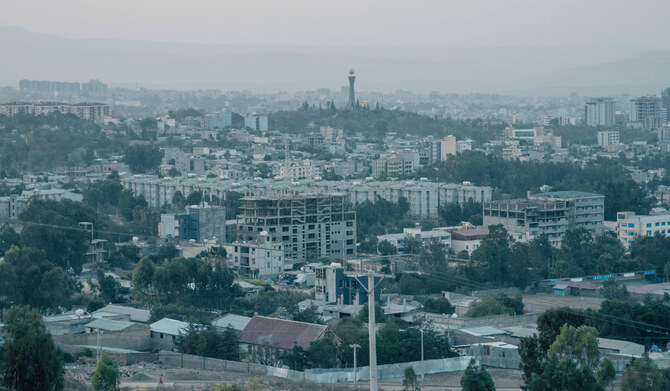
This photograh taken on May 24, 2024 shows a general view of the city of Mekele, capital of Ethiopia's region of Tigray. (AFP)
Short Url
Updated 16 March 2025
Follow

Terrified Tigrayans seek to flee renewed tensions in north Ethiopia

  • “A war between Ethiopia and Eritrea could break out at any moment,” said General Tsadkan Gebretensae, senior strategist for the Tigray forces in Getachew’s administration, in remarks published this week

ADDIS ABABA: Residents sought to flee mounting tensions in the Tigray region of Ethiopia as a political faction confirmed they had seized control of the town hall in the state capital Mekele.
Ethiopia’s most northerly state, which borders Eritrea, saw a devastating conflict between Tigrayan rebels and the federal government in 2020-22, which claimed up to 600,000 lives, according to some estimates.
The tensions come from an internal power struggle within Tigray between Getachew Reda, head of the state’s regional administration, and Debretsion Gebremichael, head of the dominant local party, the Tigray People’s Liberation Front.
“People are in terror that if armed conflict breaks out, it will be worse than the war they endured,” said Solomon Hagos, a university lecturer in Mekele, who asked for one of his names to be changed for security reasons.
Another resident said people were trying to flee.
“We were trapped in Mekele during the previous war, we do not want that to happen again,” said Mihret, 27, who only gave one name.
“We are trying to leave the region, and we went to the airport, but all the flights are full. We are looking for ways to leave the region; we are afraid,” he added.
Debretsion’s faction seized control of Mekele’s town hall on Thursday to reinstate its chosen mayor and the local radio station.
A spokesman for Debretsion said: “The previous elected mayor was fired by Getachew, which was not legal. So now the previous one has been put back in place.”
Armed supporters of Debretsion also took over the municipality in Adigrat, Tigray’s second-largest town near the Eritrean border, ousting the mayor appointed by Getachew.
“We are afraid of a new siege, of a civil war between Tigrayans,” said Mehari Gebremariam, a civil servant in Adigrat.
The tensions threaten to draw in Eritrea, which has a history of war with Ethiopia, adding another layer of fear among locals.
A war between Ethiopia and Eritrea in 1998-2000 resulted in tens of thousands of deaths.
Ethiopia’s Prime Minister Abiy Ahmed was lauded for finally reaching a peace agreement with Eritrea when he came to power in 2018 and won the Nobel Peace Prize.
But relations have soured since the end of the Tigray conflict in 2022.
Eritrea claimed in February that Ethiopia was waging an “intense campaign” against it.
A security source told AFP on condition of anonymity that armed Ethiopian convoys were heading toward the region of Afar, which borders Eritrea, in recent days.
“A war between Ethiopia and Eritrea could break out at any moment,” said General Tsadkan Gebretensae, senior strategist for the Tigray forces in Getachew’s administration, in remarks published this week.
The tensions have led to panic in Mekele.
“People are currently rushing to withdraw from banks because they fear the political tensions could lead to a suspension of basic services,” Hagos told AFP, adding that he had stocked up on food for fear of coming inflation.
He said locals could not cope with the idea of another war.
“Our people are exhausted. Our economy is devastated,” he said.


UN’s top court opens Myanmar Rohingya genocide case

Updated 14 min 8 sec ago
Follow

UN’s top court opens Myanmar Rohingya genocide case

  • The Gambia filed a case against Myanmar at the UN’s top court in 2019
  • Verdict expected to impact Israel’s genocide case over war on Gaza

DHAKA: The International Court of Justice on Monday opened a landmark case accusing Myanmar of genocide against its mostly Muslim Rohingya minority.

The Gambia filed a case against Myanmar at the UN’s top court in 2019, two years after a military offensive forced hundreds of thousands of Rohingya from their homes into neighboring Bangladesh.

The hearings will last three weeks and conclude on Jan. 29.

“The ICJ must secure justice for the persecuted Rohingya. This process should not take much longer, as we all know that justice delayed is justice denied,” said Asma Begum, who has been living in the Kutupalong refugee camp in Bangladesh’s Cox’s Bazar district since 2017.

A mostly Muslim ethnic minority, the Rohingya have lived for centuries in Myanmar’s western Rakhine state but were stripped of their citizenship in the 1980s and have faced systemic persecution ever since.

In 2017 alone, some 750,000 of them fled military atrocities and crossed to Bangladesh, in what the UN has called a textbook case of ethnic cleansing by Myanmar.

Today, about 1.3 million Rohingya shelter in 33 camps in Cox’s Bazar, turning the coastal district into the world’s largest refugee settlement.

“We experienced horrific acts such as arson, killings and rape in 2017, and fled to Bangladesh,” Begum told Arab News.

“I believe the ICJ verdict will pave the way for our repatriation to our homeland. The world should not forget us.”

A UN fact-finding mission has concluded that the Myanmar 2017 offensive included “genocidal acts” — an accusation rejected by Myanmar, which said it was a “clearance operation” against militants.

Now, there is hope for justice and a new future for those who have been displaced for years.

“We also have the right to live with dignity. I want to return to my homeland and live the rest of my life in my ancestral land. My children will reconnect with their roots and be able to build their own future,” said Syed Ahmed, who fled Myanmar in 2017 and has since been raising his four children in the Kutupalong camp.

“Despite the delay, I am optimistic that the perpetrators will be held accountable through the ICJ verdict. It will set a strong precedent for the world.”

The Myanmar trial is the first genocide case in more than a decade to be taken up by the ICJ. The outcome will also impact the genocide case that Israel is facing over its war on Gaza.

“The momentum of this case at the ICJ will send a strong message to all those (places) around the world where crimes against humanity have been committed,” Nur Khan, a Bangladeshi lawyer and human rights activist, told Arab News.

“The ICJ will play a significant role in ensuring justice regarding accusations of genocide in other parts of the world, such as the genocide and crimes against humanity committed by Israel against the people of Gaza.”