Pakistan Navy launches second Hangor-class submarine in China to boost maritime defense

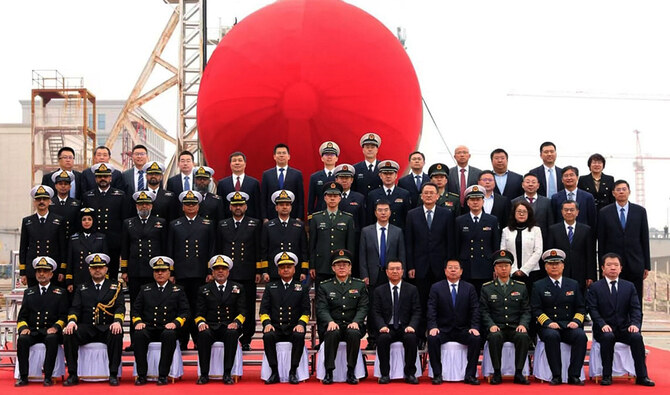
In this handout photo, released by Pakistan Navy on March 15, 2025, Pakistan’s Vice Chief of the Naval Staff Vice Admiral Ovais Ahmed Bilgrami gestures for a group photography with officials from Pakistan Navy and China Shipyard during the launching ceremony of second HANGOR Class Submarine at Wuhan, China. (Handout/Pakistan Navy)
Short Url
Updated 15 March 2025
Follow

Pakistan Navy launches second Hangor-class submarine in China to boost maritime defense

  • Equipped with advanced weapons and sensors, the submarine will strengthen Pakistan’s deterrence capabilities
  • The deal with the Chinese company will get Pakistan six more submarines with technology transfer agreement

ISLAMABAD: The Pakistan Navy launched its second Hangor-class submarine, PNS/M Shushuk, at a ceremony in Wuhan, China, as part of a strategic initiative to bolster its maritime defense capabilities, according to an official statement on Saturday.
The country’s defense ministry signed an agreement with China Shipbuilding and Offshore International Company during Chinese President Xi Jinping’s visit to Pakistan in 2015 to acquire eight of these submarines. Under the deal, four submarines are being built in China, while the remaining four will be constructed at Karachi Shipyard and Engineering Works under a transfer of technology program.
Equipped with state-of-the-art weapons and sensors, these submarines are expected to enhance Pakistan’s naval capabilities by enabling precision strikes at standoff ranges.
Pakistan’s Vice Chief of the Naval Staff, Ovais Ahmed Bilgrami, attended the ceremony as the chief guest.
“While addressing the ceremony, the Vice Chief of the Naval Staff highlighted the importance of maritime security in the prevailing geo-strategic environment of the region, as well as Pakistan Navy’s commitment to safeguarding national interests and ensuring a safe and conducive maritime environment for all,” the official statement circulated by the Directorate General of Public Relations of Pakistan Navy said.
“He emphasized that Hangor-class submarines, equipped with state-of-the-art weapons and sensors, will play a pivotal role in maintaining the balance of power and maritime order in the region,” it added.
Pakistan’s deal with the Chinese company is expected to enhance its naval defense in the Indian Ocean region by equipping its fleet with stealth-capable submarines designed for low acoustic signatures, making them harder to detect.
These advanced vessels also aim to strengthen the country’s deterrence capabilities while reinforcing Pakistan-China military ties through strategic defense collaboration.
Beyond the Hangor-class project, Pakistan is enhancing its naval capabilities through collaborations with other nations.
In 2018, the country signed a contract with Turkiye for the construction of four MILGEM-class corvettes.
Additionally, a Turkish company was also engaged to upgrade Pakistan’s Agosta 90B-class submarines.


UNGA adopts Pakistan-sponsored resolution focusing world attention on Palestine, Kashmir

Updated 9 sec ago
Follow

UNGA adopts Pakistan-sponsored resolution focusing world attention on Palestine, Kashmir

  • The resolution calls on countries to immediately cease foreign military intervention in and occupation of foreign countries and territories
  • Islamabad says the resolution reinforces international attention to the legitimate causes and aspirations of Palestinian, Kashmiri peoples

ISLAMABAD: The United Nations General Assembly (UNGA) has adopted a Pakistan-sponsored resolution on the peoples’ right to self-determination, Pakistan’s UN mission said on Friday, saying it reinforces the world attention to the Palestine and Kashmir issues.

The text, which was adopted by consensus, was recommended last month by the 193-member General Assembly’s Third Committee, which deals with social, humanitarian and cultural issues, according to Pakistani state media.

Co-sponsored by 65 countries, it called on countries to immediately cease foreign military intervention in and occupation of foreign countries and territories as well as acts of “repression, discrimination, and maltreatment.”

The resolution also declared the General Assembly’s firm opposition to acts of foreign military intervention, aggression and occupation, which have resulted in suppression of peoples’ right to self-determination in parts of the world.

“The consensual adoption of the resolution manifests broad international support for the inalienable right of the peoples facing colonialism, alien domination and foreign occupation,” Pakistan’s UN mission said on X. 

“For the people of Indian Illegally Occupied Jammu and Kashmir (IIOJK) and Palestine, the resolution reinforces international attention to their just and legitimate cause and their aspirations for freedom and dignity in accordance with UN Security Council resolutions.”

Pakistan, which does not recognize Israel, supports an independent Palestinian state based on “internationally agreed parameters” and pre-1967 borders, calling for an end to Israeli occupation of the Gaza Strip and the West Bank, including East Jerusalem.

Kashmir, on the other hand, has been divided between Pakistan and India since their independence from British rule in 1947. Both countries claim the Himalayan territory in its entirety but rule it in part and have fought multiple wars over it.

Islamabad has repeatedly urged New Delhi to hold a plebiscite in the disputed territory in line with the United Nations Security Council resolutions.

Ambassador Usman Jadoon, Pakistan’s deputy permanent representative to the UN, this week said the realization of self-determination is not merely a historical aspiration, but an enduring obligation.

“Recent developments in the Middle East demonstrate that lasting peace cannot be achieved through the continued denial and suppression of the legitimate right to self-determination of the Palestinian people,” he said on Thursday.

“Similarly, the UN Security Council has, through several resolutions, recognized the legitimate right of self-determination of the people of Jammu and Kashmir. A just resolution of the Jammu and Kashmir dispute remains central to the establishment of durable peace in South Asia.”