

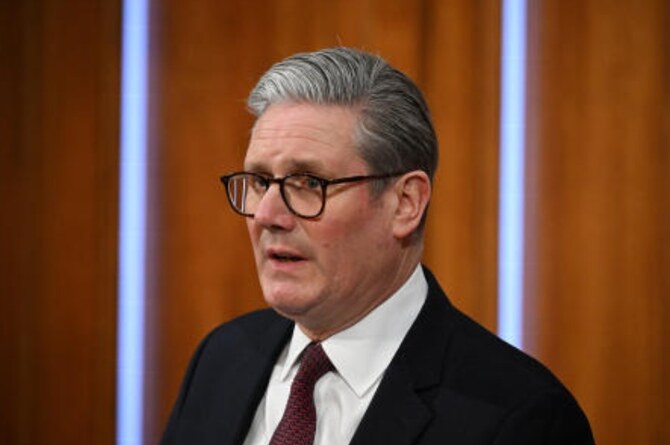

LONDON: UK premier Keir Starmer said the “ball was in Russia’s court” and that President Vladimir Putin would “sooner or later” have to “come to the table,” after a virtual summit on Saturday to drum up support for a coalition willing to protect any eventual ceasefire in Ukraine.
The British prime minister told some 26 fellow leaders as they joined the group call hosted by Downing Street that they should focus on how to strengthen Ukraine, protect any ceasefire and keep up the pressure on Moscow.
While Ukraine had shown it was the “party of peace” by agreeing to a 30-day unconditional ceasefire, “Putin is the one trying to delay,” he said.
“If Putin is serious about peace, I think it’s very simple, he has to stop his barbaric attacks on Ukraine and agree to a ceasefire, and the world is watching,” he added.
Military chiefs will now meet again on Thursday in the UK as the coalition moves into “the operational phase,” Starmer said after the talks.
“The group that met this morning is a bigger group than we had two weeks ago, there is a stronger collective resolve and new commitments were put on the table this morning,” he added.
EU chief European Commission President Ursula von der Leyen said in a message on X that Russia has to show “it is willing to support a ceasefire leading to a just and lasting peace.”
And Dutch Prime Minister Dick Schoof also said on X it was “now important to continue to exert pressure on Russia to come to the negotiating table.”
Overnight fighting continued in the relentless three-year war, with Russia saying it had taken two more villages in its Kursk border region where it has launched an offensive to wrest back seized territory.
As moves have gathered pace for a ceasefire, Moscow has pushed this week to retake a large part of the land that Ukraine originally captured in western Kursk.
But Ukrainian leader Volodymyr Zelensky, who joined the talks, denied Saturday any “encirclement” of his troops in the Kursk region.
“Our troops continue to hold back Russian and North Korean groupings in the Kursk region,” he said on social media.
The Russian defense ministry said troops took control over the villages of Zaoleshenka and Rubanshchina — north and west of the town of Sudzha, the main town that Moscow reclaimed this week.
Kyiv meanwhile said its air force had overnight downed 130 Iranian-made Russian-launched Shahed drones over 14 regions of the country.
Putin has called on embattled Ukrainian troops in Kursk to “surrender,” while his US counterpart Donald Trump urged the Kremlin to spare their lives.
“The Kremlin’s complete disregard for President Trump’s ceasefire proposal only serves to demonstrate that Putin is not serious about peace,” Starmer said late Friday ahead of the call.
Starmer and French President Emmanuel Macron have been leading efforts to assemble a so-called “coalition of the willing” ever since Trump opened direct negotiations with Moscow last month.
They say the group is necessary — along with US support — to provide Ukraine with security guarantees by deterring Putin from violating any ceasefire.
Starmer and Macron have said they are willing to put British and French troops on the ground in Ukraine but it is not clear if other countries are keen on doing the same.
Macron also called on Russia late Friday to accept the proposal for a ceasefire, and stop making statements aimed at “delaying the process.”
The French president also demanded that Moscow stop its “acts of violence” in Ukraine.
Germany on Friday likewise criticized Putin’s response to the US-proposed ceasefire in Ukraine as “at best a delaying tactic.”
US Secretary of State Marco Rubio said Friday he was “cautiously optimistic” about reaching a truce, but acknowledged there was “a lot of work that remains to be done.”
Starmer has said he welcomes any offer of support for the coalition, raising the prospect that some countries could contribute logistics or surveillance.
But Italian Prime Minister Giorgia Meloni reiterated after the call, which she joined, that Italy’s “participation in a possible military force on the ground is not envisaged.”
British Commonwealth partners Canada, Australia and New Zealand have been involved in early talks and dialled into the summit.
NATO chief Mark Rutte and European Union chiefs von der Leyen and Antonio Costa also took part, along with the leaders of Germany, Spain, Portugal, Latvia, Romania, Turkiye and the Czech Republic among others.


