

Ghosts of fast fashion: Has colonialism ruined Bangladesh’s luxury fabric trade?

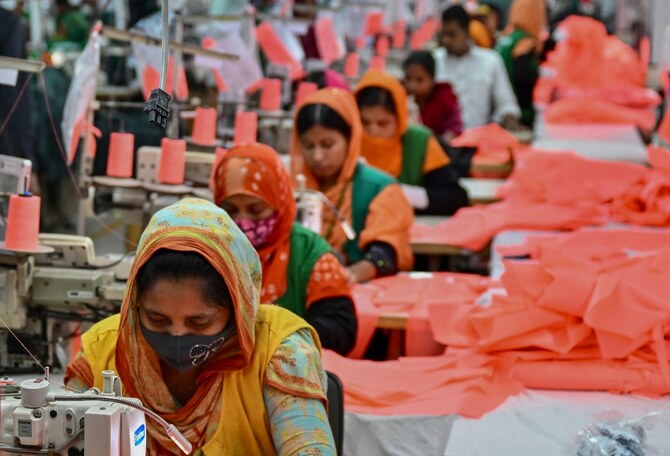
This photograph taken on Dec. 29, 2024, shows garment workers sewing clothes at a textile factory in Dhamrai, a sub-district in Dhaka. (AFP)
Short Url
Updated 15 March 2025
Follow

Ghosts of fast fashion: Has colonialism ruined Bangladesh’s luxury fabric trade?

  • Dhaka was the global center of muslin and fine handloom weaving until British colonial rule
  • Top model and designer Bibi Russell spearheads a movement to revive Bangladeshi textile art

DHAKA: Now a hub of cheap, mass-produced clothing for global brands, Bangladesh was for centuries known as the opposite — a center of coveted luxury textiles. The European appeal of these fine fabrics in the late 18th century marked the beginning of the industry’s decline, ultimately leading to its eventual erasure.

Historically, eastern Bengal — now Bangladesh — was renowned for its master weavers of silk and cotton textiles and particularly for muslin, a lightweight fabric crafted from extremely fine handspun yarns.

Dhaka became the center of muslin weaving in the early 17th century when the fabric became popular on the Indian subcontinent under the Mughal Empire. It dominated the global market for 200 years.

“Dhaka muslin was a symbol of tradition and royal nobility in this land. It was celebrated for its magnificent design and exceptional craftsmanship, earning worldwide acclaim. So fine was its weaving that an entire muslin sari could easily pass through a finger ring,” said Mohammad Ayub Ali, head of the muslin revival project at the Bangladesh Handloom Board, which works to preserve classical Bengali weaving techniques.

“Traders from various European countries, including England, the Netherlands, Portugal and Greece, were actively engaged in the muslin trade.”

This flourishing market was, however, soon overshadowed by colonial influence. Bengal’s textile industry began to wither after the British East India Company conquered the region in the mid-18th century, took control of the industry and exploited it beyond its limits.

In his 1772 work “Considerations on India Affairs,” merchant William Bolts of the British East India Company describes weavers being forcibly taken from their workplaces to produce textiles at English factories. Some resorted to self-mutilation — cutting of their own thumbs — in a desperate attempt to escape forced labor.

Another devastating blow to the native industry came with the tariffs imposed by the British colonial rulers, as England entered the Industrial Revolution and itself began mass-producing fabrics.

“The British rulers suppressed our local cotton producers and muslin weavers to create a favorable market for (their) textiles. Cheap textiles started to pour into our markets ... In the middle of the 19th century, muslin production in Dhaka was completely stopped,” Ali said.

“We were forced to import British clothes ... We once had 100 percent local input in cotton production, weaving and the expertise required to create world-class garments. But now, we only produce ready-made clothing as tailors.”

Bangladesh is the second-largest exporter of ready-made garments in the world, after China, producing large volumes quickly and cheaply. Around 4 million people are employed in factories, where unsafe working conditions, frequent deadly accidents and monthly wages that rarely exceed $120 regularly make headlines in both local and international press.

There is a direct link between the exploitative sector and colonial legacy.

“The colonizers systematically dismantled our thriving artisan economy ... The destruction of that heritage was not just about economics; it was about erasing a culture of excellence and self-reliance,” top Bangladeshi model and celebrated designer Bibi Russell, renowned for her efforts to revive her homeland’s textile art, told Arab News.

“While Bangladesh has become one of the largest exporters of ready-made garments in the world, we must ask ourselves at what cost. The fast fashion industry has created millions of jobs, but it has also perpetuated a system where workers are often undervalued, artisans are sidelined, and our natural resources are exploited. In many ways, it reflects a continuation of the exploitative systems of the past, where the value of human skill and creativity is sacrificed for profit.”



Bibi Russell speaks to Bangladeshi TV in December 2024. (Bibi Russell)

Russell is an advocate of the growing defashion movement, which calls for a shift away from the disposable culture of fast fashion — including its overconsumption, environmental degradation and the exploitation of workers in countries where labor laws and wages are poor.

She believes such a change is possible as the world is waking up and the global fashion landscape is changing, with consumers becoming more conscious of sustainability and ethical practices.

“Bangladesh has an incredible opportunity to lead this change ... Our history shows that we are resilient, and I see an opportunity to reclaim our legacy as a hub of quality and innovation, not just quantity,” she said.

“By investing in our craftspeople and celebrating their work, we can create an industry that uplifts rather than exploits, honors rather than erases ... This is our moment to rewrite the narrative — not as victims of a colonial legacy, but as innovators and creators.”


Two high-speed trains derail in Spain, police sources say 21 people killed

Updated 19 January 2026
Follow

Two high-speed trains derail in Spain, police sources say 21 people killed

  • The accident happened near Adamuz, in Cordoba province. So far, 21 people ​have been confirmed dead by police

MADRID: A high-speed train derailed and smashed into another oncoming train in southern Spain on Sunday, pushing the second train off the tracks in a collision that police sources confirmed to Reuters had killed at least 21 people.
The accident happened near Adamuz, in Cordoba province. So far, 21 people ​have been confirmed dead by police, with state broadcaster Television Espanola adding that 100 people had been injured, 25 seriously. The driver of one of the trains, which was traveling from Madrid to Huelva, was among those who died, the TV station added.
“The Iryo 6189 Malaga — (to Madrid) train has derailed from the track at Adamuz, crashing onto the adjacent track. The (Madrid) to Huelva train which was traveling on the adjacent track has also derailed,” said Adif, which runs the rail network, in a social media post.
Adif said the accident happened at 6:40 p.m. (1740 GMT), about 10 minutes after the Iryo train left Cordoba heading toward Madrid.
Iryo is a private rail operator, majority-owned by Italian state-controlled railway group Ferrovie dello Stato. The train involved was a Freccia 1000 train which was traveling between ‌Malaga and Madrid, ‌a spokesperson for Ferrovie dello Stato said.
The company said in a statement that it ‌deeply ⁠regretted what ​had happened ‌and had activated all emergency protocols to work closely with the relevant authorities to manage the situation.
The second train was operated by Renfe, which also did not respond to a request for comment.
Adif has suspended all rail services between Madrid and Andalusia.

HORRIFIC SCENE
The Iryo train had more than 300 passengers on board, while the Renfe train had around 100.
Paco Carmona, Cordoba fire chief, told TVE the first train heading to Madrid from Malaga had been evacuated.
The other train’s carriages were badly damaged, he said, with twisted metal and seats. “There are still people trapped. We don’t know how many people have died and the operation is concentrating on getting people out of areas which are very narrow,” he ⁠said. “We have to remove the bodies to reach anyone who is still alive. It is proving to be a complicated task.”
Transport Minister Oscar Puente said he was following events ‌from rail operator Adif’s headquarters in Madrid.
“The latest information is very serious,” ‍he posted on X. “The impact was terrible, causing the first two ‍carriages of the Renfe train to be thrown off the track. The number of victims cannot be confirmed at this time. ‍The most important thing now is to help the victims.”
The mayor of Adamuz, Rafael Moreno, told El Pais newspaper that he had been among the first to arrive at the scene of the accident alongside the local police and saw what he believed to be a badly lacerated body several meters from the accident site.
“The scene is horrific,” he said. “I don’t think they were on the same track, but it’s not clear. Now ​the mayors and residents of the area are focused on helping the passengers.”

CALLS FOR MEDICS
Images on local television showed a reception center set up for passengers in the town of Adamuz, population 5,000, with locals coming ⁠and going with food and blankets amid nighttime temperatures of around 42 degrees Fahrenheit (6 degrees Celsius).
A woman named Carmen posted on X that she had been on board the Iryo train to Madrid. “Ten minutes after departing (from Cordoba) the train started to shake a lot, and it derailed from coach 6 behind us. The lights went out.”
Footage posted by another Iryo train passenger, also on X, showed an Iryo staffer in a fluorescent jacket instructing passengers to remain in their seats in the darkened carriages, and those with first aid training to keep watch over fellow passengers. He also urged people to maintain mobile phone batteries to be able to use their torches when they disembarked.
Salvador Jimenez, a journalist for RTVE who was on board the Iryo train, shared images showing the nose of the rear carriage of the train lying on its side, with evacuated passengers sitting on the side of the carriage facing upwards.
Jimenez told TVE by phone from beside the stricken trains that passengers had used emergency hammers to smash the windows and climb out, and they had seen two people taken ‌out of the overturned carriages on stretchers.
“There’s a certain uncertainty about when we’ll get to Madrid, where we’ll spend the night, we’ve had no message from the train company yet,” he said. “It’s very cold but here we are.”