

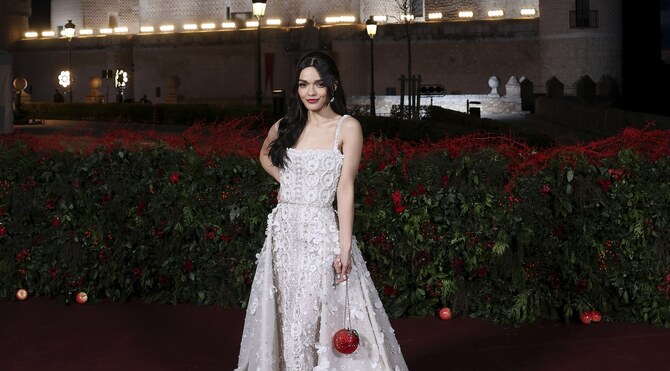
Actress Rachel Zegler stuns in Elie Saab gown

Rachel Zegler wore an ivory-toned creation by Lebanese designer Elie Saab. (Getty Images)
Short Url
Updated 15 March 2025
Follow

Actress Rachel Zegler stuns in Elie Saab gown

DUBAI: Rachel Zegler, star of Disney’s upcoming live-action movie “Snow White,” turned heads at a promotional event in Europe this week when she appeared in a breathtaking creation by Lebanese designer Elie Saab.

Featuring intricate embroidery, delicate beadwork and a regal silhouette, the gown was a testament to Saab’s signature artistry. In soft, ivory-toned fabric, it featured delicate floral appliques and shimmering embellishments, with a structured bodice supported by thin straps. A flowing overskirt cascaded into a train.

The overall aesthetic was of a dreamy, enchanted forest, in line with the Snow White theme.


Featuring intricate embroidery, delicate beadwork and a regal silhouette, the gown was a testament to Saab’s signature artistry. (Getty Images)

The actress carried a red apple-shaped purse, a symbolic nod to the fairytale’s poisoned apple. She also wore silver platform heels and minimal jewelry.

The new “Snow White” is a reimagining of the 1937 animated classic, which was Disney’s first feature-length animated film.

Zegler stars as the titular princess, alongside Gal Gadot as the Evil Queen.

Controversy has plagued the movie since it was first announced. Many activists called for a boycott due to Gadot’s stance over the conflict in Gaza.

An Israeli and former member of the Israel Defense Forces, Gadot has been an outspoken supporter of Israel on social media as well as in a passionate speech on March 4 when she was honored at the Anti-Defamation League’s annual summit in New York City.

“Never did I imagine that on the streets of the United States, and different cities around the world, we would see people not condemning Hamas, but celebrating, justifying and cheering on a massacre of Jews,” she said.

Zegler has repeatedly given interviews and used social media to advocate for a “Free Palestine,” indicating a rift between the two leads.

Meanwhile, some Disney fans have questioned casting Zegler as Snow White as she is a Latina actor. The “West Side Story” star also faced backlash when she called the 1937 original “dated” because the prince “literally stalks Snow White.”

Beyond the world of cinema, Elie Saab has made headlines with the launch of his first eau de parfum for men, called Elie Saab L’Homme.

The woody vetiver scent blends bergamot and pink pepper with a bold heart of vetiver. It deepens with cedarwood, creating a warm long-lasting finish.


Mini op-ed: Why emotional wellbeing is not only an individual concern in Arab societies

Updated 03 February 2026
Follow

Mini op-ed: Why emotional wellbeing is not only an individual concern in Arab societies

ABU DHABI: Across much of the world, emotional wellbeing is now being discussed in similar ways with familiar language: self-care, boundaries, resilience.

These terms have helped people speak more openly about stress and mental health, often for the first time. That matters. But the language also carries an assumption, one that is not always questioned. It suggests that healing begins, and largely takes place, within the individual.

In many Arab societies, that idea does not fully apply. The self is rarely experienced in isolation. Identity forms early through family life, shared responsibility, and social roles that extend beyond personal choice.

Sophie Gregoire Trudeau and Nancy Zabaneh. (Supplied) 

Emotions are often managed in relation to others, not apart from them. This difference has practical consequences, particularly as pressure and uncertainty.

Wellbeing is not just something that happens on a mat or during a six-day retreat, it shows itself in daily life, in our relationships, in how we respond under pressure, and in the choices we make when no one is watching.

That observation runs counter to a global trend that treats emotional health as a private task.

Western approaches have introduced useful tools, including emotional vocabulary, self-reflection, and psychological insight. But when these ideas travel without adaptation, they can overlook the social structures that shape behavior in societies where family and community play a central role.

Healing often begins with the individual in the West. In the East, the sense of self is more closely tied to family, community, and spirituality. Both are powerful — wellbeing lives where self-awareness meets belonging.

In the Gulf, fast economic growth, changing work patterns, and constant digital connection have altered how people live and relate to one another. Traditional support systems still play an important role, but they are under pressure.

At the same time, imported wellness language can feel out of place when it prioritizes inward focus over shared responsibility.

In this region, community and compassion belong together and remain a source of balance and meaning. Emotional awareness, in this setting, is less about self-improvement and more about how people treat one another, whether at home, at work, or during moments of stress.

The UAE has begun to reflect this broader view at a policy level. The National Strategy for Wellbeing 2031 frames emotional and mental health as a part of social wellbeing, not simply personal coping.

That emphasis is reinforced by the government’s designation of 2026 as the Year of Family, which places family relationships at the center of social stability and long-term wellbeing.

Together, these initiatives point to the vital role of families, schools, and workplaces, while leaving open the question of how collective responsibility and individual needs should be balanced in practice.

If there is one message, it is that wellbeing begins with connection to ourselves, to each other, and to what we value most.

As emotional awareness becomes a global language, its meaning will continue to shift. The task ahead may not be choosing between individual insight and collective care, but recognizing where each works, where it falls short, and how the two can exist alongside one another.

Nancy Zabaneh is a Dubai-based wellbeing educator and trauma-informed facilitator of Palestinian origin who has lived and worked in the UAE for more than 25 years. Sophie Gregoire Trudeau is a Canadian author and mental health advocate and has a decade of experience in the public eye as Canada’s former first lady. They are writing ahead of the Kayan Wellness Festival in Abu Dhabi.