

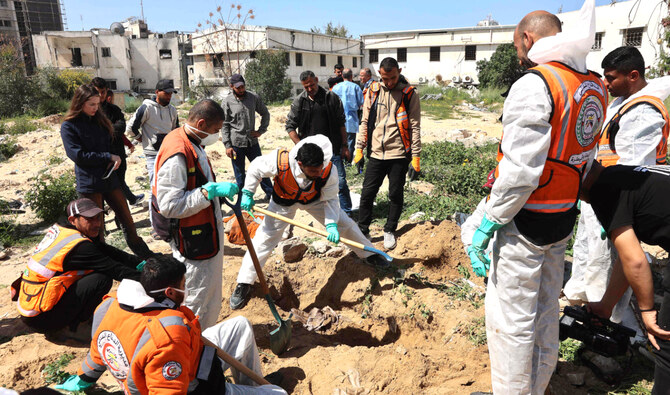
Gaza rescuers exhume dozens of bodies from Al-Shifa Hospital

Palestinian civil defense workers uncover corpses buried in the grounds of the Al-Shifa Hospital in Gaza City on Thursday. (AFP)
Short Url
Updated 14 March 2025
Follow

Gaza rescuers exhume dozens of bodies from Al-Shifa Hospital

  • The Palestinians medical facility is now largely in ruins following multiple Israeli assaults during the deadly war

GAZA CITY: Gaza’s civil defense agency reported that its crews had exhumed 48 bodies on Thursday from the courtyard of Al-Shifa Hospital, once Gaza’s biggest medical facility but now largely in ruins following multiple Israeli assaults during the war.

The agency has carried out similar work in the past to return remains to their families if they can be identified or, failing that, to remove them and give them a proper burial elsewhere.

Rescuers handed over 38 bodies after they were identified by their relatives, who took them to be reinterred in other cemeteries, agency spokesman Mahmoud Bassal said on Thursday.

“The other 10 exhumed bodies were handed over to the forensic department at the Ministry of Health for identification,” he said.

Bassal added that around 160 bodies remained buried within the hospital complex and that the process of exhumation would continue for several days.

AFP footage showed rescuers digging in parts of the courtyard and removing white bags reportedly containing human remains, which were then wrapped in blankets and carried away.

Gaza resident Mohammed Abu Asi, who identified the body of his brother, had come to the hospital to receive the remains.

“It’s like experiencing the war all over again. Recovering my brother’s body feels as though we are burying him today — the pain and the wound have reopened,” he said.

Another Gaza resident, Suha Al-Sharif, came to the site hoping to find her son’s body.

“I know what my son was wearing. That’s why I came. God willing, I will find him,” she said.

“I want to find him. I’m a mother — I am exhausted and do not know where my son is.”

Hospitals in Gaza, particularly Al-Shifa, have been repeatedly targeted by Israeli forces since the start of the war, following the Oct. 7, 2023, attack on Israel.

Gaza health workers have previously discovered bodies at Al-Shifa Hospital.

Last year, the UN Security Council expressed “deep concern” after reports of mass graves containing hundreds of bodies in or near hospitals in Gaza.

The Oct. 7 attack resulted in the deaths of 1,218 people on the Israeli side, according to official Israeli figures.

During the attack, militants took 251 people hostage, 58 of whom remain in Gaza, including 34 the Israeli military says are dead.

Israel’s retaliatory military campaign has since killed at least 48,524 people, according to the Hamas-run territory’s health ministry. The UN considers these figures reliable.


Sudanese nomads trapped as war fuels banditry and ethnic splits

Updated 4 sec ago
Follow

Sudanese nomads trapped as war fuels banditry and ethnic splits

  • War disrupts nomads’ traditional routes and livelihoods
  • Nomads face threats from bandits as well as ethnic tensions
NEAR AL-OBEID: Gubara Al-Basheer and his family used ​to traverse Sudan’s desert with their camels and livestock, moving freely between markets, water sources, and green pastures. But since war erupted in 2023, he and other Arab nomads have been stuck in the desert outside the central Sudanese city of Al-Obeid, threatened by marauding bandits and ethnic tensions. The war between the Sudanese army and the paramilitary Rapid Support Forces (RSF) has left nearly 14 million people displaced, triggered rounds of ethnic bloodshed, and spread famine ‌and disease. It ‌has also upset the delicate balance of ‌land ⁠ownership ​and livestock routes ‌that had maintained the nomads’ livelihoods and wider relations in the area, local researcher Ibrahim Jumaa said. Al-Obeid is one of Sudan’s largest cities and capital of North Kordofan state, which has seen the war’s heaviest fighting in recent months. Those who spoke to Reuters from North Kordofan said they found themselves trapped as ethnic hatred, linked to the war and fueled largely online, spreads.
“We used to be ⁠able to move as we wanted. Now there is no choice and no side accepts you,” ‌al-Basheer said. “In the past there were a ‍lot of markets where we ‍could buy and sell. No one hated anyone or rejected anyone. Now ‍it’s dangerous,” he said.
RISK OF ROBBERY
As well as the encroaching war, the nomads — who Jumaa said number in the millions across Sudan — face a threat from bandits who steal livestock.
“There are so many problems now. We can’t go anywhere and if we ​try we get robbed,” said Hamid Mohamed, another shepherd confined to the outskirts of Al-Obeid. The RSF emerged from Arab militias known ⁠as the Janjaweed, which were accused of genocide in Darfur in the early 2000s. The US and rights groups have accused the RSF of committing genocide against non-Arabs in West Darfur during the current conflict, in an extension of long-running violence stemming from disputes over land. The RSF has denied responsibility for ethnically charged killings and has said those responsible for abuses will be held to account. Throughout the war the force has formed linkages with other Arab tribes, at times giving them free rein to loot and kidnap.
But some Arab tribes, and many tribesmen, have not joined the fight.
“We require a national program to counter ‌hate speech, to impose the rule of law, and to promote social reconciliation, as the war has torn the social fabric,” said Jumaa.