

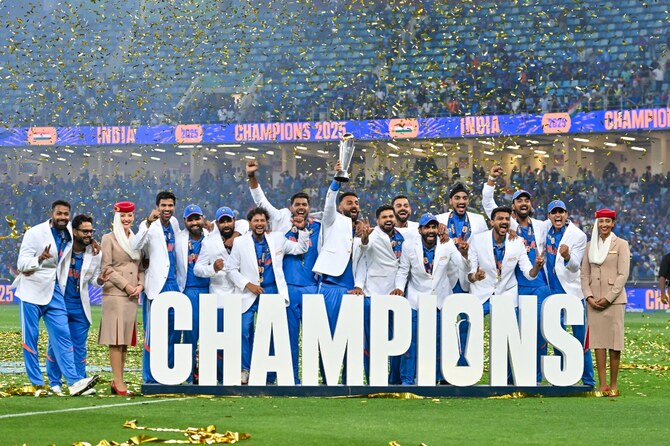

When previewing the International Cricket Council’s 2025 Champions Trophy for Arab News, Azeem Rafiq felt that India started as slight favorites. As the tournament progressed, it became apparent that several factors underlined that initial assessment. India’s superiority and team cohesion was sufficient to achieve an unbeaten route to the final in which a tenacious New Zealand was narrowly beaten.
Understandably, the Indian team, officials, management and millions of fervent supporters were overjoyed. Their delight is enhanced as the Champions Trophy is now added to the T20 World Cup, secured in June 2024 when South Africa was beaten by the narrow margin of seven runs.
No doubt Indian eyes will now turn to planning victory in the 2026 T20 World Cup, to be hosted jointly by India and Sri Lanka from mid-February to mid-March. If it had not been for an inspired performance by Australia in the final of the 2023 ODI World Cup, the Indian men’s team would hold a full set of ICC trophies in the short formats.
It is difficult to escape the conclusion that India and its supporters want to win every tournament, befitting their status as cricket’s powerhouse in terms of revenue generation and levels of support. Dominance by one team in any sport tends to breed ennui and antipathy — just ask supporters of other English Premier League teams their views on the dominance displayed by the two Manchester clubs and Liverpool at various times. These feelings are exacerbated if accompanied by a sense of injustice or bias and there is a danger India’s most recent success could fall into that category.
The resurrection of the Champions Trophy by the ICC and its choosing Pakistan as hosts was designed to provide a boost for cricket in the country. It certainly provided grounds for optimism and, as Rafiq noted, Pakistan’s message to the world was: “We are back.” However, the vibes were dampened by disappointing cricket from the hosts, by three matches lost to rain and by the geo-politically induced decision to split the tournament between Pakistan and Dubai.
Much has been made of India playing all their matches in Dubai, of being based there and not having to travel, of being familiar with the pitches and tailoring team selection to include four spinners to take advantage of them. Naturally, the Indians have downplayed these alleged benefits, one coach saying that “you (still) have to play good cricket every day when you turn up.” Whilst this is self-evidently true and they were the best team, India avoided the farcical situation in which Australia and South Africa found themselves.
Having completed their group stage matches and qualified for the semifinals, both teams had to fly from Pakistan to Dubai where the result of the final group stage match between India and New Zealand would determine the semifinal pairings. India won, which meant Australia remained in Dubai and the South Africans ended an 18-hour stay by rushing back to Lahore to play New Zealand. The reason given for this bizarre decision was to allow the team playing the semifinal in Dubai maximum time to prepare. This feels like a tacit admission of the need to balance out India’s perceived advantage.
Pakistan’s disappointment in failing to reach the semifinal stage, thereby depriving the country of the global exposure which it craved, was made worse by losing the opportunity to host the final, because India reached it. Events at the presentation ceremony will not have eased Pakistan’s pain.
Legendary former Pakistan players Wasim Akram and Shoaib Akhtar were incredulous there was no representative from the Pakistan Cricket Board on the stage, which was populated by Indians. The president of the Board of Control for Cricket in India, Roger Binny, presented jackets to the Indian players and the former BCCI secretary, now ICC chair Jay Shah, presented the trophy to India’s captain.
It is understood the PCB’s chair, Mohsin Naqvi, could not attend the occasion due to prior commitments, but both the tournament director and PCB COO, Sumair Ahmed Syed, and Director of International Cricket Usman Wahla represented him at the match. Looking at the stage in Dubai, it was hard to believe the PCB was the tournament’s official host. The PCB interpreted this lack of representation as a deliberate snub and lodged an official complaint, which is unlikely to do more than further inflame tensions. The official line is that protocol allows only elected members or directors of a board to be on the podium.
The 2025 Champions Trophy provided a significant opportunity for Pakistan to re-establish itself as a viable host for future ICC events. This was partially achieved. The PCB’s investment in stadiums has gone largely unrewarded in terms of spectator numbers. Despite Naqvi’s fulsome praise for “the commitment and collective efforts of those who ensured the tournament’s seamless execution,” other factors dogged their efforts. India’s late decision not to travel cast a long shadow not only over the cricket but also the tournament’s organization. The schedule was released just eight weeks before the opening match and tickets were available only days beforehand.
None of this will matter to either the ICC, BCCI or India. The ICC continues to make money but is dependent upon India’s participation in its tournaments and on India v Pakistan to protect broadcasting rights. International cricket is over a barrel. No national board is prepared to take the risk of challenging the insanely rich BCCI — look what happened when Pakistan tried. Market forces have been allowed to dictate the future of the game, whilst the BCCI, hand in glove with the ICC, now seems to be able to influence schedules for its own benefit.
The Champions Trophy 2025 has pulled back the curtain on the future of international cricket, in which India looks set to dominate not only off the field, but on it as well, at least in the short formats. It has taken eight years since the last Champions Trophy in 2017, when Pakistan handsomely beat India at the Oval, for this possibility to become reality.


