

‘Stranded’ astronauts closer to coming home after next ISS launch

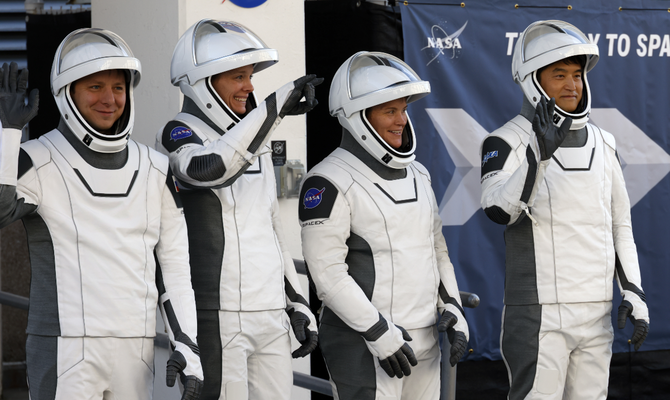
Crew 10, from left, cosmonaut Kirill Peskov, astronaut Nichole Ayers, astronaut Anne McClain and JAXA astronaut Takuya Onishi leave the Operations and Checkout building before heading to Launch Pad 39-A at the Kennedy Space Center in Cape Canaveral, Fla., for a mission to the International Space Station, Wednesday, March 12, 2025. (AP)
Short Url
Updated 13 March 2025
Follow

‘Stranded’ astronauts closer to coming home after next ISS launch

  • “All systems are looking good and weather is a go,” SpaceX wrote Wednesday on X

WASHINGTON: A routine crew rotation at the International Space Station has taken on unusual significance: It paves the way for a pair of astronauts stranded for more than nine months to finally come home.
The NASA-SpaceX Crew-10 mission is set to launch from Florida’s Kennedy Space Center on Wednesday at 7:48 p.m. (2348 GMT), bound for the ISS.
“All systems are looking good and weather is a go,” SpaceX wrote Wednesday on X, as the team of two US astronauts, one Japanese astronaut and a Russian cosmonaut said their goodbyes to relatives and drove to the launch pad.
All eyes however will be on Butch Wilmore and Suni Williams, the NASA duo who have been stuck aboard the ISS since June after their Boeing Starliner spacecraft developed propulsion issues and was deemed unfit for their return.
Wilmore and Williams were initially slated for an eight-day mission but were reassigned to Crew-9 after its astronauts arrived in September aboard a SpaceX Dragon. The spacecraft carried only two crew members instead of the usual four to make room for Wilmore and Williams.
Crew-9 can only return to Earth after Crew-10 arrives.
“We came up prepared to stay long, even though we plan to stay short,” Wilmore said in a recent news conference. “That’s what your nation’s human space flight program is all about, planning for unknown, unexpected contingencies.”
Crew-10 is expected to dock early Thursday, followed by a brief handover before Crew-9 departs on March 16 for an ocean splashdown off the Florida coast, weather permitting.
Along with Wilmore and Williams, NASA astronaut Nick Hague and Russian cosmonaut Aleksandr Gorbunov will also be aboard the returning Dragon capsule.
Space remains an area of cooperation between the United States and Russia despite the Ukraine conflict, with cosmonauts traveling to the ISS aboard SpaceX Crew Dragons and astronauts doing the same via Soyuz capsules launched from Kazakhstan.

Wilmore and Williams’s prolonged stay has recently become a political flashpoint, as President Donald Trump and his close adviser Elon Musk have accused ex-president Joe Biden’s administration of abandoning the pair.
SpaceX boss Musk has suggested, without providing specifics, that he had offered Biden a “rescue” mission outside of the routine crew rotations.
However, with Trump now in office for nearly two months, the astronauts are still set to return as originally planned.
The issue recently sparked a heated online exchange between Musk and Danish astronaut Andreas Mogensen, whom Musk called a slur for mentally disabled people. Several retired astronauts quickly came to Mogensen’s defense.
One astronaut who backed Musk however was Wilmore, who offered contradictory statements in last week’s press conference.
“I can only say that Mr. Musk, what he says is absolutely factual,” he said, seemingly endorsing the SpaceX founder’s version of events, before adding “politics is not playing into this at all.”
The Crew-10 team consists of NASA astronauts Anne McClain and Nichole Ayers, Japan’s Takuya Onishi, and Russia’s Kirill Peskov.
McClain, the mission’s commander, will be making her second trip to space.
“I’m looking forward to breaking bread with those guys, talking to them, giving them big hugs,” she said of Wilmore and Williams.
During their mission, the new crew will conduct a range of scientific experiments, including flammability tests for future spacecraft designs and research into the effects of space on the human body.


EU leaders begin India visit ahead of ‘mother of all deals’ trade pact

Updated 25 January 2026
Follow

EU leaders begin India visit ahead of ‘mother of all deals’ trade pact

  • Antonio Luis Santos da Costa, Ursula von der Leyen are chief guests at Republic Day function
  • Access to EU market will help mitigate India’s loss of access to US following Trump’s tariffs

New Delhi: Europe’s top leaders have arrived in New Delhi to participate in Republic Day celebrations on Monday, ahead of a key EU-India Summit and the conclusion of a long-sought free trade agreement.

European Council President Antonio Luis Santos da Costa and European Commission President Ursula von der Leyen arrived in India over the weekend, invited as chief guests of the 77th Republic Day parade.

They will hold talks on Tuesday with Prime Minister Narendra Modi at the EU-India Summit, where they are expected to announce a comprehensive trade agreement after years of stalled negotiations.

Von der Leyen called it the “mother of all deals” at the World Economic Forum in Davos last week — a reference made earlier by India’s Commerce Minister Piyush Goyal — as it will create a market of 2 billion people.

“The India-EU FTA has been a long time coming as negotiations have been going on between the two for more than a decade. Some of the red lines that prevented the signing of the FTA continue to this date, but it seems that the trade negotiations have found a way around it,” said Anupam Manur, professor of economics at the Takshashila Institution.

“The main contentious issue remains the Indian government’s desire to protect the farmers and dairy producers from competition and the European Union’s strict climate-based rules and taxation. Despite this, both see enormous value in the trade deal.”

India already has free trade agreements with more than a dozen countries, including Australia, the UAE, and Japan.

The pact with the EU would be its third in less than a year, after it signed a multibillion CEPA (comprehensive economic partnership agreement) with the UK in July and another with Oman in December. A week after the Oman deal, New Delhi also concluded negotiations on a free trade agreement with New Zealand, as it races to secure strategic and trade ties with the rest of the world, after US President Donald Trump slapped it with 50 percent tariffs.

The EU is also facing tariff uncertainty. Earlier this month Trump threatened to impose new tariffs on several EU countries unless they supported his efforts to take over Greenland, which is an autonomous region of Denmark.

“The expediting factor in the trade deal is the unilateral and economically irrational trade decisions taken by their biggest trading partner, the United States,” Manur told Arab News.

Being subject to the highest tariff rates, India has been required to sign FTAs with other major economies. Access to the EU market would help mitigate the loss of access to the US.

The EU is India’s largest trading partner in goods, accounting for about $136 billion in the financial year 2024-25.

Before the tariffs, India enjoyed a $45 billion trade surplus with the US, exporting nearly $80 billion. To the EU’s 27 member states, it exports about $75 billion.

“This can be sizably increased after the FTA,” Manur said. “Purely in value terms, this would be the biggest FTA for India, surpassing the successful FTAs with the UK, Australia, Oman and the UAE.”
