

Giga-projects spark $1.22bn boom in Saudi real estate market

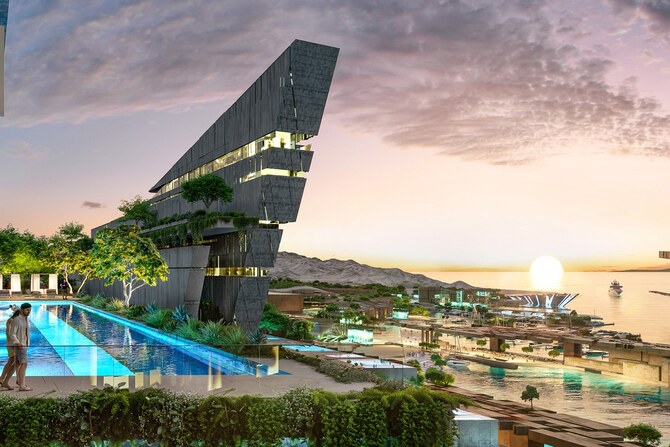
NEOM has emerged as the most sought-after destination, with 41 percent of respondents earning over SR80,000 per month expressing an intent to spend more than SR20 million on homes in such large-scale developments. Supplied
Short Url
Updated 12 March 2025
Follow

Giga-projects spark $1.22bn boom in Saudi real estate market

RIYADH: Saudi Arabia’s residential real estate market is set for a significant surge, with private buyers expected to invest SR4.58 billion ($1.22 billion) this year, according to an analysis.

The Saudi Report 2025 by global property consultancy firm Knight Frank, conducted in collaboration with YouGov, highlights that investors are willing to pay substantial premiums for homes within the Kingdom’s mega-development projects.

The study, which surveyed 1,037 households, including 100 expatriates based in Saudi Arabia, found that SR2.75 billion of potential private capital, including SR2.62 billion from Saudi nationals and SR133.7 million from expatriates, is ready to be deployed into the Kingdom’s giga-projects.

NEOM has emerged as the most sought-after destination, with 41 percent of respondents earning over SR80,000 per month expressing an intent to spend more than SR20 million on homes in such large-scale developments.

The findings underscore the growing demand for premium residential offerings in these transformative projects, which align with the Kingdom’s Vision 2030 economic diversification agenda.

“While NEOM continues to take pole position in the hearts and minds of Saudi nationals as a location they would like to live in, its popularity has decreased from 84 percent in 2023 to 17 percent this year,” Faisal Durrani, partner and head of research for MENA at Knight Frank, said.

He continued: “There are likely to be a range of reasons for this, including the emergence of other giga-projects over the last two years, perceptions around households’ ability to afford to own a home in any of NEOM’s subprojects, a lack of ready-to-move-into homes, a lack of homes actually on the market to purchase, or a combination of the above. These factors present a clear blueprint for how NEOM’s developers can boost absorption rates once homes are made available to purchase.”

According to Knight Frank, NEOM was found to be the most desirable giga-project among Saudi nationals, although those on monthly incomes of SR10,000 to SR50,000 showed a higher level of interest in living in the Belgium-sized super-city than those with incomes in excess of SR50,000.

For the latter group, Jeddah Central had greater appeal, representing 14 percent, with NEOM following in second place.

While expats with a monthly income of over SR30,000 also favor NEOM as their most preferred location to own a home, it is notable that 20 percent of all the expats surveyed have no desire to purchase residential real estate in any of the giga-projects.

“The relatively low appetite among expats to purchase a home in any of the giga-projects likely stems from a lack of understanding of what will eventually be available, a lack of proof of concept, difficulty in navigating expat ownership rules, financing challenges, or indeed a combination of the above,” Susan Amawi, general manager at Knight Frank  Saudi Arabia said.

She added: “We expect this to change over time, especially once details of the much-anticipated change to foreign ownership laws are unveiled.”

NEOM has awarded construction contracts worth $28.7 billion as of early 2025, with $100 million allocated to Magna and an additional $10.5 billion for The Line, according to an analysis by Knight Frank.

Saudi nationals and expatriates earning SR10,000 to SR20,000 per month showed the highest level of interest, followed by those with incomes between SR20,000 and SR30,000.

Meanwhile, 29 percent of respondents earning SR40,000 to SR50,000 also expressed a desire to buy a home in The Line.

However, Durrani noted a shift in preferences among higher-income groups.

“The apparent tapering in the desirability of The Line as a place to live and own a home as incomes grow could be a reflection of the perception of The Line as a ‘mass-market project,’ with those on higher incomes perhaps in favour of somewhere more exclusive,” he explained.

Durrani added: “Indeed, our results have shown that the largest proportion of those on monthly incomes of between SR70,000 and 80,000 would prefer to own a home at the Red Sea Project and King Salman Park. For this group, NEOM overall trails at just 5 percent.”

Saudi Arabia’s leading residential developer, ROSHN, has also emerged as a key player in the Kingdom’s giga-projects.

According to Knight Frank, ROSHN’s SEDRA development in Riyadh is the most sought-after project, with 39 percent of respondents selecting it as their top choice.

ROSHN’s focus on affordable homes in integrated community settings has played a pivotal role in its widespread appeal.

Other highly sought-after ROSHN developments include Warefa in Riyadh and Marafy in Jeddah.

Tariq de Jong, regional head of residential research at Knight Frank, emphasized ROSHN’s rising prominence among Saudi homebuyers.

“Away from NEOM, Saudi nationals and Saudi-based expats are actively targeting projects by ROSHN, which ranks alongside Jeddah Central as the second most popular giga project home purchase location,” Harmen de Jong, partner and regional head of Strategy & Consulting for Saudi Arabia at Knight Frank, said.

He concluded: “ROSHN has positioned itself as the Kingdom’s leading residential community developer and is working toward setting new benchmarks in creating integrated neighborhoods that blend modern living with traditional Saudi heritage, all crucially anchored by community facilities and amenities which are in high demand and in short supply.”


Using space science to protect Saudi Arabia’s environment

Updated 9 sec ago
Follow

Using space science to protect Saudi Arabia’s environment

  • Kingdom is harnessing satellite technology to forecast disasters, boost agriculture

RIYADH: Learning space science has delivered significant environmental benefits worldwide, helping many countries better understand and manage climate challenges. 

Saudi Arabia is now taking steps not only to explore the galaxy but also to invest in future generations who can apply space science to pressing environmental issues at home.

Last November, the Space Academy, part of the Saudi Space Agency, launched a series of seminars designed to enhance knowledge and develop skills in space science and technology, with a particular focus on Earth observation.

Running for nearly a month, the program formed part of a broader strategy to nurture national talent, raise scientific awareness, and build data capabilities that support innovation and research across the Kingdom.

Developing space sector can eventually help reduce some of the critical climate issues such as drought and air pollution. (AFP)

As efforts to strengthen the sector continue, important questions remain: How can space science translate into tangible environmental benefits? And how large is the global space economy?

In an interview with Arab News, Fahad Alhussain, co-founder of SeedFord, highlighted the scale of the opportunity and its environmental impact.

“To be frank, the slogan that we always use in space is that ‘saving the Earth from the space.’ It is all about this,” Alhusain told Arab News.

“You can recall a lot of related environmental issues like global warming, related to forests, related to the damage that happens to the environment. Without space, it would be almost impossible to see the magnitude of these damages.”

According to Alhussain, satellites have transformed how experts observe environmental changes on Earth, offering a comprehensive view that was previously impossible.

“By collecting data and using satellites… You can better analyze and measure so many things that help the environment,” said Fahad Alhussain. (Supplied)

He said that “the transformation of technology allows even the non-optical ways of measuring, assessing, and discovering what is going on in the environment … you can even anticipate fire before it happens in the forest.”

“You can detect the ice-melt down, you can get huge amount of information and can see it through the weather maps…there is a huge section in the economy for the environment,” Alhussain commented.

A 2022 report by Ryan Brukardt, a senior partner at McKinsey & Company, published by McKinsey Quarterly, found that more than 160 satellites currently monitor Earth to assess the impacts of global warming and detect activities such as illegal logging.

Brukardt cited NASA as an example of how advanced satellite tools are used to track environmental changes, including shifts in ocean conditions, cloud cover, and precipitation patterns. He also noted that satellite data can help governments determine when immediate action is needed, particularly in response to wildfires.

FASTFACT

Did You Know?

  • Satellites collect massive amounts of data, and AI is used to help interpret this information more efficiently and predict future outcomes.
  • The global space economy surpassed $600 billion in 2024 and is projected to exceed $1 trillion by 2030.
  • Saudi Arabia has established three key entities: the Supreme Space Council, the Saudi Space Agency, and the Communications, Space, and Technology Commission.

Beyond disaster response, satellites offer vital insights for agriculture. According to Brukardt’s report, scientists can use space-based data to monitor crop development and anticipate threats to harvests, such as drought or insect infestations.

These wide-ranging applications explain the rapid growth of the global space economy. 

According to World Economic Forum research, the sector is projected to reach $1.8 trillion by 2035, nearly tripling from $630 billion in 2023.

A deeper understanding of space and its applications offers Saudi Arabia, and the world, better tools to anticipate climate challenges, protect ecosystems, and safeguard biodiversity. (Supplied)

For Saudi Arabia, expanding space science capabilities could help address the country’s arid conditions by monitoring desertification and identifying sources of air pollution. Early detection of droughts, heatwaves, and crop stress could support more effective environmental planning and response.

Space-based data could also play a critical role in tracking environmental changes in the Red Sea and surrounding coastal ecosystems, strengthening marine conservation efforts and supporting the Sustainable Development Agenda.

As Alhussain emphasized, advancing knowledge in space science and satellite technology enables experts to measure environmental damage accurately and predict disasters before they occur, allowing for more effective responses.

By investing in space science education and research, the Kingdom can build national expertise, strengthen environmental protection policies, enhance food and water security, and contribute to global efforts to combat climate change—while also benefiting from the rapidly expanding space economy.

Ultimately, a deeper understanding of space and its applications offers Saudi Arabia, and the world, better tools to anticipate climate challenges, protect ecosystems, and safeguard biodiversity.

“By collecting data and using satellites, you can better analyze and measure so many things that help the environment,” said Alhussain.
“There will be patterns where you can warn people, scientists and decision makers to do something about it.”