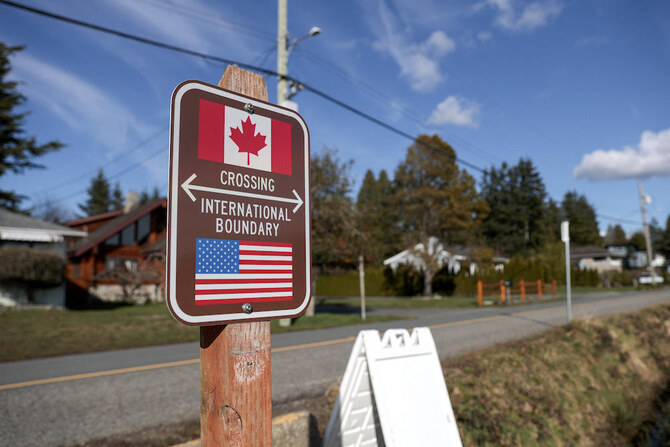
NEW YORK: Right on the US-Canadian border, Corey Fram’s tourism marketing job has gotten a lot harder of late.
Fram is director of the 1000 Islands International Tourism Council, which promotes a nature destination with castles, cruises, hikes and fishing enjoyed by Canadians and Americans. But he says US President Donald Trump’s continuous disparagement of Canada is taking a toll.
“We have had to switch gears a bit,” Fram said from his office near the 1,800 tiny scenic islands that dot the St. Lawrence River framed by New York State and Ontario province.
Seeing Canadian and American flags often flying side by side, travelers didn’t care what side of the border they were on. Now, with Trump’s recent rhetoric, Fram has had to adjust his message.
“We’ve been very careful not to broadcast and demonstrate US assets to Canadian audiences and Canadian assets to US audiences because when we have, we found that has drawn out a lot of negative sentiment,” Fram said.
Canadians have been stung by Trump’s actions and words since he returned to the White House, both around tariffs and suggestions that Canada should be annexed by the United States.
The American anthem has been booed at hockey games and some stores are removing US products from their shelves, even before Trump’s latest salvo on Tuesday, when he increased tariffs on imported Canadian steel and aluminum to 50 percent.
Travelers are responding with their wallets. New bookings to the United States from Canada have declined about 20 percent since February 1 compared with the year-ago period, according to Forward Keys, a flight ticketing data firm.
United Airlines CEO Scott Kirby said on Tuesday the company has adjusted its capacity due to a big drop in incoming traffic from Canada.
“We’ve lost a lot of interest in going to the States in general,” said Allyson C., 34, from Vancouver, who canceled her family’s summer vacation to Washington, D.C., citing the on-again, off-again tariffs and the US exchange rate.
This worries the US travel industry. Inbound travel to the United States is still just 90 percent of pre-pandemic levels, Geoff Freeman, CEO of the US Travel Association, said in an interview.
No other country’s residents go to the United States more than Canada, which notched 20.4 million visits in 2024. Canadian travelers also spend three times more on vacations than domestic US travelers, said Freeman.
Saturday night hotel bookings in Bellingham, Washington, a coastal city near the Canadian border which offers skiing and ferries to Alaska, declined 10.8 percent from February 2 through March 1. Bookings in Niagara Falls, New York, fell 8.1 percent over the same period, according to analytics firm CoStar.
Weather and the exchange rate also affected cross-border travel in 2024, said Jan Freitag, director of US hospitality at CoStar.
“The thing that is different this year is the rhetoric from the administration that has a lot of Canadians thinking twice about coming across the border.”
Fram said his tourism council is also not getting as warm a reception to invitations to bring Canadian travel writers and influencers to Thousand Islands attractions on the New York side.
“Anytime that we put a restriction and make it difficult or make people not want to cross the border, that has a lasting impact,” said Fram. “It is going to be a significant challenge to get back to where we were before this.”
The Trump administration said it will require all foreigners above the age of 14 in the US to register and submit fingerprints beginning April 11 if they stay beyond 30 days. Canadians are not exempt, even though they typically can visit the US for up to six months without a visa.
Canadians aren’t the only travelers backing off from the US Bookings from Denmark and Germany decreased 27 percent and 15 percent year-over-year, respectively, according to Forward Keys. Demand from Europe as a whole only slightly decreased at 1 percent.
But Canada’s proximity makes it more important. A 10 percent drop in Canadian travelers could cost the United States $2.1 billion in lost spending, the US Travel Association estimated.
“I would love to go back to the US, but right now, as things are, I as a Canadian don’t really feel safe or welcomed,” said artist manager Zina Oukil, 32, from Calgary. She is vacationing in Cancun, Mexico with her husband after canceling a road trip to Los Angeles.
“I feel very sad about it, but also a little bit frustrated and quite frankly angry,” Oukil said.


Canadians, stung by Trump’s tariffs and rhetoric, balk at US travel
https://arab.news/mkdck
Canadians, stung by Trump’s tariffs and rhetoric, balk at US travel

- New bookings to the United States from Canada have declined about 20 percent since February 1 compared with the year-ago period
- United Airlines CEO Scott Kirby said the company has adjusted its capacity due to a big drop in incoming traffic from Canada


Only 4% women on ballot as Bangladesh prepares for post-Hasina vote
- Women PMs have ruled Bangladesh for over half of its independent history
- For 2026 vote, only 20 out of 51 political parties nominated female candidates
DHAKA: As Bangladesh prepares for the first election since the ouster of its long-serving ex-prime minister Sheikh Hasina, only 4 percent of the registered candidates are women, as more than half of the political parties did not field female candidates.
The vote on Feb. 12 will bring in new leadership after an 18-month rule of the caretaker administration that took control following the student-led uprising that ended 15 years in power of Hasina’s Awami League party.
Nearly 128 million Bangladeshis will head to the polls, but while more than 62 million of them are women, the percentage of female candidates in the race is incomparably lower, despite last year’s consensus reached by political parties to have at least 5 percent women on their lists.
According to the Election Commission, among 1,981 candidates only 81 are women, in a country that in its 54 years of independence had for 32 years been led by women prime ministers — Hasina and her late rival Khaleda Zia.
According to Dr. Rasheda Rawnak Khan from the Department of Anthropology at Dhaka University, women’s political participation was neither reflected by the rule of Hasina nor Zia.
“Bangladesh has had women rulers, not women’s rule,” Khan told Arab News. “The structure of party politics in Bangladesh is deeply patriarchal.”
Only 20 out of 51 political parties nominated female candidates for the 2026 vote. Percentage-wise, the Bangladesh Socialist Party was leading with nine women, or 34 percent of its candidates.
The election’s main contender, the Bangladesh Nationalist Party, whose former leader Zia in 1991 became the second woman prime minister of a predominantly Muslim nation — after Pakistan’s Benazir Bhutto — was the party that last year put forward the 5 percent quota for women.
For the upcoming vote, however, it ended up nominating only 10 women, or 3.5 percent of its 288 candidates.
The second-largest party, Jamaat-e-Islami, has not nominated a single woman.
The 4 percent participation is lower than in the previous election in 2024, when it was slightly above 5 percent, but there was no decreasing trend. In 2019, the rate was 5.9 percent, and 4 percent in 2014.
“We have not seen any independent women’s political movement or institutional activities earlier, from where women could now participate in the election independently,” Khan said.
“Real political participation is different and difficult as well in this patriarchal society, where we need to establish internal party democracy, protection from political violence, ensure direct election, and cultural shifts around female leadership.”
While the 2024 student-led uprising featured a prominent presence of women activists, Election Commission data shows that this has not translated into their political participation, with very few women contesting the upcoming polls.
“In the student movement, women were recruited because they were useful, presentable for rallies and protests both on campus and in the field of political legitimacy. Women were kept at the forefront for exhibiting some sort of ‘inclusive’ images to the media and the people,” Khan said.
“To become a candidate in the general election, one needs to have a powerful mentor, money, muscle power, control over party people, activists, and locals. Within the male-dominated networks, it’s very difficult for women to get all these things.”


