

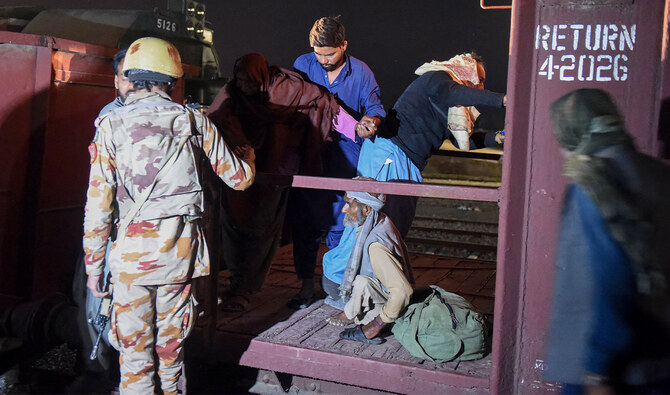

KARACHI: Security officials said on Wednesday they had freed 155 hostages after separatist militants hijacked a train carrying more than 400 people in Pakistan’s southwestern Balochistan province, with an armed rescue operation entering its second day.
The separatist Balochistan Liberation Army (BLA) bombed part of a railway track and stormed the Quetta-Peshawar-bound Jaffar Express on Tuesday afternoon in Mushkaaf, an area in the mountainous Bolan range of Balochistan. The province has been the site of low-level separatist insurgency for decades, with separatist groups accusing the government of stripping the province’s natural resources and leaving its people mired in poverty. They say security forces routinely abduct, torture and execute ethnic Baloch, allegations echoed by human rights campaigners.
Government officials and security forces strongly deny violating human rights and say they are uplifting the province through development projects, including multi-billion-dollar schemes funded by China.
In the latest assault, the train was trapped in a tunnel and the driver was killed after sustaining serious injuries, local authorities, police and railway officials said.
“So far, security forces have safely rescued 155 passengers from the terrorists,” a security official with direct knowledge of the ongoing rescue operation said on condition of anonymity. “At least 27 militants have been eliminated.”
“The terrorists have positioned suicide bombers very close to some innocent hostage passengers,” he added. “Facing possible defeat, the terrorist suicide bombers are using innocent people as human shields.”
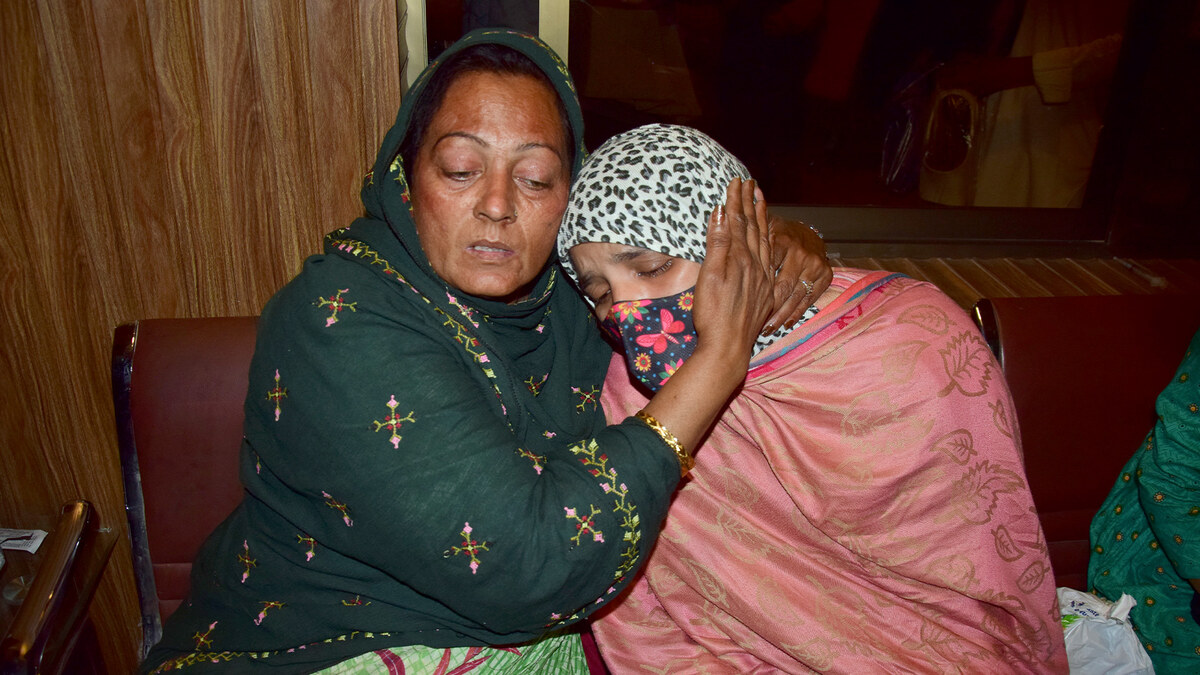
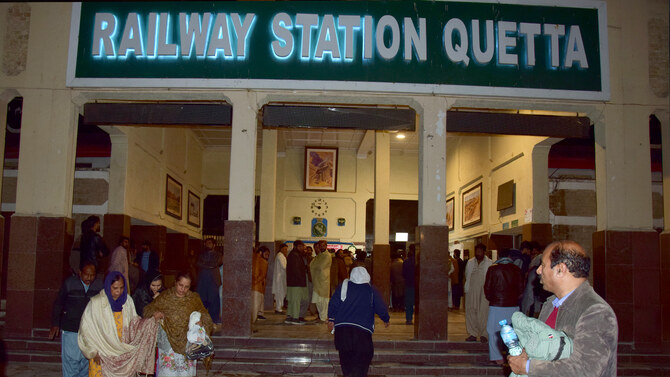
Passengers rescued by security forces from a passenger train attacked by insurgents comfort each other upon their arrival at a railway station in Quetta, Pakistan on Wednesday, March 12, 2025. (AP)
The official said the militants were in touch with their “handlers” in Afghanistan, echoing a common accusation by Pakistani security and government officials that a recent spike in militancy was being orchestrated from the neighboring country. The Taliban rulers in Kabul deny they allow Afghan soil to be used by insurgents to plan or carry out terror attacks.
PRISONER EXCHANGE
Balochistan is Pakistan’s largest province by area, covering 347,190 square kilometers and constituting 44 percent of the country’s total landmass. However, the remote province bordering Afghanistan and Iran is the country’s most backward region in terms of nearly all social and economic indicators.
There are no Internet and mobile services in nearly 60 percent of the province, according to independent monitors, and areas which have such services often see shutdowns and months-long disruptions due to security reasons.
Speaking to Arab News on Tuesday, Imran Hayat, the divisional superintendent of Pakistan Railways in Quetta, said the department was unable to communicate with staff aboard the train as militants had carried out the assault in a “no-signal zone.”
“We haven’t retrieved a single body or injured from the area yet due to the communication blackout,” he said.
The BLA said in a statement on Tuesday it had not suffered any casualties but had killed 30 soldiers and shot down a drone. There was no confirmation of this from Pakistani authorities.
The group said it was prepared for a prisoner exchange,
“The occupying state of Pakistan is given 48 hours to immediately and unconditionally release Baloch political prisoners, forcibly disappeared persons and national resistance activists.”
The BLA warned that the hostages included military, paramilitary, police and intelligence officers, who would be killed if the BLA’s demands were not met within the stipulated period “or if the occupying state attempts any military action during this time.”
The Balochistan government has imposed emergency measures to deal with the situation, spokesperson Shahid Rind told media, without giving any details.
The separatists have also recently attacked projects being developed as part of the $65-billion China-Pakistan Economic Corridor (CPEC), part of President Xi Jinping’s Belt and Road Initiative, in Balochistan. The program is also developing a deep-water port close to the new $200-million airport in Gwadar, a joint venture between Pakistan, Oman and China.


