

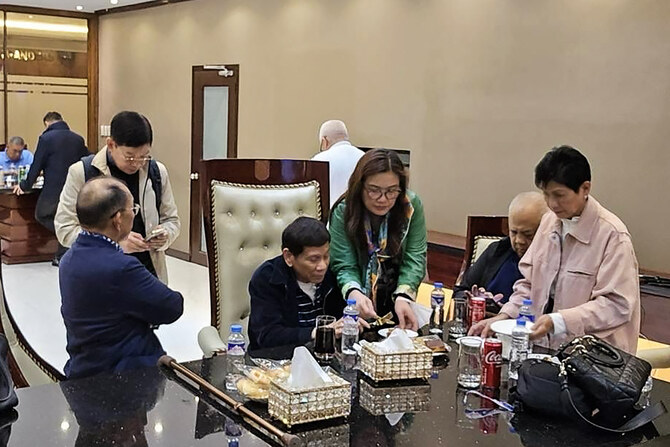

MANILA: Former President Rodrigo Duterte was taken into custody on Tuesday after the Philippine government said it received an International Criminal Court warrant over his involvement in suspected crimes against humanity related to the country’s bloody “war on drugs.”
The ICC had been investigating Duterte over his administration’s deadly anti-drugs campaign, in which according to official data over 6,000 Filipinos were killed during the ex-president’s six-year term since 2016. ICC prosecutors estimate, however, that the number of extrajudicial killings committed by security forces could be as many as 30,000.
He was arrested at Manila’s main airport after returning from a trip to Hong Kong, the office of President Ferdinand Marcos Jr. said in a statement.
“Earlier this morning, Interpol Manila received the official copy of the arrest warrant from the International Criminal Court,” the Presidential Communications Office said.
“Upon his arrival, the prosecutor general presented the ICC notification for an arrest warrant against the former president for crimes against humanity … As of now, he is in the custody of the authorities.”
Duterte won the Philippine presidency in 2016 on a promise to eradicate illegal drugs, after serving for more than two decades as mayor of Davao, the second-largest city in the Philippines, where he allegedly ran a deadly anti-drug crackdown with impunity.
The ensuing nationwide campaign drew international condemnation.
The 79-year-old has repeatedly defended the crackdown and denied the extrajudicial killing of alleged drug suspects, although he has also openly admitted to instructing police to kill in self-defense.
Duterte officially withdrew the Philippines from the ICC in 2019 as it began to look into allegations of systematic killings under his leadership.
But under the court’s withdrawal mechanism, it keeps jurisdiction over alleged crimes committed while a country was a member. While the Philippine government had refused to cooperate, the Marcos administration signaled in November that it would comply if an arrest warrant was issued.
The Philippines also remains a member of Interpol, which can seek Duterte’s arrest on behalf of the ICC.
“Under the rules of the ICC, any state, whether a state party or non-state party, can accede to the request of the ICC,” human rights lawyer Neri Colmenares told Arab News.
For the families of victims of Duterte’s deadly anti-drug campaign, his arrest has sparked new hopes for justice.
“The families of the victims see a light in, at least a glimmer of light, at the end of the tunnel for their search for justice for their loved ones who were mercilessly killed during the time of President Duterte,” Colmenares, who also serves as one of the legal counsels for the families, said.
“We will demand from President Marcos … that he should pursue the ends of justice, because that is his obligation under the Philippine laws, to execute the law and, of course, afford justice to the Filipino people.”
Rights group Karapatan is also calling on Marcos to make sure that Duterte “is actually delivered to the ICC for detention and trial.”
If transferred to the Hague, Duterte may become Asia’s first former head of state to go on trial at the ICC.
“(Marcos) should also cooperate in ensuring that Duterte is convicted by making available to the International Criminal Court additional pieces of evidence in the hands of the government,” Maria Sol Taule, Karapatan deputy secretary-general, said in a statement.
“With Duterte’s arrest, the Filipino people are hopefully a step closer to attaining justice and accountability for Duterte’s many crimes.”


