HOUSTON: The US energy secretary vowed Monday to reset federal energy policy to favor fossil fuels and deprioritize climate change as industry leaders gathered at their biggest event since President Donald Trump returned to office.
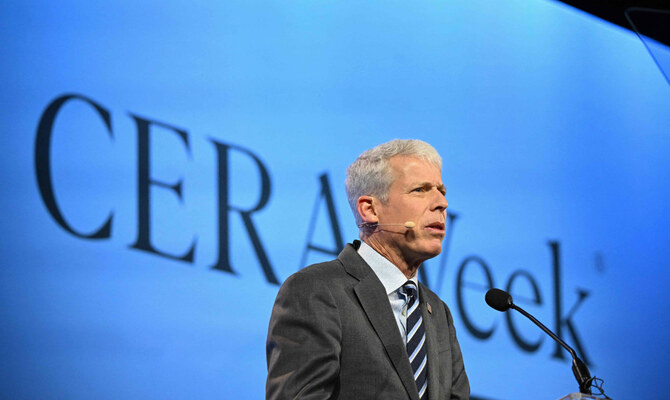
In the conference’s opening session, Energy Secretary Chris Wright cited the Trump administration’s moves to cut red tape that is delaying oil projects and promote liquefied natural gas exports as examples of a pivot away from policies pursued under former president Joe Biden.
“The Trump administration will end the Biden administration’s irrational quasi-religious policies on climate change that imposed endless sacrifices on our citizens,” Wright told a packed auditorium for the annual Cambridge Energy Research Associates (CERA) conference.
Since returning to Washington seven weeks ago, Trump and his team have overhauled the existing economic order at a dizzying pace, launching trade wars against allies and hollowing government agencies the president and his allies dislike.
Trump made energy policy a central part of his agenda with his day-one “Unleashing American Energy” executive order, promising during his inaugural address to “end the Green New Deal” in favor of “that liquid gold under our feet.”
But Mark Brownstein, senior vice president at the Environmental Defense Fund, said Wright’s tone was “long on rhetoric,” adding, “at some point the administration needs to get off the campaign stump speech and get on with the business of governing.”
Brownstein described many CERA attendees as uncertain about investments, not only because of Trump’s shifting position on energy and climate change, but also the nearly daily pivots on tariffs.
“The energy industry is a capital-intensive business and what they need to deploy capital at scale is certainty and consistency,” Brownstein told AFP.
CERA’s opening day coincided with deep stock market losses after Trump over the weekend refused to rule out a US recession.
Protesters held boisterous demonstrations outside the event in Houston. Advocacy group Oil Change International blasted the oil industry for pollution near industrial facilities and for fossil fuel investments that are worsening climate change.
Energy played a key supporting role in Trump’s 2024 presidential campaign, in which he pointed to higher gasoline prices as a reason more production was needed, embodied by his slogan: “Drill, baby, drill.”
Trump’s January 20 executive order represents a potentially wide-ranging attack on tax incentives which had been embraced by energy companies to advance billions of dollars of energy transition projects.
These projects were connected to laws enacted under Biden to mitigate climate change.
Some pundits think Trump will stop short of actions canceling existing projects where workers have been hired, including many in conservative districts.
Appearing just after Wright, Chevron CEO Mike Wirth warned that “swinging from one extreme to the other” on policy is “not the right policy approach in a long cycle industry like this.”
Wirth welcomed Trump’s executive orders on permitting reform, but said “we need to see some of this stuff put into legislation so that it’s more durable and it’s not at risk of being swung back in another direction by a future administration” with different priorities.
Wright downplayed the upheaval on trade policy after his remarks, noting Trump dropped many of his most impactful tariffs in his first term.
It’s “too early to say on tariffs, but I feel quite confident having a smart businessman every day working for America writ large, not an interest group or a particular industry,” Wright said. “I’m pretty optimistic about the outcome.”
Wright said there were “vigorous” closed-door debates about tariffs within the administration, rejecting the idea that there was ideological uniformity on the issue.
He also suggested the Trump administration wouldn’t challenge all Biden administration renewable energy projects, saying that while he wouldn’t have picked some of the same projects for loans, “we inherit a loan book... and we follow the rule of law.”


![]()

Trump’s energy chief vows reversal of Biden climate policies
Short Url
https://arab.news/jnppw
Trump’s energy chief vows reversal of Biden climate policies
- “The Trump administration will end the Biden administration’s irrational quasi-religious policies on climate change that imposed endless sacrifices on our citizens,” Wright says


Latest updates


© 2026 SAUDI RESEARCH & PUBLISHING COMPANY, All Rights Reserved And subject to Terms of Use Agreement.