Indonesia’s central bank uses Ramadan sermons to preach on inflation

1 / 2
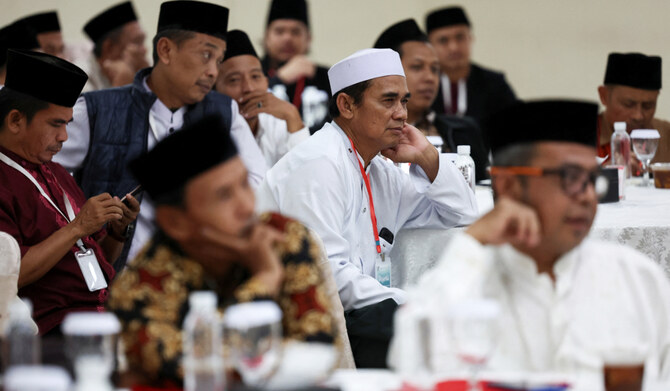
Muslim clerics attend a sermon, led by Indonesia's central bank official, on the importance of managing inflation, at Islamic Center in Majalengka, West Java province, Indonesia March 6, 2025. (REUTERS)
2 / 2
Muslim clerics attend a sermon, led by Indonesia's central bank official, on the importance of managing inflation, at Islamic Center in Majalengka, West Java province, Indonesia March 6, 2025. (REUTERS)
Short Url
Updated 11 March 2025
Follow

Indonesia’s central bank uses Ramadan sermons to preach on inflation

  • Ramadan ends with the Eid Al-Fitr festival, which, like in other Muslim countries, typically marks peak demand in Indonesia, where Muslims make up the majority of the population of 280 million

MAJALENGKA, Indonesia: Waiting to break their fast during the Muslim holy month of Ramadan, clerics in the Indonesian town of Majalengka gathered for an unusual briefing on the subject of inflation, led by the country’s central bank.
The address by a central bank official and two Muslim clerics in the town’s Islamic center was part of Bank Indonesia’s strategy to enlist preachers to warn against overconsumption during Ramadan, which can trigger price pressures in a country with a history of runaway inflation.
Though inflation has been brought under control in the past decade as authorities beef up efforts to strengthen food distribution along the supply chain, the central bank is keen to spread its message about the need to keep prices stable.


Muslim clerics attend a sermon, led by Indonesia's central bank official, on the importance of managing inflation, at Islamic Center in Majalengka, West Java province, Indonesia March 6, 2025. (REUTERS)

“We hope you as the ulemas (scholars of Islam) can be mediators to convey the message that inflation management is our common task,” said Agung Budilaksono, the senior central bank official for Majalengka.
“Inflation must be managed, because it’s like blood pressure ... If it’s too high, it will ruin your health in the long run and if it’s too low, you will get weak,” he told the clerics.
Ramadan ends with the Eid Al-Fitr festival, which, like in other Muslim countries, typically marks peak demand in Indonesia, where Muslims make up the majority of the population of 280 million.
Islamic clerics are influential among the public in Indonesia’s remote areas and towns like Majalengka in West Java, about three hours from the capital Jakarta.
“People tend to want more during Ramadan, so maybe we need to remind them again that the point of fasting is to control our lust,” said Mohamad Padil, 53, one of the clerics listening at the forum.
Inflation once ran hot in Southeast Asia’s largest economy, but in 2024 was 1.57 percent, near the lower end of the central bank’s target range, while West Java’s rate was 1.64 percent.
The rate dropped further in the first two months of 2025 due to a large increase in subsidies for electricity prices, and economists predict it will remain within the central bank’s 1.5 percent to 3.5 percent target range this year.
The central bank has run other unconventional initiatives including a podcast on spending management and programs to foster entrepreneurship as well as boost local food supply.
At the nearby Islamic boarding school of Santi Asromo, it helped build a greenhouse for students to plant Chinese cabbage and water spinach, constructing a fish farm for the school next door.


Pakistan says 34 militants killed in counterterror operations in Balochistan, Khyber Pakhtunkhwa this week

Updated 14 sec ago
Follow

Pakistan says 34 militants killed in counterterror operations in Balochistan, Khyber Pakhtunkhwa this week

  • Security forces carried out a series of ‘high tempo intelligence-driven operations’ this week in the two provinces
  • The counterterror operations take place amid surging tensions between Pakistan and Afghanistan

ISLAMABAD: Pakistani security forces killed 34 militants this week in the southwestern Balochistan and northwestern Khyber Pakhtunkhwa (KP) provinces bordering Afghanistan, the military’s media wing said on Wednesday amid a surge in militant attacks in the country.

The Inter-Services Public Relations (ISPR), the military’s media wing, said security forces carried out a series of “high tempo intelligence-driven operations” this week in the two provinces. It said 26 militants belonging to the Pakistani Taliban or the Tehreek-e-Taliban Pakistan (TTP) outfit were killed while eight militants were killed in Balochistan in the operations.

In the first counterterror operation on Tuesday, Pakistani forces targeted a TTP militant who was trying to enter the country in North Waziristan through the Pakistan-Afghanistan border, the ISPR said. Three TTP militants were killed in a second counterterror operation in Lakki Marwat district, the military added.

In the third counterterror operation, 10 TTP militants were killed in Bannu district while 12 others were gunned down in North Waziristan in another separate operation, the ISPR said.

“During the fifth engagement, own troops conducted an intelligence-based operation in the general area of Sambaza, Zhob District,” the military’s media wing said in a statement.

“After an intense fire exchange, eight terrorists belonging to Fitna Al Hindustan were successfully neutralized.”

Pakistan’s military uses the terms “Fitna Al-Khwarij” for the TTP and “Fitna Al Hindustan” for separatist militants in Balochistan. Islamabad alleges these militant groups are supported by India, a charge New Delhi has always denied.

The ISPR said security forces retrieved weapons and ammunition from the militants in Balochistan’s Zhob district, adding that they were involved in “terrorist activities” in the area.

“The security forces of Pakistan remain resolute and unwavering in their commitment to defend the nation’s frontiers,” the ISPR said.

Four police personnel killed

Separately, four police personnel were killed in KP’s district Bajaur on Wednesday after they were ambushed by unidentified gunmen.

The police personnel were on patrol duty when the gunmen opened fire on them, a statement from the chief minister’s office said.

“Such cowardly acts of terrorism cannot shake the resolve and morale of the police force,” Chief Minister Sohail Afridi was quoted as saying.

The counterterror operations take place amid surging tensions between Pakistan and Afghanistan. Islamabad said it carried out strikes on alleged militant camps in Afghanistan on Saturday night, killing over 100 militants.

Afghanistan said the attacks violated its territorial sovereignty, accusing Islamabad of killing and wounding dozens of civilians.

Islamabad alleges militants based in Afghanistan are responsible for surging militant attacks inside Pakistani territory. Afghanistan rejects these allegations and urges Pakistan to focus on its security challenges instead of blaming Kabul.

This article also appears on Arab News Pakistan