

‘Got cash?’ Tunisians grapple with new restrictions on cheques

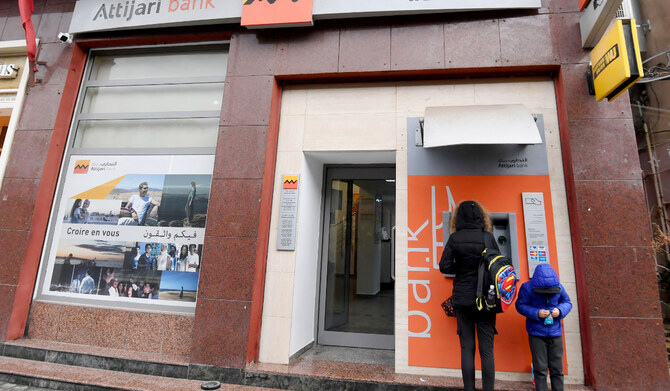
A child stands next to a woman as she withdraws money from an ATM on March 7, 2025 in Tunis. A new cheque reform, introduced by a recent law, has come into force in Tunisia. (AFP)
Short Url
Updated 11 March 2025
Follow

‘Got cash?’ Tunisians grapple with new restrictions on cheques

  • Consumers are under even more pressure during the current Muslim holy fasting month of Ramadan
  • Once a crucial pillar of Tunisia’s economic and social stability, the middle class made up around 60 percent of the population before the country’s 2011 revolution

TUNIS: Olfa Meriah stands, frustrated, before a smartphone shop near the capital Tunis. How can she buy a phone in instalments, she wonders, when a new banking reform has made split payments nearly impossible?
In Tunisia, where the average monthly salary hovers just around 1,000 dinars ($320), people have long relied on post-dated cheques to make purchases by paying in increments over months.
Unlike many other countries where cheques are now rarely seen in the era of instant online payments, the culture of paying by cheque persists in Tunisia.
But as part of banking reforms introduced in February the government seeks to reinforce the original role of cheques as a means of immediate payment. Cheques had effectively become a form of credit often tolerated by merchants.
Unlike debit cards, credit cards are not widely available in the north African country.
The new law officially aims at “curbing consumer debt” and “improving the business climate” in an economy whose real GDP growth, according to the International Monetary Fund, is projected at just 1.6 percent for 2025.
But many feel it has also begun disrupting household budgets and small businesses.
Ridha Chkoundali, a university professor and economist, said the new law “could be the last straw” for consumption and economic growth.
He said the measure upsets Tunisians’ customary consumer behavior, with mainly the middle class bearing its brunt.
“Since it came out, I’ve been searching for ways to pay for a smartphone over several months without it eating away my salary,” said Meriah, 43. “But the new cheques don’t allow that.”
Once a crucial pillar of Tunisia’s economic and social stability, the middle class made up around 60 percent of the population before the country’s 2011 revolution.
Experts now estimate it has fallen by more than half to 25 percent.

Leila, the owner of the smartphone shop in the Tunis-area district of Ariana, told AFP her sales have fallen by more than half, after she started taking cash only.
“No one buys anything anymore,” said Leila, who didn’t give her last name. “We didn’t understand the law because it’s complicated and we don’t trust it. We decided not to accept cheques anymore.”
“Got cash? Welcome. If not, I’m sorry,” she summed up.
Consumers are under even more pressure during the current Muslim holy fasting month of Ramadan.
Tunisians tend to buy more during Ramadan, stocking up on food and sweets as families gather for collective meals before and after their daytime fasting.
And as Eid Al-Fitr — the holiday marking the end of Ramadan — approaches at the end of March, shopping for clothes and gifts rises.
Many merchants had already grown reluctant to deal with cheques when the previous finance law ordered harsh prison sentences for cheque kiting — the fraudulent practice of issuing cheques with non-existent funds.
Last April, judicial authorities said they were investigating more than 11,000 bad-cheque cases.
This year’s reform is meant to reduce those cases. Based on the buyer’s income and assets, it has introduced a cap on the amount that cheques can be written for.
It also allows the merchant to check if the payer has enough funds upon each transaction by scanning a QR code on their cheque.

Many feel the measure is intrusive, and the technological shift already adds a level of complexity.
Badreddine Daboussi, who owns one of Tunis’s oldest bookstores told AFP the change has crippled his sales, adding to an already waning demand for books.
“Before, customers paid with post-dated cheques, but now they can’t, and the new online tool is complicated and unreliable.”
“They just can’t buy books anymore,” he added, noting he had even considered closing up shop.
Tunisia, a country of more than 12 million people, has long suffered sporadic shortages of basic items such as milk, sugar and flour.
Its national debt has risen to around 80 percent of GDP and inflation is at six percent, according to official figures.
Hamza Meddeb, a research fellow at the Malcolm H Kerr Carnegie Middle East Center in Beirut, wrote in October that President Kais Saied — who rejected IMF reforms — has engaged in “economic improvization” with “heavy reliance on domestic debt.”
Chkoundali, the other analyst, warned of “another recession.”
“As consumption shrinks, the already little economic growth we have will also decline,” he said.
Unemployment is already at 16 percent nationwide, according to official figures.
Feeble consumption would help push that figure even higher, Chkoundali explained, with workers risking significant layoffs as profits dwindle.


A language course is reviving Moroccan Jewish culture and bridging Middle East divide

Updated 7 sec ago
Follow

A language course is reviving Moroccan Jewish culture and bridging Middle East divide

  • “In my family there were (many) different languages — Moroccan Arabic, French, Hebrew at the synagogue, and my dad also speaks Amazigh, Berber,” said Elfassi.
  • His passions for music and language took Elfassi on a journey to Bordeaux, France, and Be’er Sheva, Israel, writing a dissertation on Jewish identity among Moroccan Jews

RABAT: Growing up in Fez, Morocco, Yona Elfassi was always aware of the history of the city, which has been a center of culture, learning and spirituality since the ninth century.
Home to great minds such as the 12th-century philosopher and jurist Ibn Rushd and his contemporary, the physician and codifier of Jewish law Maimonides, the city was shaped by Jewish, Arab, Amazigh, Spanish and French cultures.
These influences left a deep imprint on Elfassi, 37.
“In my family there were (many) different languages — Moroccan Arabic, French, Hebrew at the synagogue, and my dad also speaks Amazigh, Berber,” said Elfassi.
Music, too, was a constant presence — from Andalusian to Flamenco, to Moroccan classic, to Moroccan chaabi popular, to Berber music,” he said. “We weren’t a family of professional musicians, but we were a family that lived with music.”
As a Jewish resident of Morocco, Elfassi belongs to a tiny demographic, as 99 percent of Jews of Moroccan heritage today live elsewhere. After major emigrations in the 20th century, only around 2,500 Jews remain in a country where they once made up 5 percent of the population. Today an estimated 50,000 live in France, 25,000 in Canada and 25,000 in the United States; and some 1 million Moroccan Jews make up one of Israel’s largest ethnic groups.
His passions for music and language took Elfassi on a journey to Bordeaux, France, and Be’er Sheva, Israel, writing a dissertation on Jewish identity among Moroccan Jews. (He has two doctorates, one in sociology and political science from Sciences Po Bordeaux and one in anthropology and history from Ben-Gurion University of the Negev.)
His research into Morocco’s history eventually grew into a vocation to teach Darija, the Moroccan Arabic dialect, to allow diaspora Moroccan Jews to connect with their ancestors through language, culture and stories.
“As a sociologist, I was fueled by the conviction that academic research ought to forge connections and deepen understanding” beyond the academy, Elfassi said. “These stories and human histories are at the core of why I decided to teach, and my identity has inspired me to work with Jews of Moroccan background to reconcile with their ancestral language.”
As the COVID-19 pandemic ended, he launched Limud Darija, an educational movement and multimedia language platform. The hybrid courses mix Zoom classes with in-person gatherings, which take place in Israel. Elfassi also holds music workshops, drawing from Sephardic piyyutim— Jewish liturgical poems with Judeo-Arabic pronunciation and melodies — and the music of 20th-century Moroccan pop icons such as Hajja El Hamdaouia, Sliman Elmaghribi, Zohra El Fassiya and Abdelhadi Belkhayat.
Limud Darija’s impact has grown rapidly. “Today our community includes over 500 active members with the mission of connecting people across generations, helping participants reclaim lost voices and fostering resilience and a sense of belonging through cultural practices,” Elfassi said.
Through his Instagram feed and TikTok presence, many Moroccan Muslims have found Elfassi’s work and are inspired to see Moroccan Jews preserving the language of their shared home. Muslims, Elfassi said, in turn have expressed interest in learning Hebrew. “I opened an active WhatsApp group where we’re teaching Hebrew to Muslim speakers of Darija,” he said.
“Through this shared connection, divisions begin to fade,” Elfassi said. “The Israelis the Muslim Moroccans meet are seen as Moroccans like themselves, as family. They are talking a common language, talking about what unites them, people are begun to be seen as individuals.” The Muslims and Jews, he said, get the chance “to bond over music and heritage and language, not political or war-related topics, and they do not further the false ‘pro-Palestine’ vs ‘pro-Israel’ dichotomy, and instead humanize everyone as individuals, as human beings.”
Limud Darija students describe how the program has connected them more deeply with people in their own lives as well. “My parents talked between them in Moroccan language, but by the time I was an adult, I forgot,” said Yehudit Levy, a retired schoolteacher in Ganei Tikvah, Israel, who has studied with Elfassi for three years. “Since I started to learn with Yona, everything comes up — songs, music, food, poetry, all the traditional things come up. I smell Morocco when I am in the class.”
Noam Sibony, a Limud Darija alumnus, is a neuroscience researcher and musician living in Toronto. The 28-year-old spent nine months volunteering in Lod, an Israeli city whose population is Arab and Jewish, at a community center, working with local children and youth. Limud Darija, he said, showed him how learning the language of another culture can help build relationships that transcend regional politics and conflicts.
Habiba Boumlik, a professor of French, literature and women’s and gender studies at LaGuardia University in Queens, New York, and co-founder of the New York Forum of Amazigh Film, an annual film festival celebrating the Indigenous Berber people of North Africa, sees parallels between Elfassi’s work and her efforts to preserve the Tamazight language.
“I give credit to people who invest in learning language, and it is great with the new technology and variety of sources on the Internet. Even if people aren’t fluent, they can do so much with the language, and they will go to Morocco and connect more deeply,” Boumlik said.
Darija is closely related to the Judeo-Arabic dialect, Boumlik explained, and so has the potential to contribute to the Moroccan vernacular, just as Judeo-Arabic slang and idioms have shaped Modern Hebrew.
“The exchange among the Moroccans and Israelis will only enrich Darija as they also enrich their families and themselves,” Boumlik said. “And it is so important that they can connect with Moroccans on the Internet and have a dialogue. It is not just the culture and language of their grandparents — it is the living language and culture of the new generation.”
Bringing people together on this level, Elfassi said, is peacebuilding on a human scale, prioritizing personal stories, shared culture and mutual respect. “For me, peace will start with people, not with the decision-makers,” he said. “Peace is just two people talking to each other, having respect for each other and having a conversation where they can disagree, but where they always show respect for the humanity of the other.”