

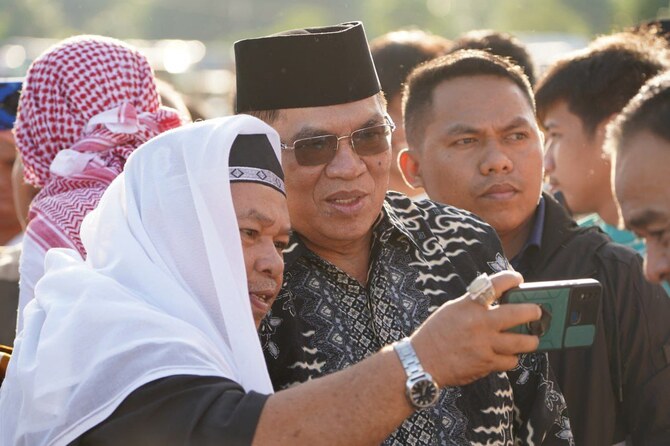

Manila: President Ferdinand Marcos Jr. has appointed a new interim chief minister to oversee the only Muslim-majority territory in the Philippines, as the region prepares for its first parliamentary elections in October.
Bangsamoro was at the heart of a four-decades-long separatist struggle until 2014, when the Philippine government struck a permanent ceasefire agreement with the Moro Islamic Liberation Front, paving the way for peace and autonomy in the region home to the biggest Muslim population in the predominantly Catholic country.
The Bangsamoro Autonomous Region in Muslim Mindanao was formed in 2019 as part of the region’s transition to autonomy, which will culminate in October this year, when it will elect its legislature and executive.
Until then, BARMM’s leadership is currently under a transition authority appointed by the Philippine president.
Marcos has appointed Abdulraof Macacua, the governor of Maguindanao del Norte — a province within the Bangsamoro region — to replace Murad Ebrahim, who had served as BARMM’s chief minister since 2019.
The change in leadership was confirmed on Sunday by Presidential Communications Office Undersecretary Claire Castro.
“This transition comes at a crucial time as the Bangsamoro region prepares for a significant milestone — its first parliamentary elections in October this year,” Presidential Peace Adviser Carlito G. Galvez, Jr. said in a statement on Monday.
“For the continuity and success of the Bangsamoro peace agreement, we place our trust in Interim Chief Minister Macacua as he takes the helm of governance.”
Macacua’s appointment was welcomed by Yshmael “Mang” I. Sali, the governor of Bangsamoro’s Tawi-Tawi province.
“We stand firmly behind the new leadership as we work together toward the goals of the Bangsamoro Government for the benefit of all its constituents,” Sali said.
Macacua, 67, has been a member of the Bangsamoro Transition Authority since 2019. Also known as Sammy Gambar, he was a senior MILF leader and had served as chief of staff of MILF’s armed wing.
Rikard Jalkebro, an expert on Muslim Mindanao and associate professor at the Anwar Gargash Diplomatic Academy in Abu Dhabi, said the “unexpected” change in BARMM’s leadership “carries significant political, governance and security” implications.
“It signals that (the palace) is not happy (or) confident that things are moving in the right direction,” Jalkebro told Arab News.
The last-minute leadership change may create uncertainties for ongoing governance programs, development initiatives and election preparations.
“Ebrahim was leading the BARMM transition with policies aligned with the peace process. Will Macacua continue these policies, or will he introduce new priorities that alter the region’s political and economic trajectory?” he said.
Though Macacua is also part of MILF, his appointment may also “indicate internal rifts within the organization,” according to Jalkebro.
As such, how the MILF and other Bangsamoro stakeholders react to the latest development in the coming months “will be critical” in determining “whether this shift strengthens or destabilizes” the transition process.
“The transition from a rebel movement to a formal political entity is delicate, and any perception of unfair political maneuvers could create tensions, particularly among grassroots MILF supporters,” Jalkebro said.
“The long-term effect will hinge on whether Macacua can maintain stability, ensure a fair election, and uphold BARMM’s autonomy without undue national government interference. This moment is a critical test for the future of Bangsamoro self-governance.”


