Philippines’ Duterte says he will accept arrest if ICC issues warrant

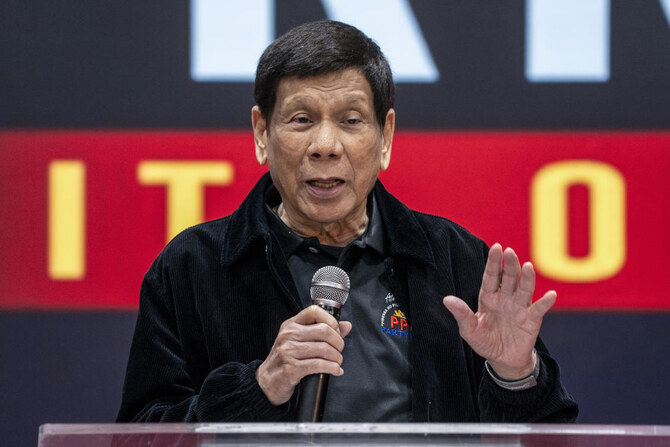
Former Philippines President Rodrigo Duterte said in Hong Kong that he was ready for possible arrest. (AP)
Short Url
Updated 10 March 2025
Follow

Philippines’ Duterte says he will accept arrest if ICC issues warrant

  • ‘War on drugs’ was the signature campaign policy that swept Duterte to power in 2016
  • The firebrand Duterte unilaterally withdrew the Philippines from the ICC’s founding treaty in 2019

HONG KONG/MANILA: Former Philippines President Rodrigo Duterte said in Hong Kong that he was ready for possible arrest amid reports the International Criminal Court (ICC) was poised to issue a warrant over his years-long “war on drugs” that killed thousands.
The “war on drugs” was the signature campaign policy that swept Duterte to power in 2016 as a maverick, crime-busting mayor, who delivered on promises he made during vitriolic speeches to kill thousands of narcotics dealers.
The office of the current President Ferdinand Marcos Jr said on Monday no official communication had been received from Interpol yet, but indicated Duterte could be handed over.
“Our law enforcers are ready to follow what law dictates, if the warrant of arrest needs to be served because of a request from Interpol,” Presidential Communications Undersecretary Claire Castro told reporters.
It was not immediately clear how long Duterte would stay in China-ruled Hong Kong — which is not a party to the ICC. Duterte was in the city to speak at a campaign rally attended by thousands of Filipino workers, hoping to boost support for his senatorial candidates in upcoming Philippine midterm elections.
“Assuming it’s (warrant) true, why did I do it? For myself? For my family? For you and your children, and for our nation,” Duterte told the rally, justifying his brutal anti-narcotics campaign.
“If this is truly my fate in life, it’s okay, I will accept it. They can arrest me, imprison me.
“What is my sin? I did everything in my time for peace and a peaceful life for the Filipino people,” he told the cheering crowds in Hong Kong’s downtown Southorn Stadium, appearing with his daughter, the Philippines Vice President Sara Duterte.
An elite Hong Kong police unit for protecting VIPs was stationed in the vicinity of the hotel where Duterte is staying, according to a Reuters witness.
The Hong Kong government’s security bureau and police gave no immediate response to a request for comment.
The Philippines presidential office dismissed speculation that Duterte might evade the law by visiting Hong Kong, while appealing to Duterte’s supporters to allow the legal process to take its course.
During a congressional hearing last year into his bloody crackdown on drugs, Duterte said he was not scared of the ICC and told it to “hurry up” on its investigation.
The firebrand Duterte unilaterally withdrew the Philippines from the ICC’s founding treaty in 2019 when it started looking into allegations of systematic extrajudicial killings.
More recently, the Philippines has signalled it is ready to cooperate with the investigation in certain areas.


Asylum applications drop to 40-year low in Sweden

A picture taken on June 26, 2023, shows migrants receiving food and clothes from an NGO in Athens. (AFP)
Updated 7 sec ago
Follow

Asylum applications drop to 40-year low in Sweden

  • Asylum seekers and their family members accounted for just 6 percent of the total, compared with 31 percent in 2018, when total immigration was 133,000

STOCKHOLM: The number of people applying for asylum in Sweden dropped by 30 percent in 2025 to the lowest level since 1985, with the ​right-of-center government saying it planned to further tighten rules this year ahead of an election in September.
The ruling minority coalition, which is supported by the anti-immigration Sweden Democrats, has made cutting the number of asylum seekers a key policy platform since taking power in 2022. It blames a surge ‌in gang ‌crime on decades of loose ‌asylum laws and ​failed ‌integration measures under previous Social Democrat-led governments.

FASTFACT

The Swedish government has cracked down on asylum seekers, made it more difficult to gain residency and citizenship, and introduced financial incentives for immigrants to leave the country.

“The change is not just about numbers in terms of lower immigration, it’s also about the way that’s made up, who is coming to Sweden with the proportion from asylum at a record low,” said Immigration Minister Johan Forssell.
The number of immigrants, excluding refugees from Ukraine, fell to 79,684 last year from 82,857 in 2024, according to figures from the Migration Board. 
Asylum seekers and their family members accounted for just 6 percent of the total, compared with 31 percent in 2018, when total immigration was 133,000.
The number of people either voluntarily returning to another country or being expelled by authorities was also up.
“This is an area which is a high priority for us,” Forssell said.
The government has cracked down on asylum seekers, made it more difficult to gain residency and citizenship, and introduced financial incentives for immigrants to leave the country since it came to power.
Forssell said the government planned to further tighten regulations in the coming year, including a new law to increase the number of returnees and stricter citizenship rules, among other measures.
Swedes will ‌vote in what is expected to be a tight general election in September.
Meanwhile, Denmark’s strict immigration policies drove asylum admissions to a historic low in 2025, with 839 requests granted by the end of November, the government said.
“It is absolutely critical that as few foreigners as possible come to Denmark and obtain asylum. My main priority is to limit the influx of refugees,” said Immigration Minister Rasmus Stoklund in a press release.
According to the ministry, “there have been very few years when the annual total remained below 1,000 ... 2025 will be a year with a historically low number of residence permits granted on asylum grounds.”
Denmark registered 1,835 asylum requests by November 2025.
The country’s immigration approach has been influenced by far-right parties for more than 20 years, and Prime Minister Mette Frederiksen, leader of the Social Democrats, has pursued a “zero refugee” policy since taking office in 2019.
Copenhagen has, over the years, implemented a slew of initiatives to discourage migrants and make Danish citizenship harder to obtain.
In 2024, the country of 6 million people accepted some 860 of the 2,333 asylum requests lodged that year.