

Sharjah’s economy to soar 7.5% in 2025, boosting its sector hub status – UAE official

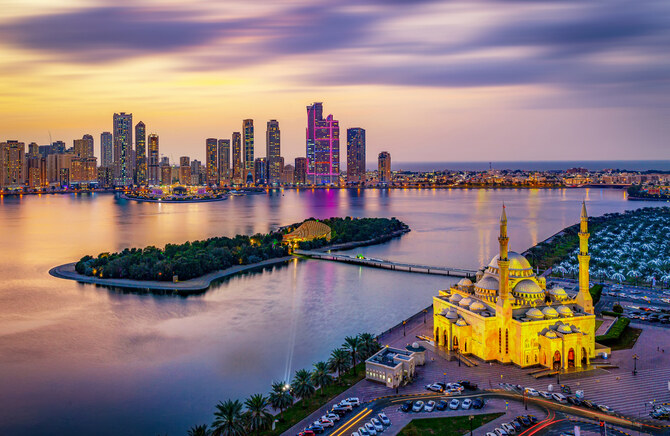
Sharjah is a key destination for manufacturing, services, and finance, with nearly 96 percent of its economy non-oil-based. Shutterstock
Short Url
Updated 10 March 2025
Follow

Sharjah’s economy to soar 7.5% in 2025, boosting its sector hub status – UAE official

JEDDAH: Sharjah’s economy is projected to grow by up to 7.5 percent in 2025, strengthening its position as a hub for diverse sectors, according to a senior UAE official.

Executive Chairman of the Department of Government Relations Sheikh Fahim bin Sultan bin Khalid Al-Qasimi highlighted that the expected expansion will be driven by progressive policies, increased economic integration, and rising foreign investment in strategic industries.

Al-Qasimi underlined the importance of ongoing dialogue with the private sector to strengthen core industries such as manufacturing, trade, agriculture, and environmental sustainability.

“We will be hosting a number of quite frank discussions with the private sector about what the government should be doing better to protect the core industries – manufacturing, trading, agriculture and the environment — that we have,” Al-Qasimi said during the Sharjah Ramadan Majlis 2025.

The event, which was held under the theme “Sharjah: Shaping the Future, Empowering Growth,” was attended by senior officials, including Sheikha Bodour bint Sultan Al-Qasimi, president of the American University of Sharjah; and Thani bin Ahmed Al Zeyoudi, minister of state for foreign trade.

During the gathering, Al-Qasimi said that Sharjah’s economy is evolving at an impressive pace, with the gross domestic product now over 145 billion dirhams ($39.47 billion), and growth of 6.5 percent registered in 2023 — surpassing the global average by 3.5 percentage points. 

“We are immensely proud of the businesses that have found their home in Sharjah, especially those in the private sector, that have been the backbone of our economy for over a decade, and there is a reason why global giants such as Halliburton and Amazon have shown their confidence by investing in our emirate,” he said. 

Al-Qasimi forecasted that continued integration, smarter policymaking, and collaboration with the private sector would contribute to growth ranging between 6.5 percent to 7.5 percent in the coming years.

He added that the automotive industry and vehicle parts trading accounted for 24 percent of the emirate’s economy, with agriculture at 19 percent, at manufacturing on 17 percent — the same level the broader food ecosystem.

Al-Qasimi also pointed to the potential growth in the real estate sector in 2025, citing major developers like Alef Group and Arada, which are making significant investments in the emirate.

Founded by Sheikh Sultan bin Ahmed Al-Qasimi and Prince Khaled bin Alwaleed bin Talal, Arada is at the forefront of Sharjah’s expanding real estate market.

To foster this growth, Al-Qasimi stressed the importance of identifying supply chain interdependencies and collaborating closely with the private sector. “We need to identify the adjacencies and interdependencies in supply chains to understand from the private sector what we need to do to move forward,” he said.

Foreign Trade Minister Al-Zeyoudi pointed to Sharjah’s attractiveness to businesses, bolstered by initiatives like “Invest in Sharjah,” the Sharjah Investment and Development Authority, or Shurooq, and Sharjah Research, Technology and Innovation Park.

“Companies are moving here, and we aim to showcase the incentives, markets, and benefits available through the UAE’s Comprehensive Economic Partnership Agreements,” he said during the same event.

Juma Al-Kait, assistant undersecretary for foreign trade at the Ministry of Economy, emphasized the significance of foreign trade, a cornerstone of the UAE’s economic strategy.

He noted that the UAE’s foreign trade grew by 14.6 percent in 2024, hitting 3 trillion dirhams, outpacing the global rate, which recorded 2 percent. “If we look at Sharjah’s foreign trade, it grew 8.1 percent in 2024 compared to last year. There is a huge potential for the private sector to benefit or to utilize important agreements.” Al-Kait said. 

Sharjah is a key destination for manufacturing, services, and finance, with nearly 96 percent of its economy non-oil-based. Home to six specialized free zones, the emirate offers flexible investment opportunities and advanced infrastructure.


Global markets slide as US-Israel strikes on Iran rattle investors 

Updated 5 sec ago
Follow

Global markets slide as US-Israel strikes on Iran rattle investors 

RIYADH: Global markets plunged on March 2 after US and Israeli strikes on Iran triggered Gulf-wide retaliation, disrupting energy and financial hubs and rattling investors worldwide. 

Equities across Asia fell in early Monday trading as investors moved into safe-haven assets amid fears of prolonged conflict and supply disruptions in the energy-rich Middle East.

Oil prices surged sharply while global stock markets came under pressure, reflecting concerns that escalating tensions could fuel inflation and slow economic growth. 

Asian markets tumbled in early trade, with Japan’s Nikkei 225 and South Korea’s Kospi declining by 2.7 percent and 4.3 percent, respectively. 

Indian benchmark indices extended losses, with the BSE Sensex falling 1.90 percent and the NSE Nifty 50 dropping 1.88 percent as of 11:30 a.m. Saudi time. 

Pakistan’s stock market was also hit by geopolitical tensions, plunging as much as 9.6 percent at the open on Monday — the worst fall of its kind on record — according to Reuters. 

Commenting on the latest developments, Charu Chanana, chief investment strategist at Saxo Bank, said in a statement that Asian markets opened Monday trading in a risk-off mood, with pressure most visible in airline, cyclical and trade-exposed sectors. 

She added that energy, mining and defense stocks — including companies involved in drone technology, which has been widely deployed in the conflict — could show relative resilience during periods of geopolitical tension. 

“Traditional defensives such as utilities, consumer staples and healthcare may hold up better than the broader market, but they are not immune if the selloff is driven by higher oil prices and inflation concerns,” said Chanana.  

She added: “Asia and EM (emerging markets) also face a dual shock of higher oil prices, which tend to be an inflation/tax effect and a broader pullback in risk appetite.”  

Tony Hallside, CEO of STP Partners, told Arab News that the immediate impact of the ongoing war is a geopolitical risk premium in crude, driven by tanker disruptions and the threat of a Strait of Hormuz choke point. 

“The macro takeaway is simple: higher energy feeds inflation expectations, squeezes consumer demand in importing economies, and complicates the path for interest rates,” said Hallside.  

He added: “The early pattern is 'risk off': investors rotate into safe havens — gold, the US dollar, Swiss franc — and trim equities, especially in energy-importing regions. You can see it in the tape: oil and gold up, major equity futures and indices weaker, and FX rewarding perceived safety and energy self-sufficiency.” 

Echoing similar views, Chanana said higher oil prices raise the risk of stickier headline inflation and could slow the pace at which inflation readings improve. 

“That does not automatically mean policy tightening, but it can make the Fed more cautious about cutting quickly, because energy-driven inflation can spill into expectations and broader pricing behavior over time,” she said.  

Chanana added that gold tends to perform well when investors seek assets less dependent on earnings visibility, supply chains or any single region’s political risk. 

Investment in gold can also serve as a policy-plus-inflation hedge in an environment where energy risks complicate the macro outlook — creating “double support” for gold and, to a degree, other precious metals. 

“Silver can see bigger upside in a risk-off bid because it typically carries more beta than gold: it can rally harder when safe-haven demand and inflation hedging rise, but it also tends to be more volatile on the way there,” said Chanana.  

She added that equities could stabilize and retrace if tensions in the region de-escalate, although oil may remain above pre-event levels as insurance and security costs take time to normalize. 

Subramanian Sharma, director of Greenback Advisory Services, told Arab News that the Iran-US conflict is likely to have a significant impact on oil prices, as a potential closure of the Strait of Hormuz could sharply raise the landing cost of crude for major importing countries, leading to higher freight and insurance expenses. 

According to Sharma, this would push up inflation in oil-importing nations and could weigh on their economic growth. 

“If the war continues for some more days, we can see a ripple effect on these economies, and it will weaken their currencies,” said Sharma. 

He cautioned that investors have grown increasingly jittery since the onset of the conflict, a trend already reflected in global equity market movements. 

“Share markets in major countries are down, and people may resort to panic selling, which will add more pressure to the dice,” said Sharma.  

He added: “Overall, the sentiment will remain bearish, and if the war prolongs, we can see more pain across the globe.”