China-US trade war heats up as Beijing’s tariffs take effect

1 / 2
People shop for vegetables in a market in Beijing on March 9, 2025. Consumer prices in China fell last month, with authorities struggling to kickstart spending and trade headwinds intensifying as US tariffs kick in under Donald Trump. (AFP)
2 / 2
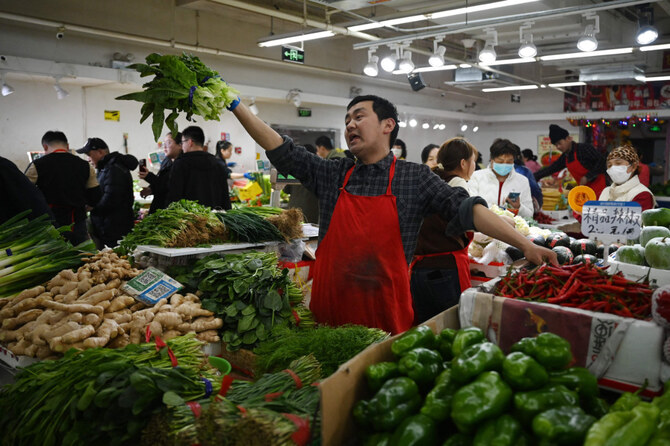
A vendor shouts out his price for lettuce in a market in Beijing on March 9, 2025, as China's trade war with the US escalates, triggered by Trump's tariffs. (AFP)
Short Url
Updated 10 March 2025
Follow

China-US trade war heats up as Beijing’s tariffs take effect

  • After imposing a blanket 10 percent tariff on all Chinese goods in early February, Trump hiked the rate to 20 percent last week
  • China retaliated by imposing levies of 10 and 15 percent on several US farm products, a move designed to hurt Trump’s voter base

BEIJING: China’s tariffs on certain US agricultural goods in retaliation for President Donald Trump’s latest hike on Chinese imports came into force Monday, as trade tensions mount between the world’s two leading economies.
Since retaking office in January, Trump has unleashed a barrage of tariffs on major US trading partners, including China, Canada and Mexico, citing their failure to stop illegal immigration and flows of deadly fentanyl.
After imposing a blanket 10 percent tariff on all Chinese goods in early February, Trump hiked the rate to 20 percent last week.
Beijing reacted quickly, its finance ministry accusing Washington of “undermining” the multilateral trading system and announcing fresh measures of its own.
Those tariffs come into effect Monday and see levies of 10 and 15 percent imposed on several US farm products.
Chicken, wheat, corn and cotton from the United States will now be subject to the higher charge.
Soybeans, sorghum, pork, beef, aquatic products, fruit, vegetables and dairy will face the slightly lower rate.
The tariffs will not apply to goods that left before March 10, however, as long as they arrive in China by April 12.
Analysts say Beijing’s retaliatory tariffs are designed to hurt Trump’s voter base while remaining restrained enough to allow room to hash out a trade deal.
The increasing trade headwinds add to difficulties faced by Chinese leaders currently seeking to stabilize the country’s wavering economy.
Sluggish consumer spending, a prolonged debt crisis in the vast property sector and high youth unemployment are among the issues now facing policymakers.
Analysts say China’s exports — which last year reached record highs — might not provide the same economic lifeline for Beijing as its trade war with Washington intensifies.

Experts say the full effects of the recent wave of tariffs have yet to be fully felt, though early signs already indicate a downturn in shipments.
China’s exports grew 2.3 percent year-on-year during the first two months of 2025, official data showed Friday, missing expectations and slowing significantly from the 10.7 percent growth recorded in December.
“As exports face downside risk with trade war looming, the fiscal policy needs to become more proactive,” wrote Zhiwei Zhang, president and chief economist at Pinpoint Asset Management.
The latest trade data came as Chinese officials congregated in Beijing for the country’s largest annual political gathering, known as the “Two Sessions.”
During a speech to delegates on Wednesday, Premier Li Qiang laid out the government’s economic strategy for the year ahead, acknowledging “an increasingly complex and severe external environment.”
Li also announced that the government’s official growth target for the year ahead would be “around five percent” — the same as 2024.
Many economists consider that goal to be ambitious, considering the hurdles facing China’s economy.
“If fiscal spending starts to ramp up again soon then that could more than offset the near-term hit to growth from tariffs,” wrote Julian Evans-Pritchard of Capital Economics.
“However, given the wider headwinds... we still aren’t convinced that fiscal support will be sufficient to deliver anything more than a short-lived boost,” he added.


Pakistan PM Sharif to seek clarity on troops for Gaza in US visit, sources say

Updated 3 sec ago
Follow

Pakistan PM Sharif to seek clarity on troops for Gaza in US visit, sources say

  • Sharif is set to attend the first formal meeting of Trump’s Board of Peace in Washington on Thursday
  • “Let me make it clear that our troops could only be part of a peace mission in Gaza,” said a source

ISLAMABAD: Before Pakistan commits to sending troops to Gaza as part of the International Stabilization Force it wants assurances from the United States that it will be a peacekeeping mission rather than tasked with disarming Hamas, three sources told Reuters.
Pakistan’s Prime Minister Shehbaz Sharif is set to attend the first formal meeting of President Donald Trump’s Board of Peace in Washington on Thursday, alongside delegations from at least 20 countries.
Trump, who will chair the meeting, is expected to announce a multi-billion dollar reconstruction plan for Gaza and detail plans for a UN-authorized stabilization force for the Palestinian enclave.
Three government sources said during the Washington visit Sharif wanted to better understand the goal of the ISF, what authority they were operating under ⁠and what the ⁠chain of command was before making a decision on deploying troops.
“We are ready to send troops. Let me make it clear that our troops could only be part of a peace mission in Gaza,” said one of the sources, a close aide of Sharif.
“We will not be part of any other role, such as disarming Hamas. It is out of the question,” he said.
Pakistan’s foreign ministry did not respond to a Reuters request for a comment.

FORCE ⁠TO OVERSEE RECONSTRUCTION AND RECOVERY
Trump’s 20-point Gaza plan calls for a force from Muslim nations to oversee a transition period for reconstruction and economic recovery in the devastated Palestinian territory, and Washington has been pressing Islamabad to join.
Analysts say Pakistan would be an asset to the multinational force, with its experienced military that has gone to war with arch-rival India and tackled insurgencies.
“We can send initially a couple of thousand troops anytime, but we need to know what role they are going to play,” the source added.
Two of the sources said it was likely Sharif, who has met Trump earlier this year in Davos and late last year at the White House, would either have an audience with him on ⁠the sidelines of the ⁠meeting or the following day at the White House.

BALANCING FACTORS
Initially designed to cement Gaza’s ceasefire, Trump sees the Board of Peace, launched in late January, taking a wider role in resolving global conflicts. Some countries have reacted cautiously, fearing it could become a rival to the United Nations.
While Pakistan has supported the establishment of the board, it has voiced concerns against the mission to demilitarise Gaza’s Islamist militant group Hamas.
Analysts say Islamabad will need to strike a balance between pleasing Trump by providing troops and any potential domestic fallout in a predominantly Muslim nation.
Husain Haqqani, a former Pakistan ambassador to the United States, said the Pakistani public supported sending troops to Gaza only to help protect Palestinians.
“If developments in Gaza after the deployment do not improve the position of Palestinians, there could be a massive reaction at the public level in Pakistan,” said Haqqani, currently a scholar at the Hudson Institute in Washington.