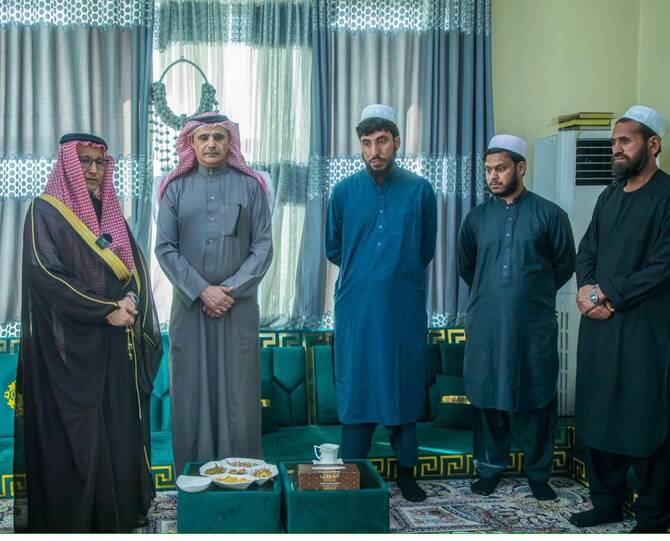
RAFHA: The Yemeni community in Rafha governorate, in the Northern Borders region of Saudi Arabia, is an enduring model of coexistence and social integration.
One of the oldest expatriate communities in the governorate, Yemeni residents have contributed for decades to the social and economic fabric of the area, becoming an inseparable part of its local identity.
With the arrival of the holy month of Ramadan, those bonds come into sharper relief. Ancient Yemeni traditions blend seamlessly with the Kingdom’s Ramadan atmosphere in scenes that speak to a spirit of brotherhood and mutual enrichment — underscoring the depth of a shared human experience in a country that prides itself on security, stability, and cultural diversity.
Speaking to the Saudi Press Agency, Yemeni residents in Rafha said they feel no sense of estrangement during their time in the Kingdom, citing the social and historical ties that unite the two peoples. They noted that Ramadan creates a unifying space where shared values converge — chief among them generosity, kinship, and social solidarity — most visibly expressed through iftar tables that bring together neighbors and friends of all nationalities.
Abdulrazzaq Al-Shuja’a explained that Yemeni families take care to preserve their Ramadan traditions as an expression of cultural identity, from extended family gatherings and the exchange of traditional dishes, to the observance of Ramadan evenings through prayer and communal activities.
Iftar spreads are anchored by dishes carried down through generations, most notably shafoot, saltah, bint al-sahn, hareesh, areekah, fahsah, masoub, lahoh, mandi with lamb, and sahawiq, set beside Saudi staples in an easy, unforced blending of two culinary cultures.
Bashar Al-Shuja’a described the Kingdom as a genuinely multicultural environment, one where different nationalities live alongside one another with real mutual respect rather than mere tolerance. Ramadan, he said, brings that quality into the open and gives it renewed force.
For Iyad Al-Hassani, the picture is also an economic one. Yemeni workers and families have contributed to development in numerous sectors and regions of the Kingdom, he said, and their participation in civic and communal life — including the shared rituals of Ramadan — reflects the depth of long-rooted human ties and embodies a genuine sense of shared responsibility.
Several Yemeni residents described the Ramadan atmosphere in the Kingdom as one that gives them a feeling of warmth and reassurance — particularly through charitable initiatives and communal iftar projects that foster connection and reinforce values of cooperation and goodwill.
The Ramadan experience for Yemenis in Rafha ultimately distills the meaning of a human belonging that transcends borders, where memories and traditions intertwine in an atmosphere of mutual appreciation. In this way, Ramadan becomes a season for deepening social ties and entrenching the values of coexistence, offering yet another reflection of the Kingdom as a model of cultural diversity and communal harmony under the unifying canopy of Islamic values.