

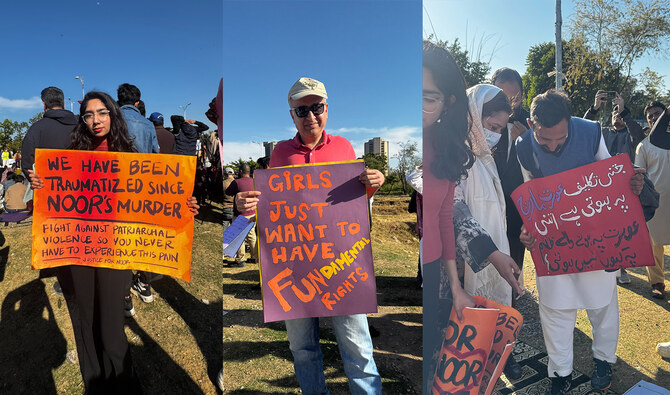

ISLAMABAD: Hundreds of women carrying placards and shouting slogans for equality took to the streets of Pakistan’s capital on Saturday afternoon, demanding an end to gender-based violence and sexual harassment in the South Asian country.
The Aurat March — Urdu for “women’s march” — began in 2018 as a single march for International Women’s Day held in Pakistan’s southern port city of Karachi. However, it has become an annual event held in multiple cities.
The marches have faced opposition from religious conservatives who allege the group receives Western funding as part of a plot to promote obscenity in Pakistan. The organizers deny this, saying the marches are locally funded with grassroots participation and focus on equal rights and opportunities for women.
This year’s march by the Islamabad chapter of the Aurat March was organized under the theme: “Feminist Politics vs Patriarchal State.” Aurat March said this year’s protest aimed to confront an oppressive state that seeks to silence women, minorities and transgenders. Hundreds of men and women, including activists and people from all walks of life, gathered at the National Press Club on Saturday to register their protest.
“The main reason for celebrating this day (Mar. 8) has always been that we resolve to continue our struggle,” Ismat Raza Shahjahan, a leader of the left-wing Awami Workers Party, told Arab News.
“And at the same time we will defend the rights we have secured and move forward with the agenda of gender equality.”

Women activists of 'Aurat March' group hold a banner during a demonstration to mark the International Women's Day in Islamabad on March 8, 2025. (AFP)
Shaheena Kausar, one of the march’s organizers, criticized police for stopping the Aurat March from marching beyond a few miles from the National Press Club. She regretted the authorities’ decision to not grant permission to Aurat March to hold its gathering beyond the press club.
“This time as well we had applied in advance and also went for meetings [for a no-objection certificate] but we were not given the NOC,” Kausar told Arab News.
“You can see, they stopped us a few meters after we marched.”
When asked why the Islamabad chapter of the Aurat March had held its gathering on Mar. 8 despite it being the month of Ramadan, in which Muslims fast from dawn till dusk, Kausar said:
“If the injustices against women are not stopping in Ramadan, then how can the march be stopped?”

A woman activist of 'Aurat March' group holds a banner during a demonstration to mark the International Women's Day in Islamabad on March 8, 2025. (AN Photo)
In Pakistan, just 21 percent of women are in the workforce and less than 20 percent of girls in rural areas are enrolled in secondary school, according to the United Nations. Only 12 women were directly elected to parliament out of 266 seats in last year’s election.
Much of Pakistani society operates under a strict code of “honor,” with women beholden to their male relatives over choices around education, employment and who they can marry. Hundreds of women are killed by men in Pakistan every year for allegedly breaching this code.
Moin, an Islamabad resident and a father of three daughters, said he has been coming to the Aurat March’s annual event ever since it started to demand equal rights for women.
“Why do I come? Well, to change the country, to sort of give a voice to help women and girls to work shoulder-to-shoulder with men,” Moin told Arab News.
“Otherwise, we don’t have a future.”

A man holds a banner during a demonstration to mark the International Women's Day in Islamabad on March 8, 2025. (AN Photo)


