

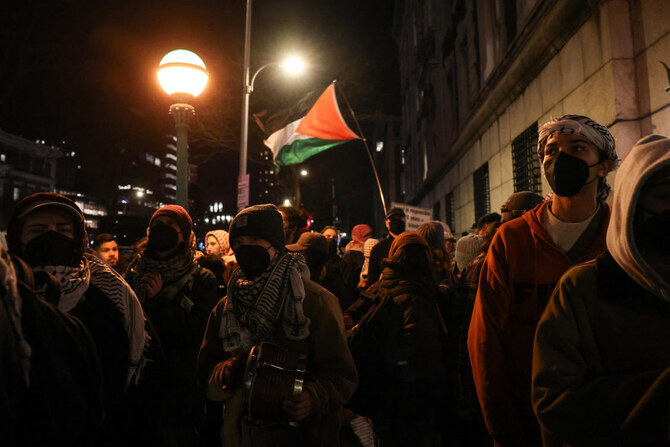

NEW YORK: US President Donald Trump’s administration said it had canceled grants and contracts worth about $400 million to Columbia University because of what it described as antisemitic harassment on and near the school’s New York City campus.
Friday’s announcement was made in a joint statement by the departments of Justice, Education and Health and Human Services as well as the General Services Administration.
The Trump administration declined to specify the grants and contracts affected or its evidence of antisemitic harassment.
The announced cuts would come out of what the administration said was more than $5 billion in grants presently committed to Columbia. Much of the funding goes to health care and scientific research but Reuters could not verify the figures.
The announcement of “immediate” cuts was likely to face legal challenges, with civil rights groups saying the contract cancelations lacked due process and were an unconstitutional punishment for protected speech.
Columbia has been at the forefront of a pro-Palestinian and anti-Israel student protest movement that swept across campuses over the last year as Israel’s war in Gaza has raged.
The university has said it has worked to combat antisemitism and other prejudice on its campus while fending off accusations from civil rights groups that it is letting the government erode academia’s free speech protections.
Columbia protesters, some of whom seized control of an academic building for a few hours in April and set up tent encampments on campus lawns, have demanded the school stop investing in companies that support Israel’s military occupation of Palestinian territories.
There have been allegations of antisemitism, Islamophobia and racism in protests and pro-Israel counter-protests.
Columbia University Apartheid Divest, a coalition of student groups behind the pro-Palestinian protests, includes Jewish students and groups among its organizers. They say that criticism of Israel is being wrongly conflated with antisemitism. Some Jewish and Israeli students have said the protests are intimidating and disruptive.
“Cancelling these taxpayer funds is our strongest signal yet that the Federal Government is not going to be party to an educational institution like Columbia that does not protect Jewish students and staff,” Leo Terrell, who leads the Justice Department’s antisemitism task force, said in the statement.
Wyn Hornbuckle, a Justice Department spokesperson, declined to specify the grants and contracts that were cut. Hornbuckle also declined to describe the government’s evidence of antisemitism at Columbia. Spokespeople for the other three departments did not respond to questions.
CRITICS SAY CUTS PUNISH POLITICAL SPEECH
The university has disciplined dozens of pro-Palestinian students and staff over the last year, in many cases issuing suspensions, and twice called in police to have pro-Palestinian protesters arrested, which was widely criticized by faculty.
Samantha Slater, a Columbia spokesperson, said school staff “pledge to work with the federal government to restore Columbia’s federal funding.”
“We take Columbia’s legal obligations seriously and understand how serious this announcement is and are committed to combating antisemitism and ensuring the safety and wellbeing of our students, faculty, and staff,” her statement said.
Slater did not say if the school was told which grants and contracts had been affected.
The Civil Rights Act’s Title VI allows the government to investigate schools that receive federal funding if they are accused of discriminating against people on the basis of religion or national origin, among other protected classes.
The New York Civil Liberties Union said Friday’s announcement of immediate cuts was misusing the law to punish political speech.
“It is unconstitutional and unprecedented, but it is entirely consistent with Trump’s long-held desire to silence views with which he disagrees and clamp down on protest,” NYCLU Executive Director Donna Lieberman said in a statement.
“Protected political speech should not be a basis of punishment, and Title VI must be applied consistently with the First Amendment.”
US Jewish organizations had mixed responses to the announcement.
Brian Cohen, executive director of the pro-Israel student organization Hillel at Columbia, said in a statement he hoped the announcement would be a “wake-up call to Columbia’s administration and trustees.”
J Street, a Washington-based pro-Israel advocacy group, said there were unacceptable levels of antisemitism at Columbia but that Friday’s announcement undercut efforts to fix this.
“This decision is part of the Administration’s broader attack on academic institutions, and may cause these same institutions to overcorrect – stifling free speech for fear of having all of their funding cut,” Erin Beiner, director of the group’s student wing J Street U, said in a statement.


