

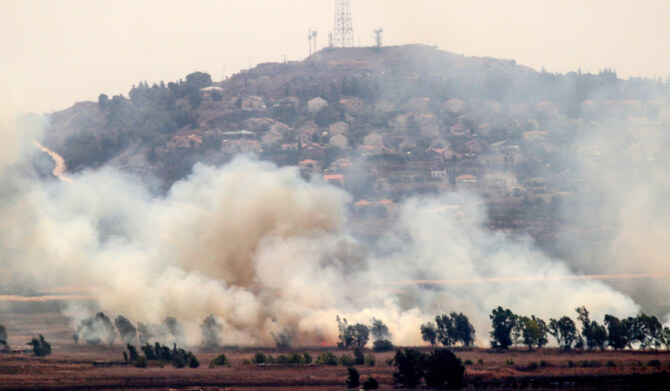


BEIRUT: An Israeli airstrike in southern Lebanon killed one and critically injured another person on Saturday.
The Israeli drone raid took place between 15 km and 20 km from the Blue Line, along the road connecting Kherbet Selem and Al-Souwaneh, a town in western Marjayoun.
The Israeli army claimed that the strike was an attack on a “Hezbollah member, who was working on restoring the infrastructure in southern Lebanon.”
The incident came a day after a significant escalation in the conflict.
BACKGROUND
The economic cost of the conflict between the Israeli army and Hezbollah is estimated at $14 billion, according to a World Bank report.
Israeli warplanes on Friday carried out a series of raids on several areas in southern Lebanon, targeting several locations without prior warning.
Over 25 raids were carried out in 20 minutes, including on valleys and forested areas.
The strikes targeted the outskirts of Zebqine, Yahoun, Aaichiyeh, Rihan, Ansar, and Baisariyeh.
The targeted villages are inhabited and deep in the south, north of the Litani River, rather than being frontline areas.
The Israeli army claimed in a statement that “it bombed military sites of the terrorist Hezbollah organization in southern Lebanon, where weapons and rocket launchers belonging to Hezbollah were identified.”
It added that “the weapons and the rocket launchers in the military sites posed a threat to Israel and constituted a blatant violation of the understandings between Israel and Lebanon.”
The army said that “it will continue to remove any threats to Israel and block any attempts to restore and strengthen Hezbollah’s presence.”
There was no official reaction from Iran-backed Hezbollah following the attacks.
However, Hezbollah MP Hassan Ezzeddine said: “The resistance remains Lebanon’s first line of defense.
“It is essential, as it constitutes an effective deterrent against any attempt by Israel to expand its occupation and extend its incursion into Lebanese territory.
“We will remain fully prepared, and we have the capabilities that qualify us to deter any aggression or any occupation attempt or expansion.”
Ezzeddine stressed that funding for the reconstruction of the south, southern suburbs, and Bekaa must not come with political conditions or interfere with Lebanon’s sovereignty and independence.
Ezzeddine said: “Any form of extortion, whether from a friendly, allied, or brotherly nation, or any country in the East or West, is completely rejected.
“We are not willing to be humiliated in rebuilding this nation and repairing what this enemy has destroyed.”
The MP’s warning came as a group of activists supporting Hezbollah launched a campaign criticizing the “silence of the Lebanese state” regarding Israeli attacks.
The activists also criticized the “silence of the quintet committee tasked with monitoring the implementation of the ceasefire agreement and the enforcement of UN Resolution 1701.”
Meanwhile, Israeli Finance Minister Bezalel Smotrich warned that Lebanese infrastructure “will pay a heavy price if Hezbollah continues its movements.”
Smotrich spoke as Israeli aggression continued on Friday night.
He added: “Tonight will be violent on our northern border, and this is just the beginning.”
The minister hinted at a potential conflict that “this time will encompass all of Lebanon, not just Hezbollah.”
MP Qassem Hashem, a member of the Development and Liberation parliamentary bloc, criticized the silence surrounding Israeli attacks and the failure to adhere to the agreement to cease hostilities.
He highlighted concerns over the encroachment on new areas of Lebanese territory and provocations that included allowing settlers and religious tourists to enter Lebanese land.
Hashem said: “We have not heard of any swift action despite the expansion of aerial attacks.
“What role is the oversight committee playing in curbing Israeli aggression, or is it merely providing cover and justifications for the Israelis to target Lebanon in preparation for imposing conditions aligned with developments in Syria and the region?”
Environment Minister Tamara El-Zein on Saturday reacted to a World Bank report released the previous day, which assessed the damage and needs resulting from Israeli action in Lebanon.
The minister said the preliminary report resulted from technical collaboration between the World Bank and the National Council for Scientific Research over several months.
The council serves as the official representative of the Lebanese state, monitoring attacks and evaluating their impact.
Data provides an initial estimated overview of the extent of the damage and allows the Lebanese state to mobilize the necessary international funding for reconstruction and recovery, the minister said.
The economic cost of the conflict between the Israeli army and Hezbollah is estimated at $14 billion, according to the report.
The damage to physical infrastructure is about $6.8 billion, while the economic losses resulting from decreased productivity, lost revenues, and operational costs amount to about $7.2 billion.
The housing sector has been the most affected, with damages estimated at about $4.6 billion.
The report indicated that trade, industry, and tourism had been significantly affected, with estimated losses amounting to about $3.4 billion.


