Fresh strikes hit Iran as Israel says war enters ‘next phase’

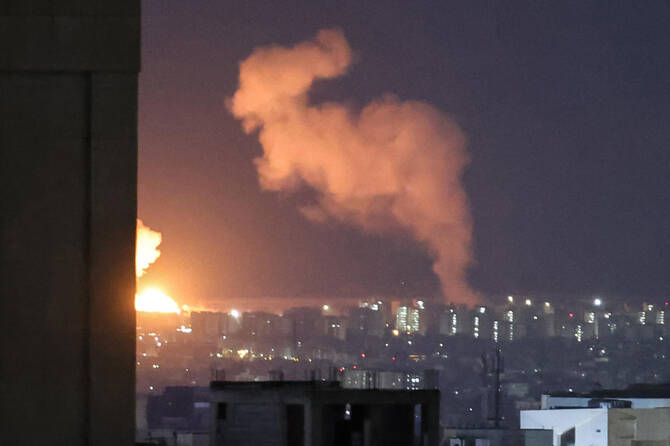
Smoke and fire rise from the site of airstrikes in a central area of the Iranian capital Tehran on March 6, 2026. (AFP)
Short Url
Updated 06 March 2026
Follow

Fresh strikes hit Iran as Israel says war enters ‘next phase’

  • Israeli jets hit Supreme Leader Ali Khamenei’s underground bunker in Tehran, which is still used by senior Iranian officials after his assassination
  • Strikes followed warnings from Israel and the US they were stepping up their attacks

TEHRAN: Fresh strikes rocked Iran on Friday as Israel vowed to escalate to a new phase in the Middle East war that has spiraled rapidly throughout the region and beyond.
Powerful explosions shattered the skies above Iran’s capital Tehran early Friday as Israel said it was striking “regime infrastructure” in the city.

The Israeli military said 50 jets struck Supreme Leader Ali Khamenei’s underground bunker in Tehran, which is still used by senior Iranian officials after his assassination.
Internet coverage is running at about one percent, according to monitor group Netblocks, limiting information about the impact of the war on ordinary Iranians.
In Tehran, the war has emptied the usually traffic-jammed streets but residents said that security forces are keeping a tight grip on the population.
The powerful Islamic Revolutionary Guard Corps (IRGC) “has closed almost every main street with armed personnel and heavy machine guns to frighten people,” a 30-year-old Tehran resident said from Paris.
“The people are the real enemy in their eyes, not the Americans. Their extremists say first you have to deal with the enemy at home.”
Friday morning’s strikes on Tehran followed warnings from Israel and the US they were stepping up their attacks, first launched on Saturday in a barrage that killed Iran’s supreme leader Ayatollah Ali Khamenei.
“We are now moving to the next phase of the operation,” Israel’s military chief Lt. Gen. Eyal Zamir said in a televised statement.
“We have additional surprises ahead which I do not intend to disclose,” he added.
Iran launched new retaliatory attacks early Friday against neighboring countries that host US forces. There were no immediate reports of casualties.
It also launched a new wave of missiles and drones targeting Tel Aviv, Israel, on Friday morning, the semiofficial ISNA news agency reported.
The latest strikes mark a full week of attacks affecting countries across the Middle East.


France, allies preparing bid to ‘gradually’ reopen Strait of Hormuz: Macron

Updated 3 sec ago
Follow

France, allies preparing bid to ‘gradually’ reopen Strait of Hormuz: Macron

ABOARD FRENCH AIRCRAFT CARRIER CHARLES DE GAULLE: France and its allies are preparing a “defensive” mission to reopen the strategically vital Strait of Hormuz, President Emmanuel Macron said Monday as the Middle East war entered its second week.
The French leader landed by helicopter on the Charles de Gaulle aircraft carrier, dispatched to the Mediterranean after US-Israeli strikes on Iran on February 28 triggered a war that has sown regional chaos and which threatens to spill into other parts of the world.
Macron said during a visit to Cyprus earlier in the day that the Hormuz mission would be aimed at escorting container ships and tankers in order to gradually reopen the strait “after the end of the hottest phase of the conflict.”
“This is essential for international trade, but also for the flow of gas and oil, which must be able to leave this (Gulf) region once again,” Macron said during a visit to the island to discuss regional security.
Speaking alongside Cypriot President Nikos Christodoulides and Greek Prime Minister Kyriakos Mitsotakis, Macron said a “purely defensive, purely support mission” will be put together by European and non-European states.
The European Union on Monday said it was ready to “enhance” its operations to protect maritime traffic in the Middle East.
The EU has been discussing reinforcing its naval mission in the Red Sea after the US-Israeli attacks on Iran triggered a broader regional war.
Maritime traffic in the Strait of Hormuz, a key Gulf waterway through which a fifth of global crude passes, has all but halted since the war broke out.
Macron visited Cyprus after the EU member was targeted by Iranian-made drones last week.
The French leader said an attack on Cyprus was an attack on all of Europe.
“When Cyprus is attacked, it is Europe that is attacked,” he said.
The drone attack in Cyprus led to France’s deployment of the Charles de Gaulle carrier to the Mediterranean, as well as a frigate and air defense units to the island.
Paris has insisted its stance in the region is “strictly defensive.”

- Bombing won’t bring change -

The initial US-Israeli strikes on Iran killed supreme leader Ali Khamenei, and the Islamic republic on Monday named his son, Mojtaba Khamanei, as his successor — an appointment US President Donald Trump said he was “not happy” with.
Aboard the Charles de Gaulle, Macron said the conflict’s duration depended on what US-Israeli objectives were, warning that “profound” changes to the Iranian leadership could not occur “through American-Israeli bombings alone.”
“We are putting ourselves in a position to last,” he said, adding that the war, “in this intense phase,” could last “several days, perhaps several weeks.”
The flagship Charles de Gaulle may eventually be deployed to the Strait of Hormuz as part of the announced mission, Macron said.
A French frigate was already taking part in the EU’s Operation Aspides, which was launched in the Red Sea in 2024 to prevent attacks on trade vessels by Iran-backed Houthi rebel forces.
Macron earlier said that France would contribute “in the long term” with two frigates to Operation Aspides.
“What we want to do is to ensure freedom of navigation and maritime security,” he said.
Separately, the French president on Monday morning spoke to Israeli Prime Minister Benjamin Netanyahu about the situation in the Middle East and Lebanon, the Elysee said.