

Syrian Arab Republic welcomes re-activation of its frozen OIC membership after 13 years

1 / 2
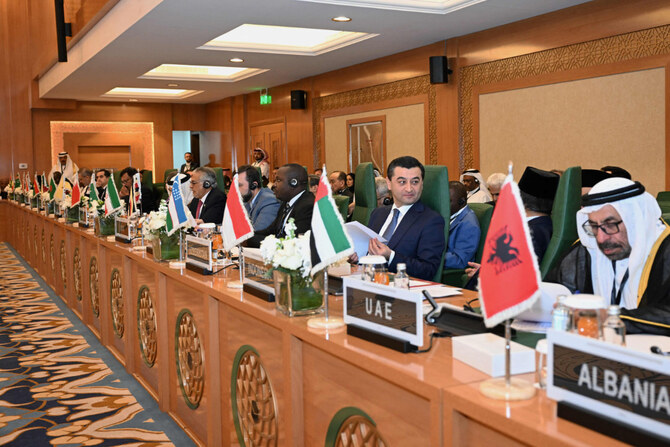
Syria's Interim Foreign Minister Asaad al-Shibani attends an Extraordinary Session of the OIC Council of Foreign Ministers in Jeddah on March 7, 2025. (AFP)
2 / 2
Diplomats attend an Extraordinary Session of the OIC Council of Foreign Ministers in Jeddah on March 7, 2025. (AFP)
Short Url
Updated 08 March 2025
Follow

Syrian Arab Republic welcomes re-activation of its frozen OIC membership after 13 years

  • Syria's membership was frozen in August 2012 amid the civil war under the Bashar Assad regime
  • In December, Syrian opposition forces led by the Hayat Tahrir Al-Sham toppled Assad

CAIRO: The Syrian Arab Republic welcomed on early Saturday the re-activation of its membership in the Organization of Islamic Cooperation (OIC) after it was frozen for 13 years, the foreign ministry said. 

“This decision represents an important step toward Syria’s return to the regional and international communities as a free and just state,” a ministry said in a statement.

Syria's membership frozen since 2012, was re-activated during a meeting of the 57-member group at the organization's headquarters in Jeddah, Saudi Arabia, on Friday, a Turkish diplomatic source said.

The source said the initiative put forth by Turkish Foreign Minister Hakan Fidan to re-activate Syria’s membership was accepted.


Turkiye’s Foreign Minister Hakan Fidan attends an Extraordinary Session of the OIC Council of Foreign Ministers in Jeddah on March 7, 2025. (AFP)

A statement posted on the OIC website highlighted Syria's membership as one of the topics in the discussion of the "extraordinary ministerial" meeting at the organization's headquarters in Jeddah, Saudi Arabia, but did not mention how the meeting turned out.

In his opening statenment, OIC Secretary-General Hissein Brahim Taha said the initiative to include an item on Syria on the agenda of the session comes at an appropriate time. 

In December, Syrian opposition forces led by the Hayat Tahrir Al-Sham (HTS) toppled Bashar Assad after an 11-year civil war, ending his five-decade rule. 

Syria’s new government has since sought to rebuild ties with Arab nations, Western powers, and others.

Syrian Foreign Minister Asaad Hassan Al-Shibani was called into the meeting to take Syria’s seat after the vote, the source said. A video shared by Turkiye’s Foreign Ministry showed members applauding as the minister entered the room.

NATO member Turkiye has backed opposition forces looking to oust Assad for years. It is a close ally and supporter of the new government in Damascus, vowing to help rebuild the country and help them train their armed forces.

Last month, Syria’s new President Ahmed Al-Sharaa received an invitation from Egyptian counterpart Abdel Fattah El-Sisi to participate in an Arab League summit in Cairo, a major step in rebuilding ties with the Arab world after Assad’s downfall. 


Syria nears anniversary of Assad’s fall amid renewed ‘deeply troubling’ abuses, UN warns

Updated 05 December 2025
Follow

Syria nears anniversary of Assad’s fall amid renewed ‘deeply troubling’ abuses, UN warns

  • Early steps by interim leadership ‘encouraging but only the beginning’ of long process of accountability, human rights chief says
  • Concern that rising hate speech, both online and on the streets, has intensified violence against Alawite, Druze, Christian, Bedouin communities 

NEW YORK: Syria is days away from marking the first anniversary of the fall of President Bashar Assad’s regime, but the country’s interim authorities face mounting criticism over continuing abuses and a fragile security environment, the UN human rights chief said. 

In a statement on Friday, UN High Commissioner for Human Rights Volker Turk said early steps by the interim leadership, including the creation of national commissions for transitional justice and missing persons, and investigative bodies examining violence in coastal areas and in Suweida, were “encouraging but only the beginning” of a long process of accountability. 

Trials for suspects linked to last year’s coastal violence have begun, and a draft law on transitional justice has been announced. But Turk said the human rights situation remains deeply troubling. 

According to the UN, hundreds of people have been killed over the past year in summary executions, arbitrary killings, and abductions. Victims include members of minority communities and individuals accused of ties to the former government. Deaths were attributed to gunfire, stabbings, blunt-force attacks, shelling, hand grenades and explosive remnants of war. 

The UN said perpetrators include security forces under the interim authorities, armed groups aligned with them, remnants of the former government’s forces, local militias, and unidentified armed actors. 

Investigators also documented reports of sexual violence, arbitrary detention, looting, destruction of homes, forced evictions, and property confiscations, along with restrictions on free expression and peaceful assembly. 

Turk warned that rising hate speech, both online and on the streets, had intensified violence against Alawite, Druze, Christian, and Bedouin communities. 

The past year has also seen repeated Israeli military operations inside Syrian territory, including incursions and the occupation of additional areas. The UN said it had received reports of civilian casualties in a recent Israeli strike near Damascus, along with arrests and home searches carried out during military actions. 

Turk expressed concern that former armed groups have been integrated into new security forces without adequate human rights checks, raising the risk of repeat violations. 

“Proper vetting and comprehensive security sector reform are essential to prevent individuals responsible for serious abuses from entering the security forces,” he said. 

He urged Syria’s interim authorities to ensure independent and transparent investigations into all violations, past and present, and to hold those responsible to account. 

“Accountability, justice, peace, and the security of all Syrians are absolute prerequisites for a successful transition,” Turk said, adding that victims must have access to remedies and reparation. 

The UN Human Rights Office said its Damascus program is supporting efforts to advance inclusive transitional justice and strengthen the rule of law as Syria navigates a post-Assad transition.