Putin says any Ukraine peace deal must ensure Russia’s security, vows no retreat

1 / 2
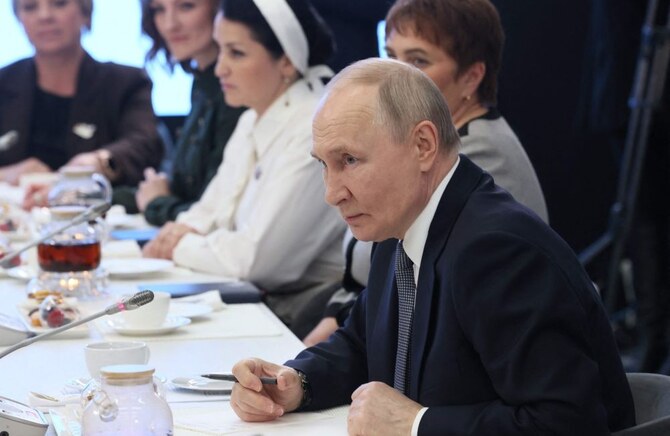
Vladimir Putin meets with workers and wards of the Defenders of the Fatherland State Fund, the foundation supporting veterans of the Russian military action in Ukraine, Moscow, Mar. 6, 2025. (AFP)
2 / 2
Vladimir Putin meets with Badra Gunba, the newly elected President of Georgia’s breakaway region of Abkhazia, in Moscow, Russia, Mar. 5, 2025. (Reuters)
Short Url
Updated 06 March 2025
Follow

Putin says any Ukraine peace deal must ensure Russia’s security, vows no retreat

  • Vladimir Putin: ‘There are still people who want to go back to the time of Napoleon, they forget how it ended’
  • Putin: ‘All the mistakes of our enemies and opponents began with this: in underestimating the character of the Russian people and representatives of Russian culture in general’

MOSCOW: Russia will seek a peace deal in Ukraine that safeguards its own long-term security and will not retreat from the gains it has made in the conflict, President Vladimir Putin said on Thursday in comments to relatives of soldiers killed there.
Putin also took an indirect swipe at French President Emmanuel Macron, saying Western leaders should not underestimate the Russian people and should keep in mind the fate of Napoleon Bonaparte, whose invasion of Russia in 1812 ended in disaster.
“We must choose for ourselves a peace option that will suit us and that will ensure peace for our country in the long term,” Putin told a group of Russian women who have lost loved ones during the three-year war in Ukraine.
Asked by the mother of one fallen soldier if Russia would retreat, Putin said he did not intend to do that. Russia currently controls just under a fifth of Ukraine — or about 113,000 square km.
At times during the meeting some women wiped away tears.
US President Donald Trump has upended Western policy on the Ukraine war, opening up bilateral talks with Moscow and pausing military aid to Kyiv after clashing with Ukrainian President Volodymyr Zelensky in the White House last week.
Reuters reported in November that Putin was open to discussing a Ukraine peace deal with Trump but ruled out any major territorial concessions and would insist that Kyiv abandon ambitions to join NATO.
In comments last summer setting out his terms for ending the war, Putin also said Ukraine must withdraw all its forces from the entire territory of four Ukrainian regions claimed and partly controlled by Russia.

Opinion

This section contains relevant reference points, placed in (Opinion field)

Trump’s dramatic change of US policy on Ukraine has raised hopes for peace talks but has also alarmed Washington’s European allies who this week have reaffirmed their support for Kyiv.
France’s Macron angered Moscow on Wednesday when he said in an address to the nation that Russia was a threat to Europe.
Macron said Paris could discuss extending its nuclear umbrella to allies and that he would hold a meeting of army chiefs from European countries willing to send peacekeeping troops to Ukraine after any peace deal.
Russia mocked Macron, calling him “Micron.” Russian cartoons cast him as France’s Emperor Napoleon riding toward defeat in Russia in 1812.
“There are still people who want to go back to the time of Napoleon, they forget how it ended,” Putin said on Thursday, without mentioning Macron by name.
“All the mistakes of our enemies and opponents began with this: in underestimating the character of the Russian people and representatives of Russian culture in general,” Putin added.


In Lahore’s historic Walled City, Ramadan fills the rows at Mughal-era Sunehri Mosque

Updated 46 sec ago
Follow

In Lahore’s historic Walled City, Ramadan fills the rows at Mughal-era Sunehri Mosque

  • Experts call for restoration of the 18th-century mosque amid encroachments and structural strain
  • Generations of traders shift their work schedules in Ramadan to gather for iftar and nightly prayers

LAHORE, Pakistan: In Old Lahore’s Kashmiri Bazaar, Ramadan changes the rhythm of trade.

By late afternoon, shop shutters begin to drop halfway and traders step away from their counters. Within minutes, the courtyard of Sunehri Mosque begins to fill.

On most days, the 18th-century mosque holds just a few rows of worshippers. In Ramadan, that number more than doubles.

“It has been 27 years since I have been leading the prayers here,” Qari Mohammed Hanif, the 47-year-old imam at the mosque, told Arab News. “On normal days, there are four to five rows. But in Ramadan, the mosque fills completely. People stand till the lower end.”

The congregation is largely drawn from the surrounding market — shopkeepers, traders and workers who close their businesses and walk directly into prayer.

The congregation at Sunehri Masjid is largely drawn from shopkeepers, traders and workers who close their businesses and walk directly into prayer. (Supplied)

For many, the mosque is inseparable from livelihood.

“I have a shop at Sunehri Masjid,” said Nasir Mehmood, 46, who runs a yarn business steps away. “This is our third generation running the shop. First it was my grandfather, then my father and now us. The shop is 50 years old.”

He said that at the beginning of Ramadan, he breaks his fast at home with his family. As the month progresses, the routine shifts.

“We start breaking our fast here at the shop, together with our friends and fellow shopkeepers. We also offer Taraweeh prayers here,” he continued, referring to the special Ramadan prayer performed after the obligatory Isha prayer at night.

Working hours extend as well.

“For the first three to four fasts, we come at 12 p.m. and leave after Asar prayers,” said Sheikh Mohammed Saleem, 50, who runs a clothing shop nearby. “After that, our routine changes. We open at 11 a.m. and stay until 12 a.m. at night, continuing this schedule until the last fast of Ramadan.

“Some food is brought from home, and some we buy from the market,” he added. “All of us gather together to break our fast.”

For many, the mosque is inseparable from livelihood. (Supplied)

Others return year after year for spiritual reasons.

“I have been coming here for 11 years,” said Mohammed Rafique, 45. “Whenever I am in this area, I always come to this mosque. I find peace here, peace in my heart. There is something from Allah. I cannot explain it. Whenever I come here, I try to break my fast here.”

Even younger traders feel a strong attachment to the space. Abdullah, 25, who gave only one name, said the mosque has become part of his working life.

“I have a shop in Lahore’s Rang Mehal, in Kasera Bazaar, under Sunehri Masjid,” he said. “I have been here for three years. The environment here is very good, the people are good.”

GILDED DOMES

The building that fills so quickly during Ramadan was constructed in 1753 during the later Mughal period by Nawab Bhikari Khan, a deputy governor of Lahore. Its three gilded domes gave it the name “Sunehri,” meaning golden.

Unlike imperial Mughal mosques built in expansive courtyards, Sunehri Mosque was embedded within a functioning marketplace. It rose not in isolation but among shops, a structure woven into commercial life rather than set apart from it.

“The Sunehri Mosque is small in scale because it was built during the decline of the Mughal Empire, a time when political power had weakened and resources were limited,” cultural heritage expert Saad Zahid told Arab News. “Its modest size and comparatively simple detailing reflect this period of reduced imperial strength.

Sunehri Mosque was embedded within a functioning marketplace. It rose not in isolation but among shops, a structure woven into commercial life rather than set apart from it. (Supplied)

“Unlike earlier Mughal monuments, it does not display the same richness or refinement, making it an important example of late Mughal architecture in Lahore,” he added.

Lahore, once a major administrative and cultural center of the Mughal Empire, saw numerous mosques constructed at the height of imperial power. Like most of them, Sunehri Mosque’s courtyard also featured a central pond, a hallmark of Mughal mosque design, though visitors usually find it dry these days.

Sunehri Masjid

While the mosque remains active and crowded during Ramadan, aspects of its physical condition raise concern.

The historic shops built beneath the mosque are now heavily encroached upon, obscuring parts of the mosque’s facade. Piles of wooden ladders and used boxes are stacked along sections of the structure. Tangled electricity wires hang across and above the building, cutting through the visual line of its domes. In some areas, residents hang washed clothes along its outer walls to dry.

B

angled electricity wires hang across and above the building, cutting through the visual line of its domes.  (Supplied)

Behind the mosque lies Baoli Bagh, once associated with an important Sikh-era gurdwara site, which Zahid said also deserves conservation.

He also argued that, like the Badshahi and Wazir Khan mosques, Sunehri Mosque should remain open to visitors beyond prayer times and be more actively promoted as part of Lahore’s historic landscape.

“The frescoes inside the mosque today appear overly bright and artificial. The original Mughal paintings were likely more subtle in tone, suggesting that later interventions have altered its authentic appearance,” he said, emphasizing the urgency of the building’s careful restoration to protect original design, materials and architectural identity rather than replace them with new construction.