



LAHORE: In Old Lahore’s Kashmiri Bazaar, Ramadan changes the rhythm of trade.
By late afternoon, shop shutters begin to drop halfway and traders step away from their counters. Within minutes, the courtyard of Sunehri Mosque begins to fill.
On most days, the 18th-century mosque holds just a few rows of worshippers. In Ramadan, that number more than doubles.
“It has been 27 years since I have been leading the prayers here,” Qari Muhammad Hanif, the 47-year-old imam at the mosque, told Arab News. “On normal days there are four to five rows. But in Ramadan, the mosque fills completely. People stand till the lower end.”
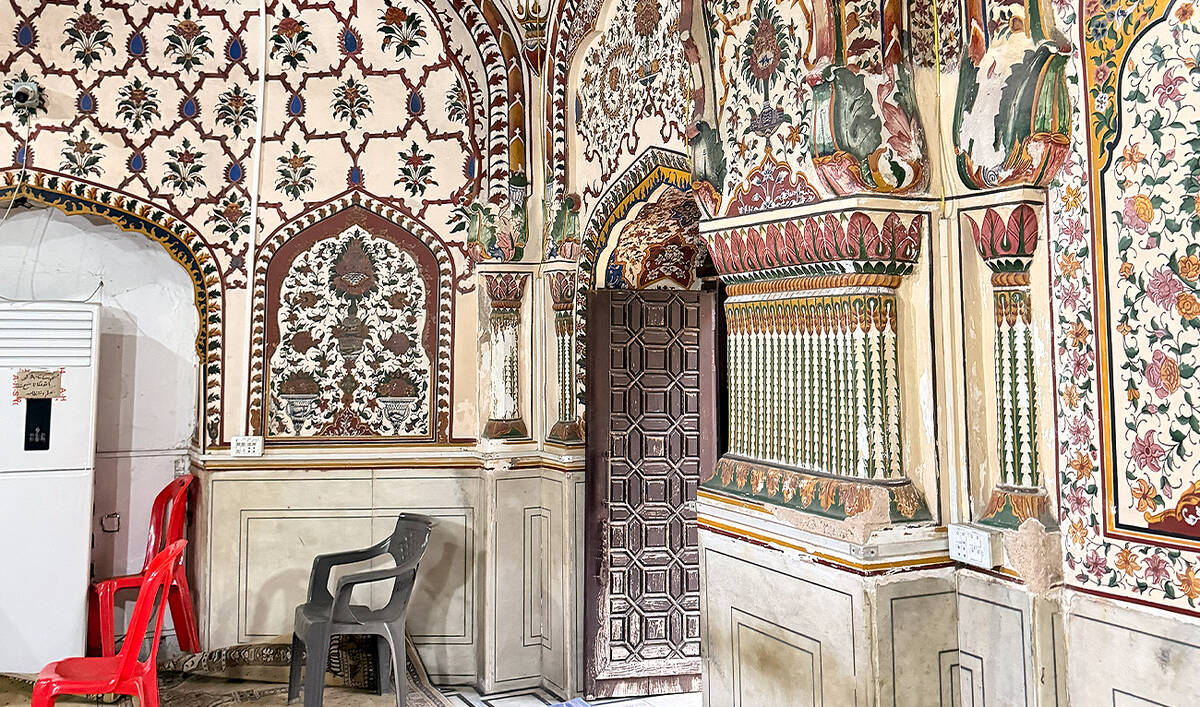
Photo taken on February 23, 2026, shows the interior of Sunehri Mosque situated in Lahore’s Kashmiri Bazaar. (AN Photo)
The congregation is largely drawn from the surrounding market — shopkeepers, traders and workers who close their businesses and walk directly into prayer.
For many, the mosque is inseparable from livelihood.
“I have a shop at Sunehri Masjid,” said Nasir Mehmood, 46, who runs a yarn business steps away. “This is our third generation running the shop. First was my grandfather, then my father and now us. The shop is 50 years old.”
He said that at the beginning of Ramadan, he breaks his fast at home with his family. As the month progresses, the routine shifts.
“We start breaking our fast here at the shop, together with our friends and fellow shopkeepers. We also offer Taraweeh prayers here,” he continued, referring to the special Ramadan prayer performed after the obligatory Isha prayer at night.
Working hours extend as well.
“For the first three to four fasts, we come at 12pm and leave after Asar prayers,” said Sheikh Muhammad Saleem, 50, who runs a clothing shop nearby. “After that, our routine changes. We open at 11am and stay until 12am at night, continuing this schedule until the last fast of Ramadan.”
“Some food is brought from home, and some we buy from the market,” he added. “All of us gather together to break our fast.”
Others return year after year for spiritual reasons.
“I have been coming here for 11 years,” said Muhammad Rafique, 45. “Whenever I am in this area, I always come to this mosque. I find peace here, peace in my heart. There is something from Allah. I cannot explain it. Whenever I come here, I try to break my fast here.”
Even younger traders feel attached to the space. Abdullah, 25, who gave only one name, said the mosque has become part of his working life.
“I have a shop in Lahore’s Rang Mehal, in Kasera Bazaar, under Sunehri Masjid,” he said. “I have been here for three years. The environment here is very good, the people are good.”
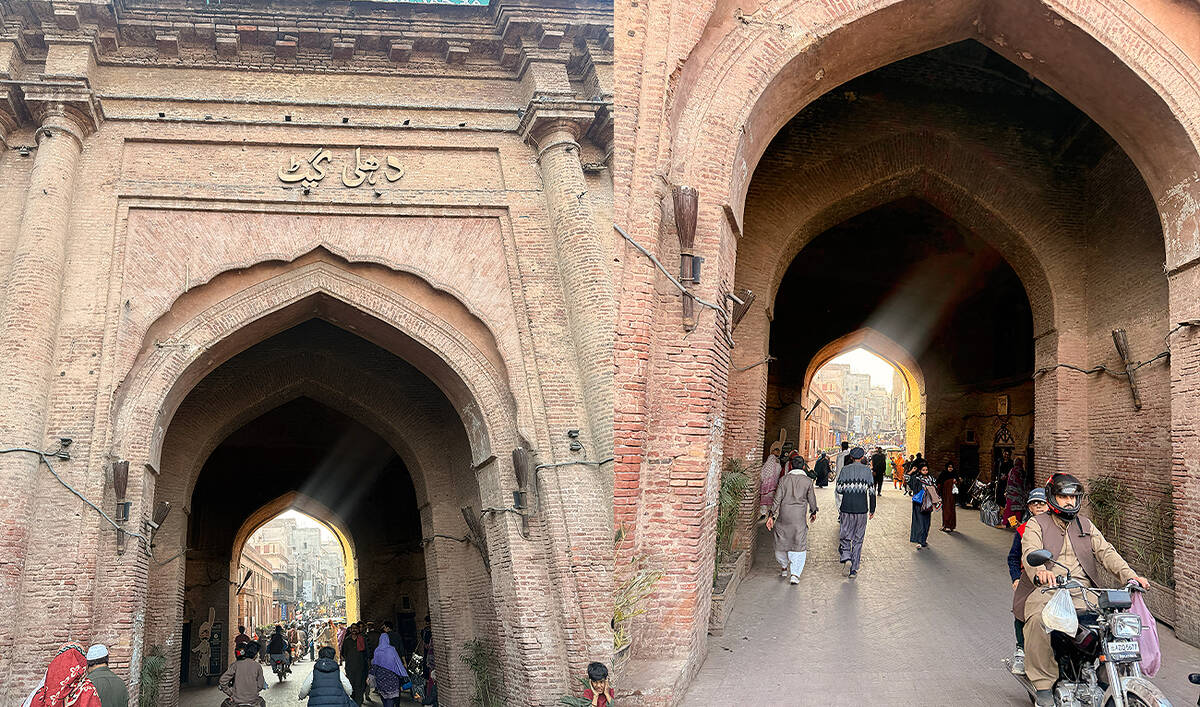
Photo taken on February 23, 2026, shows Delhi Gate situated in Walled City of Lahore, Pakistan. (AN Photo)
GILDED DOMES
The building that fills so quickly during Ramadan was constructed in 1753 during the later Mughal period by Nawab Bhikari Khan, a deputy governor of Lahore. Its three gilded domes gave it the name “Sunehri,” meaning golden.
Unlike imperial Mughal mosques built in expansive courtyards, Sunehri Mosque was embedded within a functioning marketplace. It rose not in isolation but among shops, a structure woven into commercial life rather than set apart from it.
“The Sunehri Mosque is small in scale because it was built during the decline of the Mughal Empire, a time when political power had weakened and resources were limited,” cultural heritage expert Saad Zahid told Arab News. “Its modest size and comparatively simple detailing reflect this period of reduced imperial strength.”
“Unlike earlier Mughal monuments, it does not display the same richness or refinement, making it an important example of late Mughal architecture in Lahore,” he added.
Lahore, once a major administrative and cultural center of the Mughal Empire, saw numerous mosques constructed at the height of imperial power. Like most of them, Sunehri Mosque’s courtyard also featured a central pond, a hallmark of Mughal mosque design, though visitors usually find it dry these days.
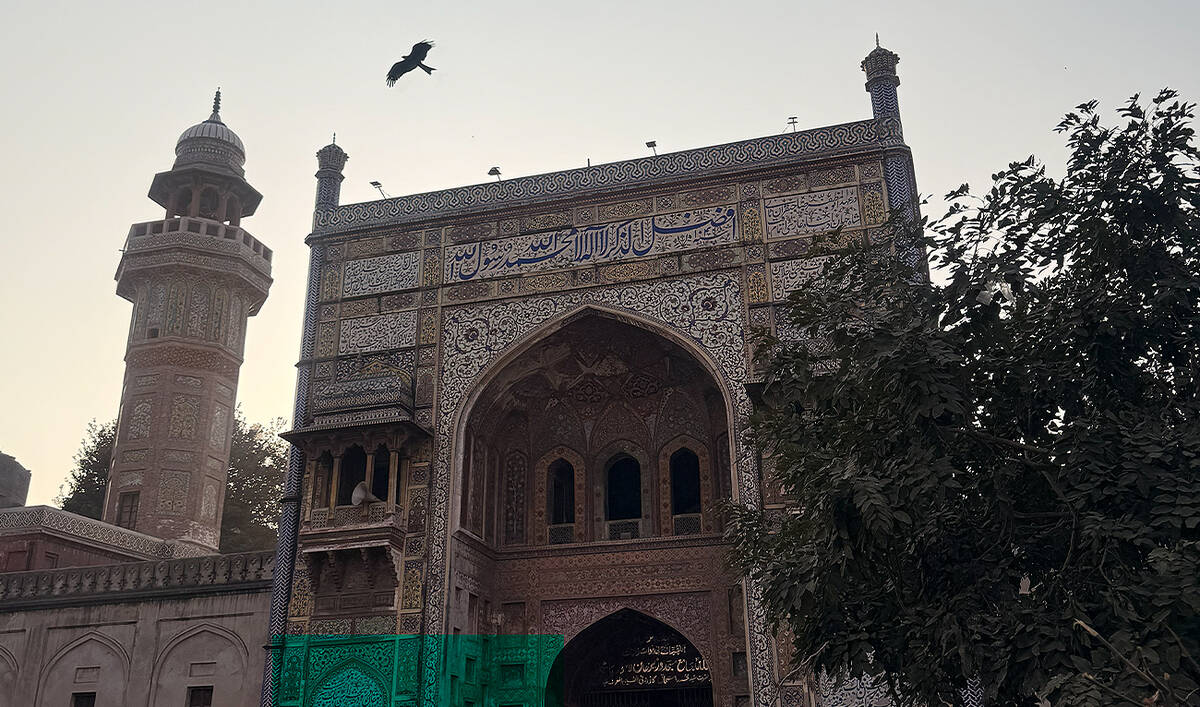
Photo taken on February 23, 2026, shows the historic Wazir Khan Mosque in Lahore’s Walled City. (AN Photo)
STRUCTURAL CONCERNS
While the mosque remains active and crowded during Ramadan, aspects of its physical condition raise concern.
The historic shops built beneath the mosque are now heavily encroached upon, obscuring parts of the mosque’s façade. Piles of wooden ladders and used boxes are stacked along sections of the structure. Tangled electricity wires hang across and above the building, cutting through the visual line of its domes. In some areas, residents hang washed clothes along its outer walls to dry.
Behind the mosque lies Baoli Bagh, once associated with an important Sikh-era gurdwara site, which Zahid said also deserves conservation.
He also argued that, like the Badshahi and Wazir Khan Mosques, Sunehri Mosque should remain open to visitors beyond prayer times and be more actively promoted as part of Lahore’s historic landscape.
“The frescoes inside the mosque today appear overly bright and artificial. The original Mughal paintings were likely more subtle in tone, suggesting that later interventions have altered its authentic appearance,” he said, emphasizing the urgency of the building’s careful restoration to protect original design, materials and architectural identity rather than replace them with new construction.


