

Post-uprising polls won’t shake Nepal’s delicate India-China balance

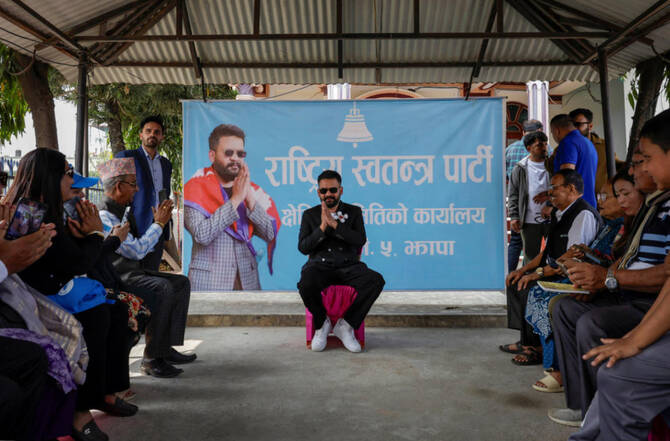
Balendra Shah, a rapper-turned-politician and the prime ministerial candidate for Rastriya Swatantra Party (RSP), interacts with locals ahead of Nepal's general election, at a RSP office in Damak in Jhapa district, in Nepal, on February 25, 2026. (REUTERS)
Short Url
Updated 26 February 2026
Follow

Post-uprising polls won’t shake Nepal’s delicate India-China balance

  • Landlocked Himalayan nation of 30 million people will elect a new government on March 5
  • Poll comes 6 months after demonstrations brought down Marxist leader KP Sharma Oli's govt

NEW DELHI: Nepal votes next week for the first time since deadly anti-corruption protests toppled the government, but analysts say any winner will likely maintain the delicate diplomatic balance between its two giant neighbors, India and China.
The landlocked Himalayan nation of 30 million people will elect a new government on March 5, six months after youth-led demonstrations brought down the administration of Marxist leader KP Sharma Oli.
Who will win is an open question, but Nepali journalist Sudheer Sharma said it will likely be “very difficult” for any single party to secure a majority, meaning longstanding political dynamics may continue.
“Nepal’s relation with India or China depends on what type of coalition it will be and who will be the dominant power,” said Sharma.
“The fundamentals of the relationship will not change, but some approaches might.”
Younger candidates are campaigning on promises to overhaul a stagnant economy and remove an aging political elite, while veteran politicians emphasize stability and security if returned to power.
Key investors and trading partners Beijing and New Delhi are watching closely, but analysts suggested that the new government will likely continue Katmandu’s pragmatic balancing act between the two powers, who compete for influence.
Nepal’s largest trading partner is India, accounting for 63 percent of imports, or $8.6 billion, followed by China at 13 percent, or $1.8 billion, according to World Bank figures.

‘Regular relationship’

India has long considered Hindu-majority Nepal as a traditional ally, with open borders along the plains.
“Some issues are there, some problems are there, but the regular relationship should be stable,” journalist Sharma said.
Retired Indian diplomat Rakesh Sood described New Delhi’s ties with Nepal as “extensive,” encompassing trade, tourism and hydropower.
Nepal is integrated with cross-border infrastructure in both directions: power lines from hydropower dams feed electricity to India, while China connects through its Belt and Road Initiative over the Himalayas via Tibet, and makes investments in airports and railways.
For nearly two decades, Nepal’s political landscape was dominated by veteran leaders — many of them former Maoist insurgents — who took turns in power since the end of a 10-year civil war in 2006.
Last September’s unrest erupted as youth protests against a brief social media ban, but was fueled by far wider anger at economic stagnation and corruption.
Over two days, 77 people were killed, scores were injured, and hundreds of buildings were set on fire.
Oli, 74, forced out by the uprising, is seeking a return to power for a potential fifth term as prime minister.
He had a fractious relationship with New Delhi — after taking office in 2024, he chose China for his first trip abroad, rather than the customary visit to India.
“In Nepal, the then leftist-led government had an uncomfortable relationship with India — and that was overthrown,” Sharma added.

‘Balance ties’

A new cohort of first-time candidates has emerged from the loosely organized Gen Z movement that helped drive the protests, young Nepalis seeking economic reform.
“Nepal’s leadership, even if at times seemingly inclined to lean toward one power or the other, aims to balance ties with India and China,” South Asia expert Michael Kugelman told AFP.
“It’s hard to imagine that changing, even if there is a new influx of younger people in politics.”
He suggested the status quo will likely remain, with China “comfortable with any type of political dynamic” in Katmandu, including one with a younger profile, as long as it remains open to Beijing.
“A government with youth leaders would likely not take positions on relations with India and China that diverge much with the previous government,” Kugelman said, suggesting that Nepali youth are “generally not hostile to China — even if some would prefer less Chinese influence.”
Both India and China have pumped in hundreds of millions of dollars in investments into Nepal, and both are backing voting preparations, with New Delhi sending vehicles to aid the Election Commission.
Kugelman said change may come if a new generation of politicians sweeps into power on an anti-corruption ticket and shakes up old practices of opaque funding for mega-projects.
“Young people in Nepal won’t support Chinese or Indian actions that aim to shape Nepal’s politics or put vast amounts of money in the hands of the government in ways that aren’t transparent,” he said.


Columbia student detained by ICE is abruptly released after Mamdani meets with Trump

Updated 27 February 2026
Follow

Columbia student detained by ICE is abruptly released after Mamdani meets with Trump

  • Ellie Aghayeva, an Azerbaijani, hasn’t been publicly linked to any of the pro-Palestinian demonstrations
  • Mamdani asked Trump to drop cases against other students facing deportation for their roles in protests against Israel
NEW YORK: Federal immigration authorities arrested a Columbia University student early Thursday, triggering protests on campus along with allegations that agents had entered the university-owned residence under false pretenses.
Just hours after detaining student Ellie Aghayeva, though, the federal government abruptly reversed course, permitting her to walk free after an apparent intervention by President Donald Trump.
In a social media post Thursday afternoon, Mayor Zohran Mamdani said he expressed concerns about the arrest during an unrelated meeting with Trump, who then agreed to release her immediately.
“I am safe and okay,” Aghayeva wrote on Instagram, minutes after Mamdani’s post, adding she was in “complete shock” from the experience.
The head-spinning series of events marked the latest development to emerge from the Republican president’s unlikely relationship with a democratic socialist mayor he once threatened to have deported.
On Thursday, while pitching Trump on a massive housing project, Mamdani also called on the president to drop cases against several other current and former students facing deportation for their roles in protests against Israel.
Aghayeva, a senior from Azerbaijan studying neuroscience and politics, hasn’t been publicly linked to any of the pro-Palestinian demonstrations that roiled Columbia’s campus. A self-described content creator, she has amassed a large social media following by sharing day-in-the-life videos and tips for navigating college as an immigrant.
Early Thursday, federal agents gained entry to her apartment by claiming they were searching for a missing person, according to a petition from her lawyers and a statement released by Columbia. She quickly dashed off a message to her more than 100,000 followers on Instagram: “DHS illegally arrested me. Please help.” A photo accompanying the post appeared to show her legs in the backseat of a vehicle.
A Department of Homeland Security spokesperson said Aghayeva’s student visa had been terminated in 2016 for failing to attend classes. Inquiries to Columbia about her visa status and how long she had been enrolled in the university were not returned.
In their petition, attorneys for Aghayeva said she had entered the country on a visa in or around 2016. They declined to provide additional comment, including details about her immigration status.
A spokesperson for DHS, Tricia McLaughlin, denied allegations levied by some state officials that agents had gained entry to her apartment by posing as New York City police officers. She didn’t respond to questions about whether they had claimed to be seeking a missing person.
The use of disguises or other misrepresentations by immigration authorities has drawn attention in recent months, after federal agents were seen posing as utility workers and other service employees in Minneapolis and elsewhere.
The practice is legal, in most cases. But immigration attorneys say such ruses are becoming increasingly common, adding to concerns about the Trump administration’s dramatic reshaping of immigration enforcement tactics nationwide.
In recent weeks, Trump has once again intensified his attacks on several universities, including Harvard and UCLA. The arrest would seem to mark the first federal enforcement action against at Columbia since the university agreed to pay more than $220 million to the administration over the summer.
“It’s a horrifying sign that the roving eye of the administration is turning back to Columbia,” said Michael Thaddeus, a mathematics professor at Columbia and vice president of the university’s chapter of the American Association of University Professors, which has sued Trump. “The idea that secret police would abduct and imprison students in our midst is something we’d expect from an authoritarian regime.”
Many students and faculty called on Columbia to increase protections for international students following the arrest last March of Mahmoud Khalil, a former graduate student and pro-Palestinian activist, whose deportation case remains ongoing.
In an email to the Columbia community Thursday, acting president Claire Shipman said that residential staff had been reminded not to allow federal law enforcement into university buildings without a subpoena or warrant.
“If you encounter or observe DHS/ICE agents conducting enforcement activities on or near campus, immediately contact Public Safety,” Shipman wrote. “Do not allow them to enter non-public areas or accept service of a warrant or subpoena.”