VATICAN CITY: Pope Francis was resting Wednesday, the start of the solemn Lenten period leading up to Holy Week observances, after sleeping through the night with a ventilation mask as he undergoes hospital treatment for double pneumonia.
In its latest update, the Vatican said that the pope rested well overnight, waking up shortly after 8 a.m. Pope Francis remained in stable condition, with a guarded prognosis, meaning he was not out of danger. He resumed supplemental oxygen delivered by a nasal tube in the morning, alternating from a ventilation mask at night as doctors seek to ease his breathing for a deeper rest.
The 88-year-old pope, who has chronic lung disease and had part of one lung removed as a young man, had two respiratory crises on Monday in a setback to his recovery.
On Tuesday, he was breathing with just the help of supplemental oxygen after respiratory crises a day earlier, but resumed using a ventilation mask at night, the Vatican said.
Francis’ hospitalization began on Feb. 14 and is the longest of his 12-year papacy.
Ash Wednesday
Francis’ treatment continues as the Vatican prepares for Lent, the solemn period beginning with Ash Wednesday and leading up to Easter on April 20. A cardinal has been designated to take Francis’ place at Vatican celebrations, with a traditional service and procession in Rome
On Ash Wednesday, observant Catholics receive a sign of the cross in ashes on their foreheads, a gesture that underscores human mortality. It is an obligatory day of fasting and abstinence for Catholics that signals the start of Christianity’s most penitent season.
Vatican prepares for Lent without Francis
The pope had intended to attend a spiritual retreat this coming weekend with the rest of the Holy See hierarchy. On Tuesday, the Vatican said the retreat would go ahead without Francis but in “spiritual communion” with him. The theme, selected weeks ago and well before Francis got sick, was “Hope in eternal life.”
Francis, who is not physically active, uses a wheelchair and is overweight, had been undergoing respiratory physiotherapy to try to improve his lung function. The accumulation of secretions in his lungs was a sign that he doesn’t have the muscle tone to cough vigorously enough to expel the fluid.
Doctors often use noninvasive ventilation to stave off intubation or the use of more invasive mechanical ventilation. Francis has not been intubated during this hospitalization. It’s not clear if he has provided any instructions on the limits of his care if he declines seriously or loses consciousness.
Catholic teaching holds that life must be defended from conception until natural death. It insists that chronically ill patients, including those in vegetative states, must receive “ordinary” care such as hydration and nutrition, but “extraordinary” or disproportionate care can be suspended if it is no longer beneficial or is only prolonging a precarious and painful life.


![]()

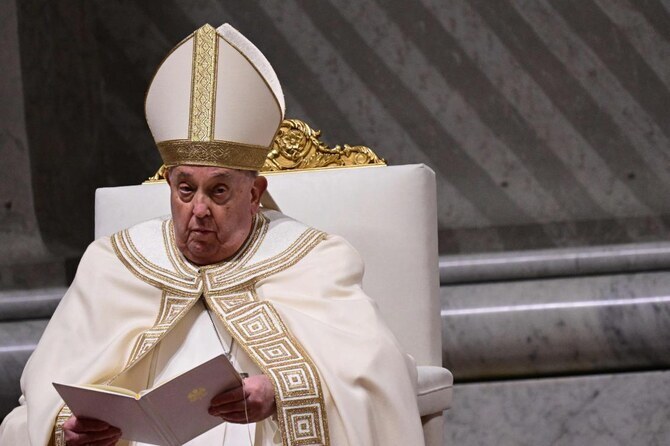
Pope resting after sleeping through the night with a ventilation mask as he battles pneumonia
Short Url
https://arab.news/64r5f
Pope resting after sleeping through the night with a ventilation mask as he battles pneumonia
- The Vatican said that the pope rested well overnight, waking up shortly after 8 a.m.
- Pope Francis remained in stable condition, with a guarded prognosis, meaning he was not out of danger


Latest updates


© 2026 SAUDI RESEARCH & PUBLISHING COMPANY, All Rights Reserved And subject to Terms of Use Agreement.