
LONDON: The impact of the Trump administration’s decision to slash $60 billion in aid funding and cancel 90 percent of contracts by the US Agency for International Development is being felt by millions of the most vulnerable people in the Middle East and North Africa.
In countries like Iraq, Syria and Yemen, lifesaving aid programs to feed and provide healthcare for huge populations affected by conflict have halted. In Jordan, hundreds of development projects to boost the economy face an uncertain future and thousands of jobs may disappear.
The widespread halt in aid was confirmed just as countries across the region started to mark the holy month of Ramadan.
In an internal memo and filings in federal lawsuits, the US administration said it is eliminating more than 90 percent of USAID’s foreign aid contracts and $60 billion in overall assistance around the world. The memo said officials were “clearing significant waste stemming from decades of institutional drift.”

Displaced Sudanese people at a camp near the town of Tawila in North Darfur. (AFP)
More changes are planned in how USAID and the State Department deliver foreign assistance, it said, “to use taxpayer dollars wisely to advance American interests.”
Many Republican lawmakers believe USAID has been wasteful and harbors a liberal agenda. President Donald Trump has also promised to dramatically reduce spending and shrink the federal government.
USAID’s supporters say the agency not only provides vital assistance around the world, but for less than one percent of the federal budget, it is also America’s greatest soft power tool.
The crisis first arose on Jan. 20 when Trump signed an executive order halting all foreign assistance for a 90-day review period because the aid industry was “not aligned with American interests.”
Within days, Elon Musk’s Department of Government Efficiency was homing in on USAID programs, and by last week termination letters had been sent to nongovernmental organizations around the world.
Nearly 5,800 of USAID’s 6,200 multi-year contracts worth $54 billion were cut. The State Department also cut $4.4 billion in foreign aid-related grants.
Much of the agency’s vast array of work, from providing food to the starving, healthcare programs and economic development initiatives, has been stopped.
Many promised waivers for lifesaving programs have reportedly failed to materialize.

More than 6,000 of USAID’s 10,000 staff have been placed on administrative leave or fired, and tens of thousands of people working around the world have also lost their jobs.
Control of USAID has been moved to the State Department, which is locked in legal battles over the cuts. The department did not respond to a request for comment.
The MENA region received $3.9 billion from USAID in 2023. The sudden removal of the agency’s support could cause further suffering and instability in the region, Yossi Mekelberg, associate fellow of the MENA Program at Chatham House, told Arab News.
“We’re talking about budgets of billions, which goes to projects between humanitarian and development,” he said. “The minute you take it away, you make people either suffer from humanitarian crises or you stop the development of these countries.
“If you want to maintain stability in the Middle East, which is important to the United States, you need economic development.”
Opinion
This section contains relevant reference points, placed in (Opinion field)
Below are details of how the shuttering of USAID has affected people and projects across the region.
IRAQ
In a country where more than 1 million people have still not returned to their homes after the war with Daesh extremists ended in 2017, USAID provided vital support to vulnerable populations.
Since the 2003 US-led invasion that toppled Saddam Hussein, the agency has spent billions trying to help Iraq rebuild. USAID funded clean water supplies, food aid, healthcare and support for women victims of violence.
The agency also provided grants to grow businesses and boost local economies and funded development projects to improve water supplies and food production.
The amount spent in Iraq in 2023 was more than $220 million, but many of the long-term projects, which have now stopped, were based on spending commitments over many years.
One USAID officer working on Iraq told Arab News that he could not imagine what would happen to Iraq’s displaced population without the agency’s funding.
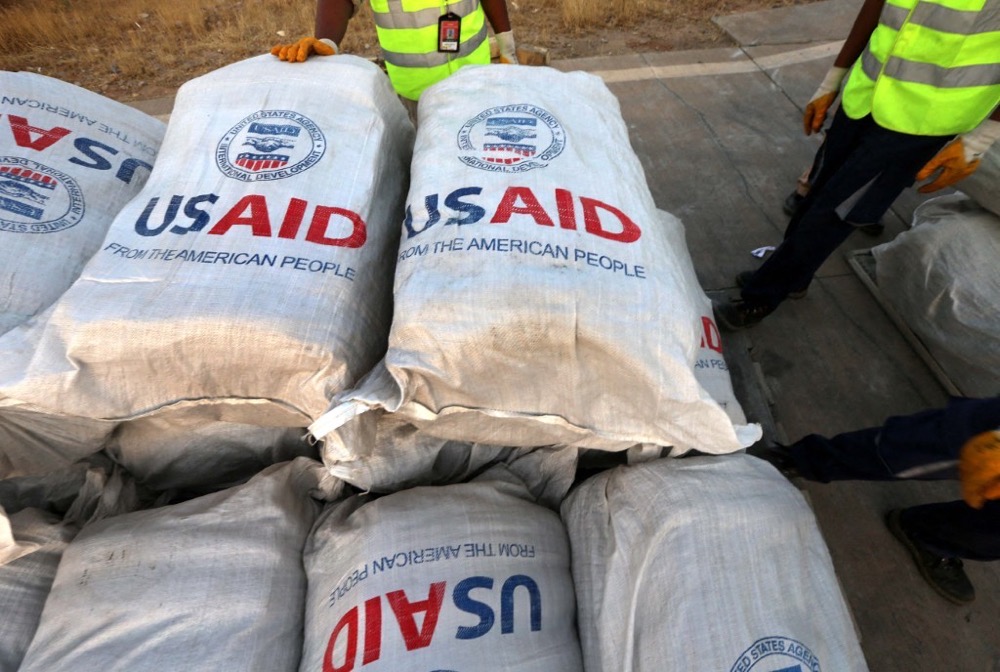
USAID has spent billions trying to support Iraqis. (AFP)
“It’s heartbreaking,” he said. “I shudder to think of the human impacts of this, the lives lost, the time … it will take to ever recover from this. The whole sector is destroyed.”
Before the widespread canceling of contracts last week, he said some UN agencies and NGOs continued with essential assistance as they tried to interpret Trump’s executive order and the promised waivers.
Now everything related to USAID funding had stopped, said the officer, whose decade-long career with the agency was also terminated with 15 days’ notice.
This included assistance to the 100,000 displaced people in 21 formal camps in the northern Kurdish region.
The USAID officer said the halt was particularly bitter for Iraqis given the recent history of US foreign policy in the country.
He said the halting of aid risks plunging Iraq back into chaos by opening the way for extremist ideologies to regain traction.
“We are pulling the rug out from under what the US would consider a critical ally in this region.”
SYRIA
The humanitarian community was just getting to grips with a new Syria after the fall of President Bashar Assad in December.
The approach to delivering aid to the country during its 14-year civil war was hampered by the division of territory under the warring parties, along with international sanctions against the Assad regime.
Finally, it seemed, a coordinated surge of humanitarian operations could take place with new rulers in Damascus in control of much of the country.
“It was the opportunity in Syria for the first time in 14 years to really do an ‘all of country’ response,” Imrul Islam from the Syria International NGO Regional Forum told Arab News.

Al-Hol camp in Syria’s northeastern Al-Hasakah Governorate. (AFP/File)
The war had left more than 16 million Syrians needing humanitarian aid, according to the UN.
Islam estimates that USAID paid for at least a quarter of the entire humanitarian funding in Syria, with the northern parts of the country particularly reliant on NGOs to deliver essential aid.
When the “stop work” orders were sent in January from USAID to the NGOs they funded, it was a bitter blow.
Aid organizations in Syria were left in limbo as most projects ground to a halt almost overnight. The waivers granted for lifesaving aid failed to deliver a release of funds, so organizations continued essential deliveries by running up debt.
Last week’s blanket termination of contracts means that almost everything previously funded by USAID has now stopped, including operations considered lifesaving.
NGO coordination forums in Syria are assessing the scale of the fallout, but already Islam warned that “people will die” as a result.

NGOs estimate that at least 300,000 people would be affected by the halting of water and sanitation projects, and around 600,000 are not receiving food assistance. (AFP/File)
Several international NGOs rely on USAID for 95 percent of their funding and are now deciding whether they will have to leave Syria altogether.
As of February, NGOs estimate that at least 300,000 people would be affected by the halting of water and sanitation projects, and around 600,000 are not receiving food assistance.
In just northeast Syria, at least 2,800 per month would lose access to surgical procedures. “Thousands and thousands” of people are losing their jobs, Islam said.
Millions of people, he added, would lose access to assistance in the north of the country.
GAZA
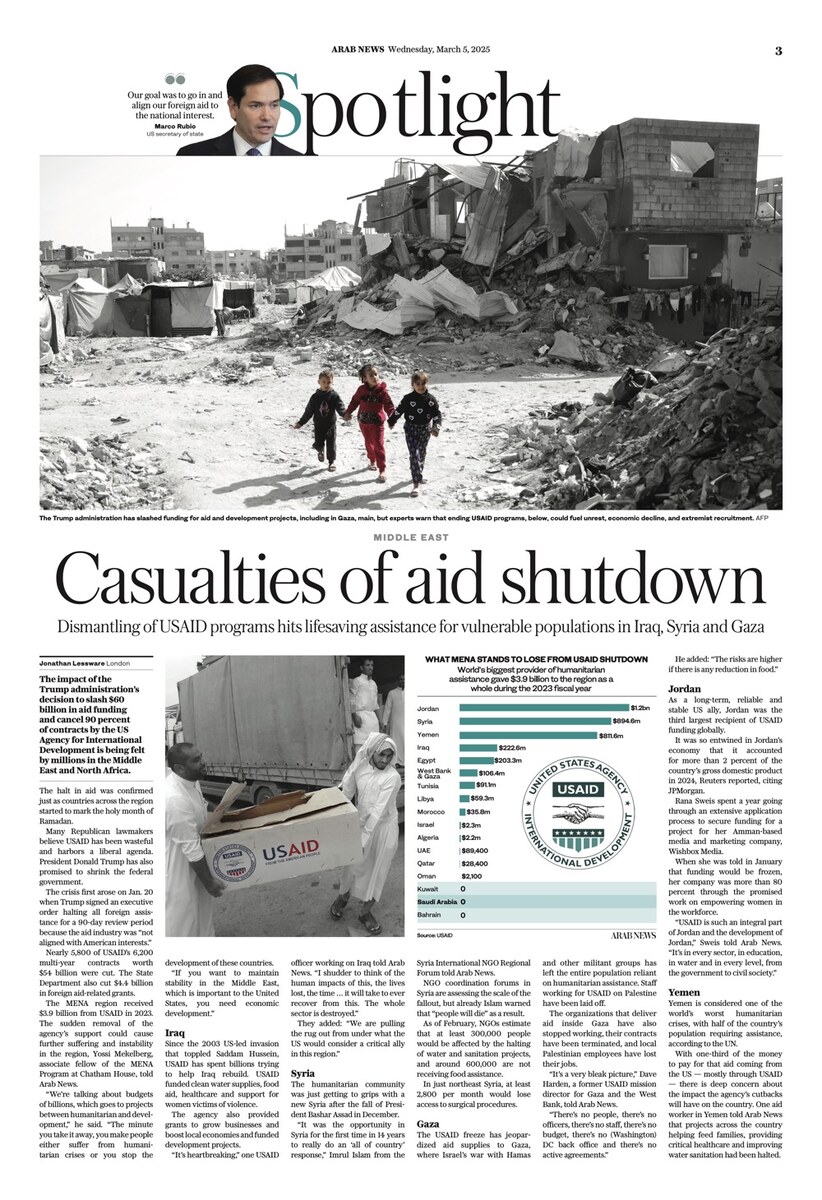
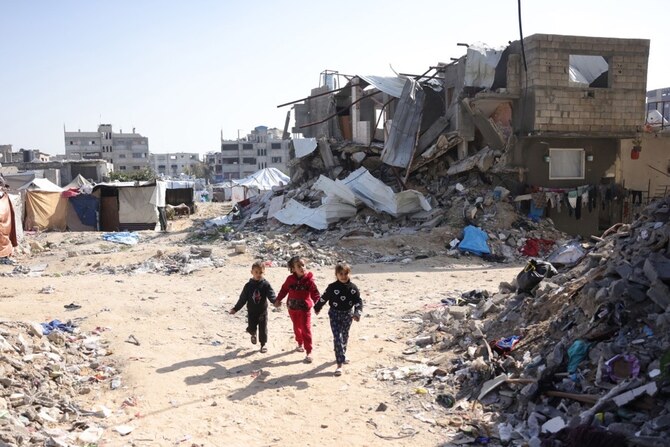
The USAID freeze has jeopardized aid supplies to Gaza, where Israel’s ongoing war with Hamas and other militant groups has left the entire population of more than 2 million reliant on humanitarian assistance.
It also risks undermining the ceasefire agreed in January that halted the devastating 15-month conflict.
USAID has provided $2.1 billion in humanitarian assistance in Gaza since October 2023, when Hamas attacked Israel, triggering the war.
The agency said in November it would provide an additional $230 million for economic recovery and development programs in the West Bank and Gaza.
Staff working for USAID on Palestine have been laid off. The organizations that deliver aid inside Gaza have also stopped working, their contracts have been terminated, and local Palestinian employees have lost their jobs.
“It’s a very bleak picture,” Dave Harden, a former USAID mission director for Gaza and the West Bank, told Arab News.

USAID said in November it would provide an additional $230 million for economic recovery and development programs in the West Bank and Gaza. (AFP/File)
“There’s no people, there’s no officers, there’s no staff, there’s no budget, there’s no (Washington) D.C. back office and there’s no active agreements.”
He agreed that it placed extra pressure on an already fragile ceasefire that relies on a massive aid delivery operation to alleviate the suffering.
“The risks are higher if there is any reduction in food,” he said.
So far, he believed UN reserves of food and other aid have filled the gap left by USAID, but this will start to run out.
Harden said the loss of USAID was not only devastating for Palestinians but also bad for Israel, which often used the agency as a communication channel.
JORDAN
As a long-term, reliable and stable US ally in the region, Jordan was the third largest recipient of USAID funding globally.
In 2023, the kingdom received $1.2 billion from the agency with much of it being used to support economic development.
While not suffering the scale of the humanitarian struggles in other countries in the region, the USAID funding supported businesses and government projects.
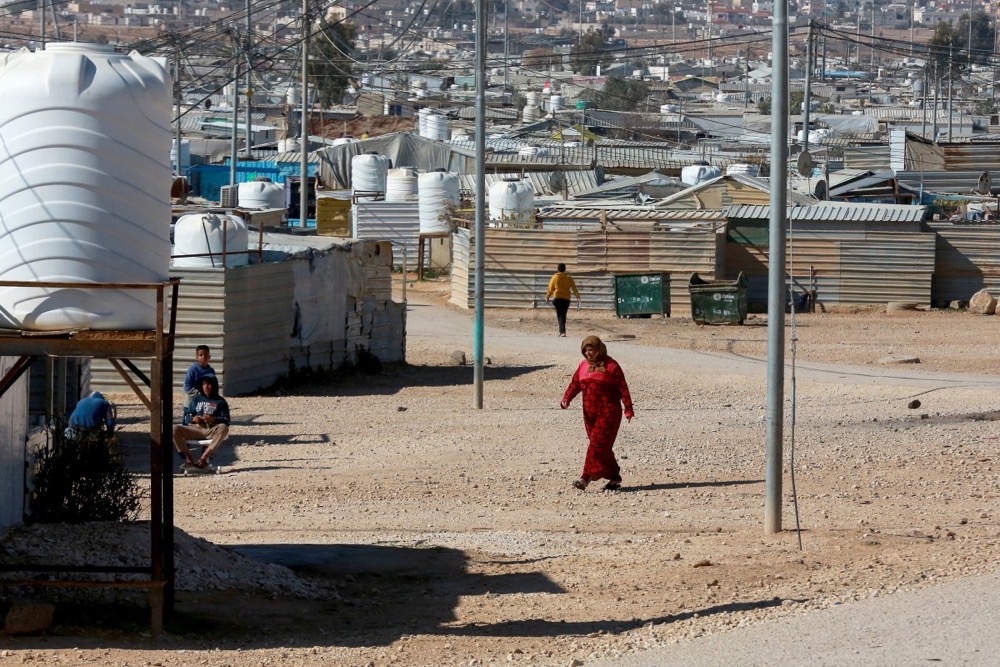
In 2023, the kingdom received $1.2 billion from USAID with much of it being used to support economic development. (AFP/File)
The funding was so entwined in Jordan’s economy that it accounted for more than 2 percent of the country’s gross domestic product in 2024, Reuters reported, citing JPMorgan.
The cuts in funding have rippled through the economy, leading to thousands of job losses according to some reports.
Rana Sweis spent a year going through an extensive application process to secure funding for a project for her Amman-based media and marketing company, Wishbox Media.
She then waited more than four months before approval came for an $81,000 grant from USAID’s Makanati project, which encouraged women into work in Jordan.
The year-long project started in May 2024 with money released in monthly increments in line with regular progress reports.
When she was told in January that funding would be frozen, her company was more than 80 percent through the promised work on empowering women in the workforce.
This included a 25-minute documentary, social media campaigns, infographics and other multimedia production.
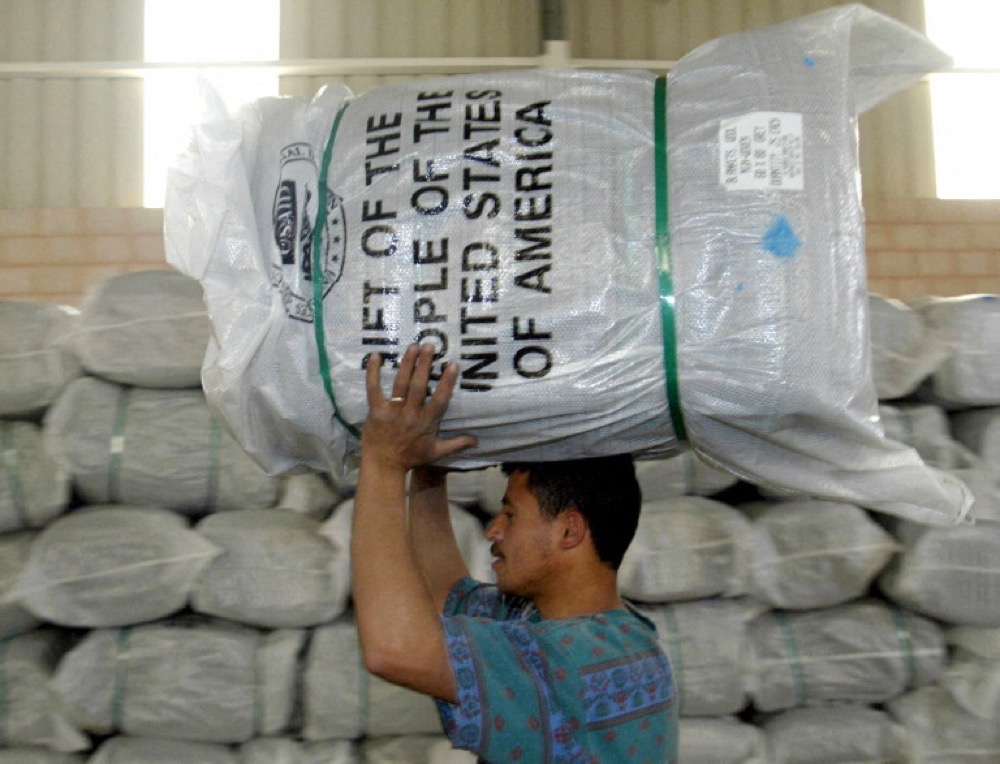
As a long-term, reliable and stable US ally in the region, Jordan was the third largest recipient of USAID funding globally. (AFP/File)
Sweis said they now expect to lose nearly half of the grant but still hope to receive two pending payments left outstanding.
She had to let one staff member go and cancel the company’s internship program. “It’s a big loss for a small company, but what can I do?” she told Arab News.
“People are losing their jobs in Washington, people are not getting all these humanitarian lifesaving vaccines in Africa, and that’s how I deal with the loss we had.”
While she may be putting the impact on her company in perspective, hundreds of businesses across Jordan would have been taking similar or even greater financial hits in recent weeks.
“It’s a shock for Wishbox, but it’s a shock for me personally because USAID is such an integral part of Jordan and the development of Jordan,” she said. “It’s in every sector, in education, in water and in every level, from the government to civil society.”
YEMEN
Yemen is considered one of the world’s worst humanitarian crises, with half of the country’s population requiring assistance, according to the UN.
With one-third of the money to pay for that aid coming from the US — mostly through USAID — there is deep concern about the impact the agency’s cutbacks will have on the country.
The US announced $220 million in additional aid, including nearly $200 million through USAID, in May 2024.
Yemen’s civil war began in 2014 when the Houthi militia, backed by Iran, took control of the capital and largest city, Sanaa, demanding a new government.

The US announced $220 million in additional aid, including nearly $200 million through USAID, in May 2024. (AFP/File)
Since the eruption of the war, the US has spent nearly $5.9 billion on the humanitarian response, according to a US Embassy statement last year.
One aid worker in Yemen told Arab News that projects across the country helping feed families, providing critical healthcare and improving water sanitation had been halted.
The worker said the cuts had come at a particularly difficult time with the start of Ramadan.