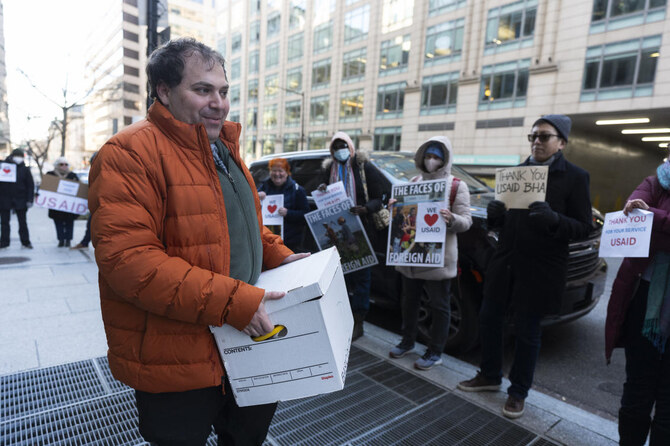
WASHINGTON: President Donald Trump’s administration said on Sunday it was placing all personnel at the foreign assistance agency USAID, except leaders and critical staff, on paid administrative leave and eliminating 1,600 positions in the United States.
Billionaire Elon Musk’s Department of Government Efficiency has led an effort to gut the US Agency for International Development, the main delivery mechanism for American foreign assistance and a critical tool of US “soft power” for winning influence abroad.
“I regret to inform you that you are affected by a Reduction in Force action,” said an email sent to one of the workers being fired that was reviewed by Reuters. Those who got the note will be let go from federal service effective April 24, the email said.
USAID said on its website that just before midnight on Sunday US Eastern Time, all direct hires except essential workers will be put on leave and 1,600 USAID personnel in the US would be cut.
An earlier notice sent to staff and reviewed by Reuters said about 2,000 US positions would be eliminated.
The White House did not immediately respond to a request for comment.
On Friday, a federal judge cleared the way for the Trump administration to put thousands of USAID workers on leave, a setback for government employee unions that are suing over what they have called an effort to dismantle it.
Two former senior USAID officials estimated that a majority of some 4,600 USAID personnel, career US Civil Service and Foreign Service staffers, would be placed on administrative leave.
“This administration and Secretary (of State Marco) Rubio are shortsighted in cutting into the expertise and unique crisis response capacity of the US,” said Marcia Wong, one of the former officials. “When disease outbreaks occur, populations displaced, these USAID experts are on the ground and first deployed to help stabilize and provide aid.”
Trump ordered a 90-day pause on foreign aid shortly after taking office on January 20, halting funding for everything from programs that fight starvation and deadly diseases to providing shelters for millions of displaced people across the globe.
The administration has approved exceptions to the freeze totaling $5.3 billion, mostly for security and counter-narcotics programs, according to a list of exemptions reviewed by Reuters that included limited humanitarian relief.
USAID programs got less than $100 million in exemptions, compared to roughly $40 billion in programs it administered annually before the freeze.


![]()


Trump administration eliminating 1,600 USAID jobs in the US
Short Url
https://arab.news/vaf2c
Trump administration eliminating 1,600 USAID jobs in the US
- USAID said on its website that all direct hires except essential workers will be put on leave
- An earlier notice sent to staff said about 2,000 US positions would be eliminated


Italy approves new migration bill including powers to impose ‘naval blockades’ on migrant ships
ROME: Italy’s conservative government led by Premier Giorgia Meloni on Wednesday approved a bill introducing new measures aimed at fighting illegal immigration, including a so-called “naval blockade” for migrant ships trying to reach Italian shores.
A cabinet meeting in the late afternoon gave the go-ahead to the bill, which now needs to be discussed and approved in both chambers of parliament before becoming effective.
Italy’s new migration package — which also includes stricter surveillance at borders and cooperation with European agencies — comes a day after the approval of the new EU pact on migration and asylum, which Rome plans to implement swiftly.
The package includes new powers that would enable Italian authorities to impose a naval blockade on migrant ships trying to enter Italy’s territorial waters, under certain conditions.
Authorities can ban the crossing into Italian waters for up to 30 days, in cases in which the migrant ship poses “serious threats to public order or national security,” as in the concrete risk of terrorist acts or terrorist infiltration, the bill says. The blockade is extendable up to a maximum of six months.
It would also be possible to stop the ships from entering Italian waters in the case of a drastic influx in migrants that could jeopardize the secure management of borders.
Those violating the rules would face fines of up to 50,000 euros ($59,400) and would see their boats confiscated in the case of repeated violations, a measure that seems to target humanitarian rescue ships.
In those cases, the intercepted migrants could be “transported to third countries other than their country of origin, with which Italy has entered into specific agreements,” the bill says.
Under those rules, the Meloni government aims at restarting offshore processing hubs similar to the two controversial ones created in Albania, which have been substantially inactive for about two years due to legal hurdles.
These centers — a major effort by the Meloni government to manage migration flows — have constantly sparked debates about their legality and efficacy, raising strong opposition from humanitarian groups.
The Italian bill’s approval comes after European lawmakers on Tuesday voted to approve new immigration policies that allow nations to deny asylum and deport migrants because they either hail from a country designated safe or could apply for asylum in a country outside the 27-nation bloc.
Italy’s Foreign Minister Antonio Tajani hailed the new rules on Tuesday, saying the confirmation from the European Parliament on the list of safe countries “proves Italy right.”
A cabinet meeting in the late afternoon gave the go-ahead to the bill, which now needs to be discussed and approved in both chambers of parliament before becoming effective.
Italy’s new migration package — which also includes stricter surveillance at borders and cooperation with European agencies — comes a day after the approval of the new EU pact on migration and asylum, which Rome plans to implement swiftly.
The package includes new powers that would enable Italian authorities to impose a naval blockade on migrant ships trying to enter Italy’s territorial waters, under certain conditions.
Authorities can ban the crossing into Italian waters for up to 30 days, in cases in which the migrant ship poses “serious threats to public order or national security,” as in the concrete risk of terrorist acts or terrorist infiltration, the bill says. The blockade is extendable up to a maximum of six months.
It would also be possible to stop the ships from entering Italian waters in the case of a drastic influx in migrants that could jeopardize the secure management of borders.
Those violating the rules would face fines of up to 50,000 euros ($59,400) and would see their boats confiscated in the case of repeated violations, a measure that seems to target humanitarian rescue ships.
In those cases, the intercepted migrants could be “transported to third countries other than their country of origin, with which Italy has entered into specific agreements,” the bill says.
Under those rules, the Meloni government aims at restarting offshore processing hubs similar to the two controversial ones created in Albania, which have been substantially inactive for about two years due to legal hurdles.
These centers — a major effort by the Meloni government to manage migration flows — have constantly sparked debates about their legality and efficacy, raising strong opposition from humanitarian groups.
The Italian bill’s approval comes after European lawmakers on Tuesday voted to approve new immigration policies that allow nations to deny asylum and deport migrants because they either hail from a country designated safe or could apply for asylum in a country outside the 27-nation bloc.
Italy’s Foreign Minister Antonio Tajani hailed the new rules on Tuesday, saying the confirmation from the European Parliament on the list of safe countries “proves Italy right.”
Latest updates


Recommended


© 2026 SAUDI RESEARCH & PUBLISHING COMPANY, All Rights Reserved And subject to Terms of Use Agreement.