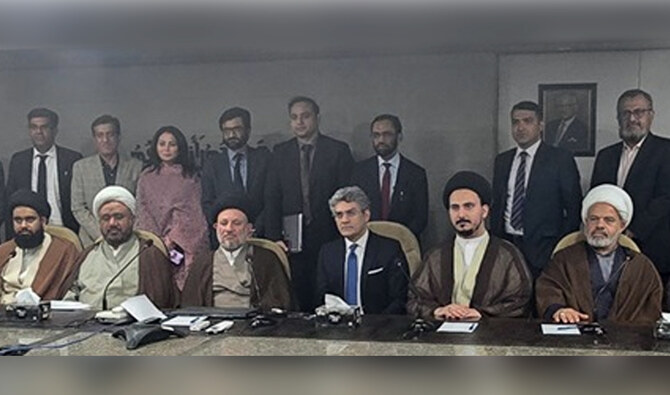
KARACHI: A delegation from Iraq’s Scientific Foundation for Financial Transactions, led by prominent scholars, announced plans on Tuesday to collaborate with the Pakistani banking sector by adopting its Shariah-compliant financing models during a visit to the Pakistan Stock Exchange (PSX), according to an official statement.
Pakistan has been actively transitioning toward Islamic finance since April 2022, after the Federal Shariat Court (FSC) ruled that the prevailing interest-based banking system violated Islamic principles, directing the government to fix the problem within five years.
The ruling came as the country faced significant economic challenges, ultimately bringing it closer to sovereign debt default in 2023 before securing a $3 billion Stand-By Arrangement from the International Monetary Fund (IMF) in July of that year.
Despite these hurdles, the PSX demonstrated remarkable resilience, with its benchmark KSE-100 Index reaching an all-time high of 81,459 points in September 2024, earning recognition as one of the world’s best-performing equity markets. The PSX also came to symbolize Pakistan’s economic recovery, attracting foreign delegations, most recently the Iraqi scholars.
“Our objective is to leverage Pakistan’s proven models of Islamic finance to benefit our own market,” the PSX statement quoted one of them as saying. “With 50 percent of Iraqi banks operating on Islamic principles and remarkable growth— from 200 billion dinars to a trillion dinars over the past six years— we see immense potential for collaboration in Islamic finance.”
PSX officials provided an overview of Pakistan’s capital market and highlighted the country’s evolving landscape of Islamic finance.
“We are thrilled to host our esteemed Iraqi counterparts and explore partnership opportunities,” PSX Managing Director Farrukh H. Sabzwari said. “By focusing on capacity building and product innovation, we are confident that our collaborative efforts will benefit both Pakistani and Iraqi capital markets.”
The visit is part of a series of high-level exchanges between Pakistan and Iraq, aiming to deepen bilateral cooperation across various sectors. The ongoing visit of the Iraqi scholars also marks a step toward expanding economic and financial collaboration, particularly in Islamic finance.


![]()

Iraqi scholars seek Islamic finance collaboration with Pakistan during stock market visit
Short Url
https://arab.news/b25v6
Iraqi scholars seek Islamic finance collaboration with Pakistan during stock market visit
- Half of Iraq’s banks operate on Islamic principles, with the sector boasting a value of a trillion dinars in six years
- Pakistan has been transitioning toward Islamic finance since a court ruling declared interest to be against Shariah
Latest updates




© 2026 SAUDI RESEARCH & PUBLISHING COMPANY, All Rights Reserved And subject to Terms of Use Agreement.