

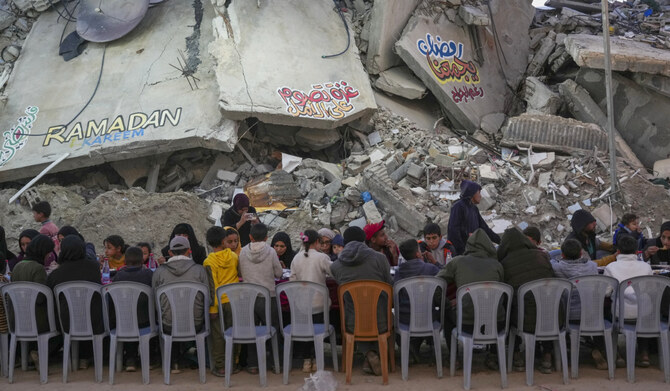

Jerusalem: The ministry of health in Hamas-run Gaza said four people were killed and six others wounded in Israeli attacks Sunday after the first phase of a fragile truce in the territory drew to a close.
“Since this morning, four dead and six wounded” have been brought to “hospitals in the Gaza Strip following Israeli attacks in various parts of the territory,” the ministry said in a statement. It earlier said Israeli tanks targeted the border areas of Abasan Al-Kabira town, east of Khan Yunis city, in the southern Gaza Strip.
Israel said Sunday it endorsed a proposal to temporarily extend the truce in Gaza as a bridging measure after the first phase of its ceasefire with Hamas drew to a close.
The proposal, put forward by US President Donald Trump’s Middle East envoy Steve Witkoff, would cover Ramadan, due to end late March, and Passover, lasting through mid-April, according to a statement from the Israeli prime minister’s office released just after midnight.
The first phase of a ceasefire deal between Israel and Palestinian militant group Hamas was set to expire over the weekend without any certainty as to the second phase, which is hoped to bring a more permanent end to the Gaza war.
Negotiations have so far been inconclusive, with the fate of hostages still held in Gaza and the lives of more than two million Palestinians hanging in the balance.
According to the Israeli statement, the extension would see half of the hostages still in Gaza released on the day the deal comes into effect, with the rest to be released at the end if agreement is reached on a permanent ceasefire.
There was no immediate response from Hamas, which earlier rejected the idea of an extension.
Israel’s backing of what it described as a US plan comes amid a flurry of warnings not to restart the war, which after 15 months devastated Gaza, displaced almost the entire population of the coastal strip and sparked a hunger crisis.
United Nations head Antonio Guterres warned against a “catastrophic” return to war and said a “permanent ceasefire and the release of all hostages are essential to preventing escalation and averting more devastating consequences for civilians.”
Meanwhile Washington announced late Saturday it was boosting its military aid to Israel.
Secretary of State Marco Rubio said he was using “emergency authorities to expedite the delivery of approximately $4 billion in military assistance,” noting that a partial arms embargo imposed under former president Joe Biden had been reversed.
Israeli officials engaged in ceasefire negotiations with Egyptian, Qatari and American mediators in Cairo last week. But by early Saturday there was no sign of consensus as Muslims in Gaza marked the first day of Ramadan with colored lights brightening war-damaged neighborhoods.
A senior Hamas official told AFP the Palestinian militant group was prepared to release all remaining hostages in a single swap during the second phase.
“Hamas will not be happy to drag on phase one, but it doesn’t really have the capacity to force Israel to go on to phase two,” Max Rodenbeck, an analyst for the International Crisis Group, told AFP.
Hamas hostage video
Under the six-week ceasefire that took effect on January 19, Gaza militants freed 25 living hostages and returned the bodies of eight others to Israel, in exchange for hundreds of Palestinian prisoners.
The deal, reached following months of gruelling negotiations, largely halted the war that erupted with Hamas’s October 7, 2023 attack on Israel.
While Hamas on several occasions reiterated its “readiness to engage in negotiations for its second phase,” Israel preferred to secure more hostage releases under an extension of the first phase.
A Palestinian source close to the talks told AFP that Israel had proposed to extend the first phase in successive one-week intervals with a view to conducting hostage-prisoner swaps each week, adding that Hamas had rejected the plan.
Of the 251 hostages taken during Hamas’s October 7 attack, 58 hostages remain in Gaza, including 34 the Israeli military says are dead.
Hamas’s armed wing released footage showing what appeared to be a group of Israeli hostages in Gaza, accompanied with the message: “Only a ceasefire agreement brings them back alive.”
AFP was unable to immediately verify the video, the latest that militants have released of Gaza captives.
Netanyahu’s office called it “cruel propaganda” but Israeli campaign group the Hostages and Missing Families Forum said the Horn family, two of whose members appear in the video, had given permission for the footage of them to be published.
Israeli-Argentine Yair Horn was released on February 15 but his brother Eitan remains in captivity in Gaza.
“We demand from the decision-makers: Look Eitan in the eyes. Don’t stop the agreement that has already brought dozens of hostages back to us,” the family said.
Netanyahu's coalition worries
Domestic political considerations are a factor in Netanyahu’s reluctance to begin the planned second stage.
Finance Minister Bezalel Smotrich, the leader of the far-right faction in the governing coalition, has threatened to quit if the war is not resumed.
“The Israeli government could fall if we enter phase two,” said Michael Horowitz, head of intelligence for risk management consultancy Le Beck International.
Israel has said it needs to retain troops in a strip of Gaza along the Egyptian border to stop arms smuggling by Hamas.
The Hamas attack that began the Gaza war resulted in the deaths of 1,218 people, mostly civilians, while the Israeli retaliation has killed 48,388 people in Gaza, also mostly civilians, figures from both sides show.


