

KSrelief signs $5.15m deal to aid Ukrainians

1 / 2
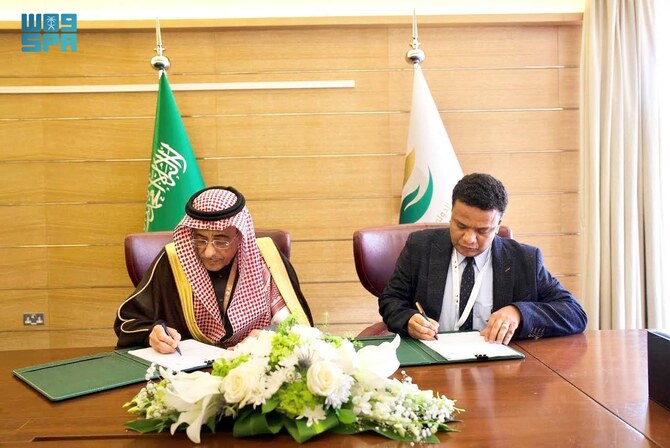
The Yemen deal was signed by KSrelief Assistant Supervisor General for Operations and Programs Ahmed Al-Baiz and BCHR Executive Director Fahmi Mansour.
2 / 2
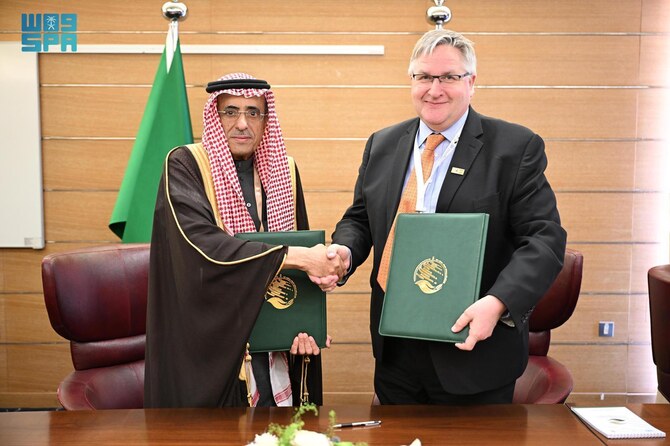
The Ukrainian deal was signed by KSrelief Assistant Supervisor General for Operations and Programs Ahmed Al-Baiz and the UN Population Fund’s deputy executive director, Andrew Saberton. (SPA)
Short Url
Updated 01 March 2025
Follow

KSrelief signs $5.15m deal to aid Ukrainians

RIYADH: Saudi aid agency KSrelief has signed a $5.15 million cooperation agreement with the UN Population Fund to provide emergency protection for vulnerable groups in Ukraine.

The deal will benefit 49,360 people, the Saudi Press Agency reported on Saturday.

It was signed by KSrelief Assistant Supervisor General for Operations and Programs Ahmed Al-Baiz and the fund’s deputy executive director, Andrew Saberton, in Riyadh.

The agreement will deliver essential services related to gender-based violence in affected areas of Ukraine.

It focuses on supporting mobile psychosocial teams, and establishing safe spaces for women and girls with economic empowerment opportunities, dignity kits and community psychological support.

Additionally, it aims to strengthen the capabilities of community psychological support service providers.

Al-Baiz also signed a cooperation agreement with the Benevolence Coalition for Humanitarian Relief in Riyadh to promote sustainable agriculture and empower the agricultural and fishery sectors of Yemeni governorates.

The deal will enhance the resilience of farmers and fishermen, and contribute to local food production by supplying agricultural inputs such as seeds, equipment, safety tools, fishing boats, veterinary kits and greenhouses.

It also involves training on agricultural and fishery practices, and improving irrigation by pumping water from wells, and establishing drip irrigation and canal networks.


Saudi students celebrate wildlife through art

Updated 13 sec ago
Follow

Saudi students celebrate wildlife through art

JEDDAH: Prince Mohammed bin Salman Royal Reserve celebrated its second school art competition this month, with 1,600 entries received from 120 schools — a 324 percent increase compared to its inaugural year.

This year’s theme, “In Our Nature,” invited students to represent one of three large mammals found in the Reserve that are central to its rewilding program — the Arabian wolf, Arabian oryx, and Persian onager.

Elefteria Castis, the reserve’s chief of strategy and business, told Arab News that such a rapid increase in interest had not been expected so quickly.

“Their focus has been to increase reach across the 24,500 sq. km reserve. The competition already reaches 120 schools across the reserve’s landscape; our goal for the 2026–2027 edition is to reach 100 percent of schools within Reserve communities, an additional 20 schools,” she said.

“We also want to broaden the creative arts categories. Last year we focused on art and photography, this year we included poetry and prose, and expanded it thematically to include heritage.” 

She added: “The unprecedented growth signals a clear interest in the initiative from schoolchildren, parents and educators and certainly opens up the possibilities of expansion nationally and regionally sooner than we anticipated. The idea of a national school awards certainly is appealing. Whether that comes to pass or not, our long-term vision is to continue to contribute to nationwide environmental education and awareness initiatives through, among other creative arts, to inspire young people.” 

The program, an essential part of the reserve’s community outreach, raises awareness among younger generations about environmental and cultural conservation. It enables students to share these values with their families and wider community, supporting sustained engagement and long-term environmental stewardship.

“The Art Competition provides a platform for artistic expression rooted in young people’s cultural identity and framed by the conservation strategy of the Prince Mohammed bin Salman Royal Reserve,” said Castis.

“When young people understand why nature is important and find connections with their heritage, families listen, and the next generation of conservation leaders is fostered.”

Community development and environmental awareness remain core pillars of the reserve’s Integrated Development Management Plan, which provides the strategic framework for delivering conservation outcomes rooted in local communities.

Two awards ceremonies held in Al-Wajh and Duba celebrated the winners, with entries exhibited for parents, teachers and reserve staff.

Launched during the 2024–25 school year, the program has seen significant growth, with entries increasing from 383 across 55 schools to 1,626 from 120 schools in 2025-26.

Castis said every artwork was a winner: “The submissions brought to life historic connections between people and wildlife. For instance, one student depicted oryx alongside the petroglyphs that can be found of the species throughout the reserve. Through the competition and submissions, students depicted the relationships with the land, and a shared vision for ecological restoration. Many reflected ideas of coexistence between communities, animals and landscapes, while also expressing pride in the reserve’s natural heritage and a hopeful vision for the future.”

She added: “One particularly memorable piece depicted the reserve’s ranger corps, including its female rangers, highlighting the role people play in protecting nature and the growing connection young people feel to conservation efforts across the reserve. Another student depicted a school classroom with the three species from the competition on the wall and textbooks on the environment on the desks, bringing to life the reserve’s environmental education program.”

The competition is seen as a starting point for longer-term engagement with the next generation, said Castis: “If all goes as planned, we would like to have our first exhibition this year.”