Top Democrat accuses Trump, Vance of ’doing Putin’s dirty work’ as Ukraine backers lament White House blowout

1 / 2
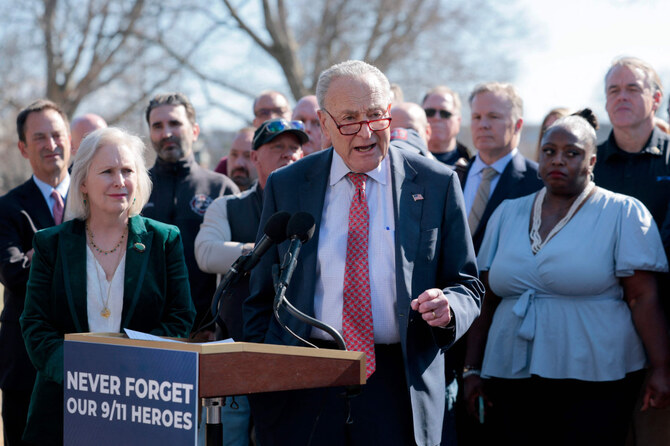
US Senate Minority Leader Chuck Schumer (D-NY) speaks at a news conference outside the US Capitol Building on February 26, 2025 in Washington, DC. (Getty Images via AFP/File)
2 / 2
Republican Sen. Lindsey Graham speaks to reporters in Washington D.C. on Feb. 28, 2025. (AP)
Short Url
Updated 01 March 2025
Follow

Top Democrat accuses Trump, Vance of ’doing Putin’s dirty work’ as Ukraine backers lament White House blowout

  • While some key Republicans hoped the deal would revive American support for Kyiv, those who are opposed to Ukraine aid said Trump and Vance did the right thing

WASHINGTON: US Democratic lawmakers rushed to the defense of Volodymyr Zelensky following Friday’s blowup at the White House that saw President Donald Trump and Vice President JD Vance painting the Ukrainian president as “disrespectful” and anti-peace.

Top Democrats said it was proof that Trump is playing into the hands of Russian President Vladimir Putin.

“Trump and Vance are doing Putin’s dirty work. Senate Democrats will never stop fighting for freedom and democracy,” Senate Democratic leader Chuck Schumer (New York) said.

House Democratic Leader Hakeem Jeffries (New York) described the meeting as “appalling and will only serve to further embolden Vladimir Putin, a brutal dictator.”

“The United States must not reward Russian aggression and continue to appease Putin,” he added.

For Sen. Chris Murphy of Connecticut, the meeting ”was a planned ambush designed to embarrass President Zelensky in order to benefit Vladimir Putin.“

”That was an embarrassment. That was an abomination. What you watched was American power being destroyed in the world as everybody watches President Trump become a lapdog for a brutal dictator in Moscow,” he said.

Sen. Richard Blumenthal of Connecticut hoped that the talks “can be resumed or restored, and this event won’t derail continued support.”

“I have very strong hopes that the coalition we have in Congress — and it is a very strong bipartisan coalition — will be persuasive to the administration and others that we have a long-term national security interest in Ukraine prevailing over Putin’s brazen aggression.”

Sen. Amy Klobuchar of Minnesota said: “Answer to Vance: Zelensky has thanked our country over and over again both privately and publicly. And our country thanks HIM and the Ukrainian patriots who have stood up to a dictator, buried their own & stopped Putin from marching right into the rest of Europe. Shame on you.”

Losing support

Zelensky had traveled to Washington to sign a deal that would give the US access to its mineral riches as Trump attempts to pressure Ukraine into a deal to end the war with Russia. Although support for Ukraine has waned among GOP congressional members in the three years since Russia invaded, key Republicans hoped the deal would revive American support for Kyiv.

Instead, the fallout from a heated Oval Office exchange between Trump, Zelensky and Vance has many Republicans — even those who previously backed Ukraine — scolding Zelensky. For other GOP lawmakers who have long criticized US support for Ukraine, the exchange was an opportunity to laud Trump for berating Ukraine’s leader.

Here’s what Republican leaders are saying as the future of Ukraine hangs in the balance:

Republicans who have supported Ukraine in the past

Sen. Lindsey Graham, South Carolina: Graham called the meeting a “complete, utter disaster” and said he’s “never been more proud” of Trump. “What I saw in the Oval office was disrespectful and I don’t know if we can ever do business with Zelensky again.”

Secretary Of State Marco Rubio: “Thank you @POTUS for standing up for America in a way that no President has ever had the courage to do before. Thank you for putting America First. America is with you!”

House Republican Leader Steve Scalise, Louisiana: “President Trump is fighting for PEACE around the world and is putting America First as our best negotiator — he’s the only one to get Russia to the table to consider a serious and lasting peace agreement with Ukraine.”

Rep. Don BacoN, Nebraska: “A bad day for America’s foreign policy. Ukraine wants independence, free markets and rule of law. It wants to be part of the West. Russia hates us and our Western values. We should be clear that we stand for freedom.”

Rep. Mike Lawler, New York: “Diplomacy is tough and often times there are serious differences of opinion and heated exchanges behind closed doors. Having this spill out into public view was a disaster — especially for Ukraine.”

Rep. Brian Fitzpatrick, Pennsylvania: “It was heartbreaking to witness the turn of events that transpired in today’s meeting regarding Ukraine’s future. It is time to put understandable emotions aside and come back to the negotiation table.”

Republicans who are opposed to Ukraine aid
Sen. Josh Hawley, Missouri: “Remember: the US Senate has repeatedly and for years voted BILLIONS of taxpayer dollars to Ukraine with no strings attached and with no true oversight. It’s time for some ACCOUNTABILITY.”

Sen. Mike Lee, Utah: “Thank you for standing up for OUR COUNTRY and putting America first, President Trump and Vice President Vance!”

Sen. Roger Marshall, Kansas: “Not another penny.”

Rep. Andy Biggs, Arizona: “Dictator Zelensky had the audacity to disrespect President @realDonaldTrump and VP @JDVance during what should have been a friendly meeting, and @POTUS rightfully showed him the door. This is the leadership America has craved for four years.”


US intel did not suggest a preemptive strike from Iran before US-Israeli attacks, AP sources say

Updated 02 March 2026
Follow

US intel did not suggest a preemptive strike from Iran before US-Israeli attacks, AP sources say

  • The official said a variety of factors created a golden opportunity to take out much of Iran’s leadership

WASHINGTON: Trump administration officials told congressional staff in private briefings Sunday that US intelligence did not suggest Iran was preparing to launch a preemptive strike against the US, three people familiar with the briefings said.
The administration officials instead acknowledged there was a more general threat in the region from Iran’s missiles and proxy forces, two of the people said. The third person, however, said the administration emphasized that Iran’s missiles and proxy forces posed an imminent threat to US personnel and allies in the region.
The officials did not provide any clarity about what would happen next in Iran after the joint US-Israeli operation, the two people said. All three people insisted on anonymity to discuss details that have not been made public.
The information conveyed to the congressional staff contrasts with the message from President Donald Trump. “Our objective is to defend the American people by eliminating imminent threats from the Iranian regime. A vicious group of very hard, terrible people,” he said in a video message after launching strikes on Iran.
Senior Trump administration officials, who like others were not authorized to comment publicly and spoke on condition of anonymity, had told reporters Saturday that there were indicators that the Iranians could launch a preemptive attack.
The White House and Pentagon did not immediately reply to requests for comment on Sunday night. Details of the briefing were first reported by Politico.
On Tuesday, Secretary of State Marco Rubio, Defense Secretary Pete Hegseth, CIA Director John Ratcliffe and Gen. Dan Caine, chairman of the Joint Chiefs of Staff, will brief the full membership of Congress on the US military operation against Iran, the White House said Sunday. Rubio also was slated to brief Hill leadership Monday, the same day Hegseth and Caine are planning a press conference about the operation.
Three strikes, three locations, within a single minute
The military operation came after authorities from Israel and the US spent weeks tracking the movements of senior Iranian leaders, including Supreme Leader Ayatollah Ali Khamenei, and shared information that allowed the strikes to be carried out in a surprise daylight attack, according to an Israeli military official and another person familiar with the operation.
The eventual barrage of US-Israeli attacks on Iran came so quickly that they were nearly simultaneous — with three strikes in three locations hitting within a single minute — killing Khamenei and some 40 senior figures, including the head of the paramilitary Revolutionary Guard and the country’s defense minister, the Israeli military official said Sunday.
The official said a variety of factors created a golden opportunity to take out much of Iran’s leadership, like weeks of training and monitoring the movements of senior figures as well as intelligence in real-time before the attack began that key targets were gathered together.
Striking by day also gave an additional element of surprise, said the official, who said so many major, rapid-fire strikes were critical to keep key officials from fleeing after the first strike. The official said Israel closely cooperated with its US counterparts and had used a similar tactic at the beginning of last June’s war — which resulted in the killing of several senior Iranian figures.
The official also noted Khamenei having posted defiant tweets taunting President Donald Trump in the days before the attack.
The details about the strikes came as the conflict entered its second day, with Trump saying in a video message Sunday that he expected it would continue until “all of our objectives are achieved.” He did not spell out what those objectives were.
The Republican president also said the US military and its partners hit hundreds of targets in Iran, including Revolutionary Guard facilities, Iranian air defense systems and nine warships, “all in a matter of literally minutes.”
CIA had long tracked top Iranian leaders
Before the attacks, the CIA had for months tracked the movements of senior Iranian leaders, including Khamenei.
The intelligence was shared with Israeli officials, and the timing of the strikes was adjusted in part because of that information about the Iranian leaders’ location, according to the person familiar with the planning.
The intelligence-sharing between US and Israel reflects the preparation that went into the strikes, which threw the future of the Islamic Republic into uncertainty and raised the risk of escalating regional conflict.
The US regularly shares intelligence with allies including Israel. Those partnerships, and the accuracy of the intelligence they yield, is often critical not only to the success of a military operation but also to the public’s support for it.
Virginia Sen. Mark Warner, the senior Democrat on the committee, told The Associated Press that, historically, “our working relationship with the Mossad and Israel is really strong.” Mossad is the Israeli spy agency.
Warner said he has serious concerns about the justification for the strikes, Trump’s long-term plans for the conflict and the risks that US service members will face. The military announced Sunday that three American troops had been killed in the Iran operation.
“No tears will be shed over their leadership being eliminated, but always the question is: OK, what next?” Warner said.
Iran has signaled it’s open to talks with the US
A senior White House official said Iran’s “new potential leadership” has suggested it is open to talks with the United States. That official, who spoke on condition of anonymity to discuss internal administration deliberations, said Trump has indicated he’s “eventually” willing to talk but that for now the military operation “continues unabated.”
The official did not say who the potential new Iranian leaders are or how they made their alleged willingness to talk known. Separately, Trump told The Atlantic that he planned to speak with Iran’s new leadership.
“They want to talk, and I have agreed to talk, so I will be talking to them,” he said Sunday, declining comment on the timing.